

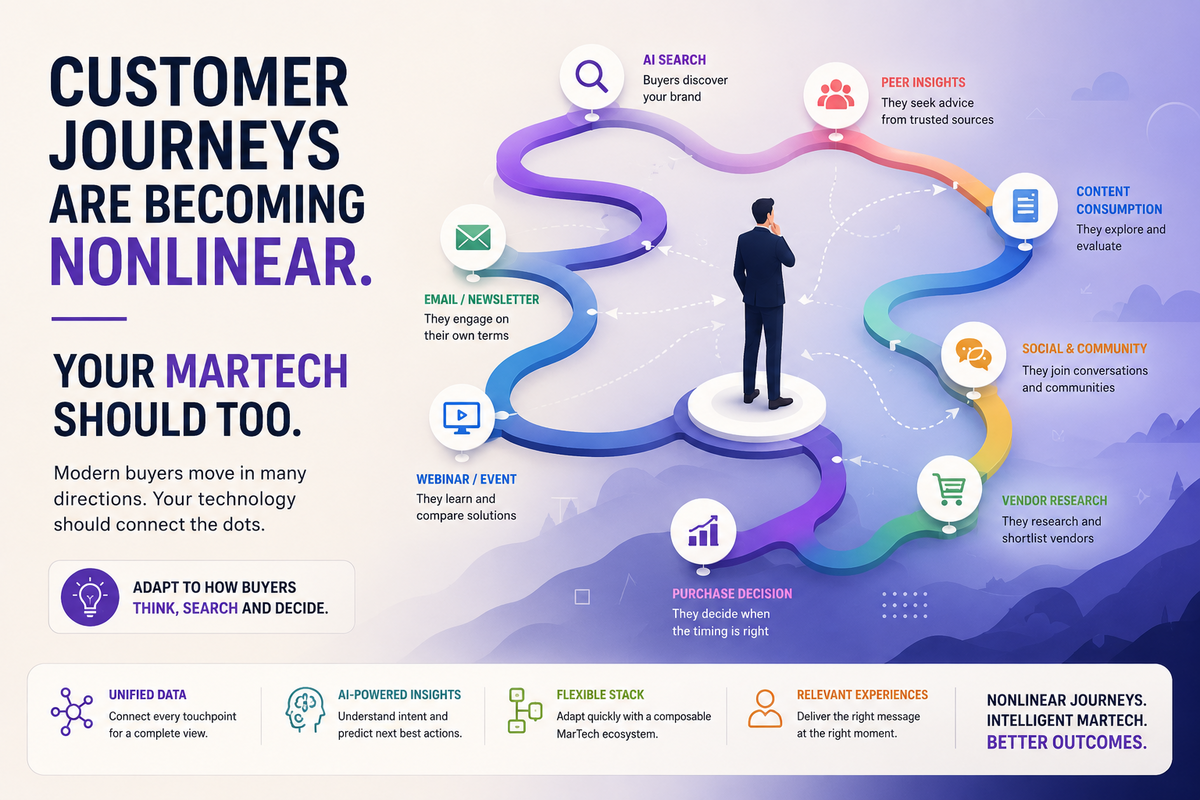
For years, B2B marketing followed a predictable formula. Buyers became aware of a problem, explored potential solutions, compared vendors, and eventually contacted a sales team. Marketing technologies were designed to support this structured funnel, guiding prospects from one stage to the next with carefully timed campaigns and automated workflows.
That reality no longer exists.
Today's B2B buyers rarely move through a linear journey. They discover brands through AI-powered search, industry newsletters, LinkedIn conversations, analyst reports, webinars, partner recommendations, customer communities, and independent research, often switching between these touchpoints multiple times before making a purchase decision. By the time they engage with a sales representative, much of the buying journey has already taken place.
This shift is redefining how organizations think about marketing technology. Traditional automation built around sequential customer journeys is giving way to intelligent, adaptive ecosystems capable of responding to buyers wherever they choose to engage. For B2B decision makers, the question is no longer whether customer journeys have changed. The question is whether their MarTech strategy has evolved alongside them.
The Traditional Marketing Funnel No Longer Reflects Buyer Behavior
The rapid advancement of AI-powered search experiences, generative AI assistants, and self-service buying has fundamentally changed how business decisions are made. Recent industry research shows that B2B buyers complete a significant portion of their evaluation before ever speaking with a vendor. Instead of following a predetermined sequence, they gather information from multiple sources simultaneously, often validating insights through peers and independent communities before visiting a company's website.
This trend has accelerated with the growing adoption of AI-generated search summaries and conversational search experiences. Buyers increasingly expect immediate answers instead of navigating multiple webpages, making discoverability across different digital channels more important than ever.
As a result, every interaction has become a potential entry point into the customer journey. A prospect may download a whitepaper months before attending a webinar, revisit a product comparison through AI search, engage with a social media discussion, and only then request a product demonstration. Another buyer may skip several of those interactions entirely and arrive through a partner recommendation.
These journeys are neither predictable nor identical.
Yet many organizations continue relying on marketing automation platforms designed around rigid workflows and predefined nurture sequences. While automation remains valuable, static journeys often fail to reflect the dynamic nature of modern buying behavior.
The focus is shifting from managing funnels to understanding buyer intent in real time.
Modern MarTech Must Adapt Instead of Direct
Artificial intelligence is transforming marketing technology from a collection of execution tools into an intelligent decision-making ecosystem.
Modern MarTech platforms are increasingly capable of interpreting behavioral signals across multiple channels, identifying purchase intent, and recommending the next best action based on live customer interactions rather than predetermined workflows. Instead of assuming where a prospect should move next, AI analyzes how buyers are actually engaging across digital touchpoints.
This evolution is particularly important as organizations consolidate their technology stacks. Rather than managing disconnected tools for email marketing, CRM, customer data, analytics, personalization, and advertising, many enterprises are investing in integrated platforms that provide a unified customer view.
The growing popularity of composable MarTech architectures further reflects this shift. Businesses want the flexibility to connect specialized applications while maintaining a consistent flow of customer data across the entire marketing ecosystem.
Equally significant is the increasing importance of first-party data. As privacy regulations continue evolving and reliance on third-party cookies declines, organizations are prioritizing data collected directly from customer interactions. Every webinar registration, content download, product page visit, chatbot conversation, and email engagement contributes valuable context that helps marketing teams better understand buyer intent.
Rather than treating these activities as isolated events, modern MarTech combines them into a continuously evolving customer profile that supports more relevant engagement throughout the buying journey.
The Future Belongs to Adaptive Customer Experiences
One of the most significant developments in B2B marketing is the growing role of AI agents and autonomous marketing capabilities. Instead of simply automating repetitive tasks, these systems are beginning to orchestrate customer experiences by analyzing behavior, recommending personalized content, optimizing campaigns, and identifying emerging buying opportunities with minimal manual intervention.
This does not eliminate the need for human marketers. Instead, it allows marketing teams to focus more on strategy, creativity, and customer value while AI manages operational complexity behind the scenes.
For B2B decision makers, this represents a strategic opportunity. The organizations that will outperform competitors are not necessarily those with the largest marketing budgets or the most extensive technology stacks. They will be the companies that build connected ecosystems capable of adapting to constantly changing buyer behavior.
A flexible MarTech strategy also strengthens collaboration across marketing, sales, and customer success teams. Shared data, unified reporting, and AI-powered insights create a more consistent customer experience while enabling faster, more informed business decisions. As buying committees continue to grow and purchase cycles become increasingly complex, this level of coordination becomes a competitive advantage rather than simply an operational improvement.
Customer journeys will only become more dynamic as AI-powered discovery, conversational interfaces, digital communities, and self-service buying continue to reshape B2B purchasing. Organizations that continue forcing prospects into predefined funnels risk creating experiences that feel disconnected from how buyers actually make decisions.
The future of B2B marketing belongs to businesses that recognize customer journeys as living, evolving experiences rather than linear processes. A modern MarTech strategy should do more than automate campaigns, it should understand intent, connect data across every touchpoint, and adapt continuously as buyers move between channels. In an environment where every interaction has the potential to influence a purchasing decision, adaptability is becoming the defining characteristic of high-performing marketing organizations.