

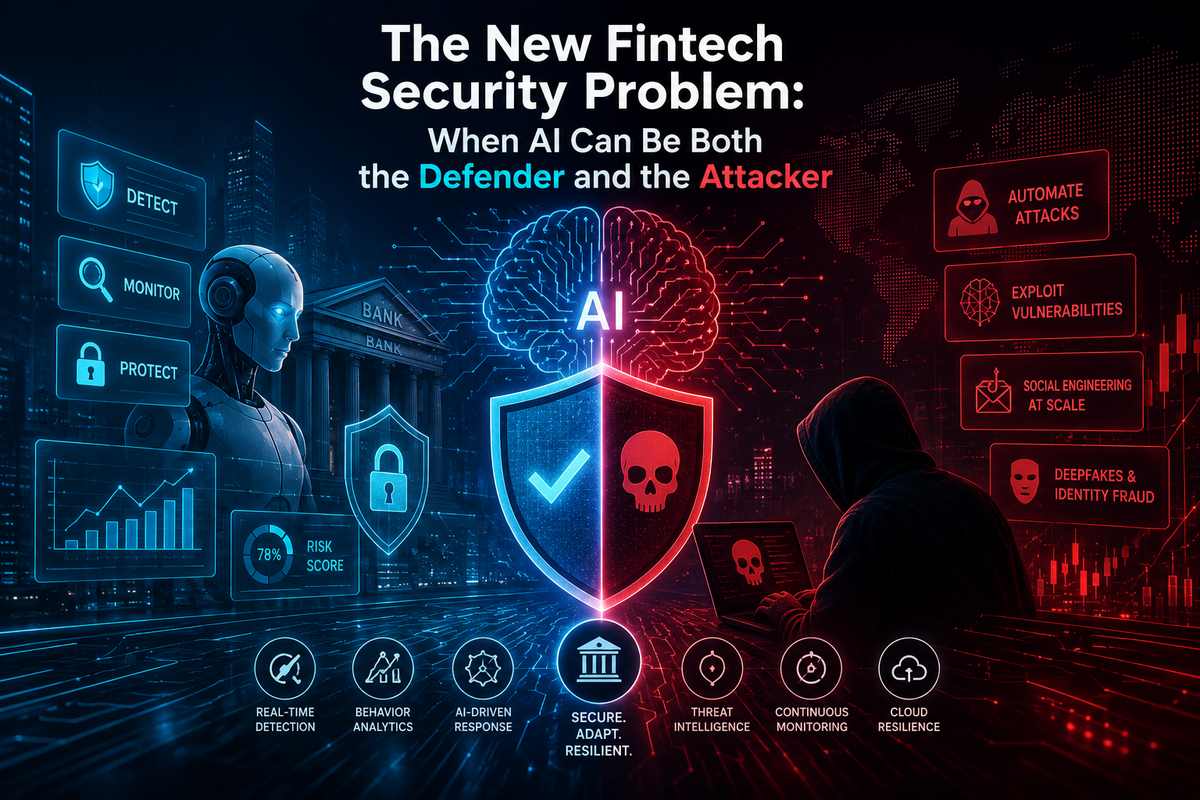
For years, financial institutions treated artificial intelligence as a weapon against fraud. Machine learning models could identify unusual transactions, detect suspicious account activity, recognize patterns humans might miss, and help security teams respond to threats faster.
Now, the equation is becoming more complicated.
The same technology helping banks detect fraud can also help attackers discover vulnerabilities, automate social engineering, generate convincing deepfakes, and scale cyberattacks at machine speed. AI is no longer simply another security tool in the financial technology stack. It is becoming part of the threat environment itself.
That creates a new fintech security problem: what happens when the defender and the attacker are powered by increasingly similar intelligence?
Recent research from the International Monetary Fund highlights the scale of the shift. Its June 2026 analysis found that AI can accelerate vulnerability discovery and exploitation while simultaneously strengthening cyber defenses. The concern is particularly significant for financial services because banks, payment networks, cloud platforms, and other institutions depend on interconnected digital infrastructure. A weakness in a commonly used system can potentially spread far beyond a single organization.
For B2B decision-makers, this means cybersecurity can no longer be treated as a static barrier around financial systems. It is becoming an intelligence race.
AI Is Turning Financial Cybersecurity Into a Machine-Speed Battle
The financial sector is already moving aggressively toward autonomous systems. A June 2026 Cloud Security Alliance survey found that 62% of financial-services organizations had deployed AI agents, while 93% of organizations using agents had granted them some level of autonomy. Cybersecurity operations and fraud detection were among the leading use cases.
That adoption creates enormous opportunities. An AI system can continuously monitor transactions, compare behavioral patterns, identify anomalies, correlate threat intelligence, and prioritize incidents far faster than traditional manual processes. Instead of waiting for a security team to investigate suspicious activity, intelligent systems can detect signals across millions of interactions almost instantly.
But attackers can use AI in much the same way.
AI can dramatically reduce the time and expertise required to search for vulnerabilities or produce convincing fraudulent communications. Deepfake technology can make identity verification more difficult. Automated systems can adapt attacks faster, while AI-generated social engineering can become increasingly personalized.
Research published in 2026 on trustworthy AI in fintech identifies emerging risks including data and model poisoning, adversarial attacks, prompt injection, and deepfake-driven attacks against KYC systems. The important shift is that the AI system itself becomes part of the attack surface.
This changes the economics of financial cybercrime. The attacker no longer needs to manually scale every operation, and the defender can no longer assume that yesterday's security controls will remain effective tomorrow.
The result is a race between automated offense and automated defense.
The Bigger Risk Is No Longer a Single Breach
Financial institutions have always worried about cyberattacks. The emerging concern is what AI could do to the speed and scale of those attacks.
The IMF has specifically warned that AI could amplify systemic financial risk by accelerating attacks against commonly used technologies and infrastructure. In other words, the biggest danger may not be a completely new type of cyberattack. It may be the ability to discover, replicate, and exploit existing weaknesses much faster.
This is particularly relevant as financial organizations introduce AI agents into customer service, fraud prevention, compliance, and back-office operations. More autonomous systems mean more systems capable of accessing data, interacting with applications, and making decisions without constant human intervention.
That creates another layer of risk.
An intelligent system with excessive permissions could potentially turn a security incident into an operational incident. A compromised AI workflow might expose sensitive information, manipulate a decision, or interact with connected tools in ways its designers did not anticipate.
The answer is not to stop using AI. In fact, financial institutions increasingly need AI precisely because the threat environment is becoming too fast and complex for manual defense alone.
The strategic question is how to make AI-powered defense more resilient than AI-powered attacks.
Fintech Security Is Moving From Protection to Continuous Resilience
The next generation of financial cybersecurity will likely be less about building an impenetrable perimeter and more about continuously detecting, validating, and containing threats.
That means organizations will need to understand not only where their AI systems operate, but also what data they access, what permissions they hold, which external systems they connect to, and how their decisions can be audited.
This is becoming particularly important as financial institutions move from AI experimentation toward autonomous operations. A recent Cambridge Centre for Alternative Finance report found that 48% of respondents viewed adversarial AI as a top concern, while 51% identified loss of human oversight as a major AI risk.
Meanwhile, the industry is already responding. In India, for example, the banking sector is reportedly working with 25 technology providers to strengthen defenses against AI-enabled cyber threats, using advanced cyber security tools alongside collaborative security frameworks rather than relying on isolated institutional defenses.
For B2B leaders, this signals a broader transformation. Cybersecurity, AI governance, fraud prevention, compliance, and operational resilience are becoming increasingly interconnected disciplines.
The fintech security leader of the future will not simply ask whether an AI system can detect a threat. They will ask whether the organization can understand, contain, and recover from an AI-driven threat before it becomes systemic.
That is the real paradox of AI in financial services. The technology can make defenses smarter while making attacks faster. It can reduce fraud while creating new avenues for deception. It can strengthen resilience while increasing the complexity of the systems that need protection.
The competitive advantage, therefore, will not belong to organizations that use the most AI. It will belong to those that understand the dual nature of the technology and build security architectures capable of adapting as quickly as the threat itself.
In fintech, the future of cybersecurity may ultimately become an intelligence contest. And in that contest, staying ahead will require more than better algorithms. It will require continuous visibility, responsible autonomy, stronger governance, and the ability to treat AI as both a powerful defender and a potential adversary.