

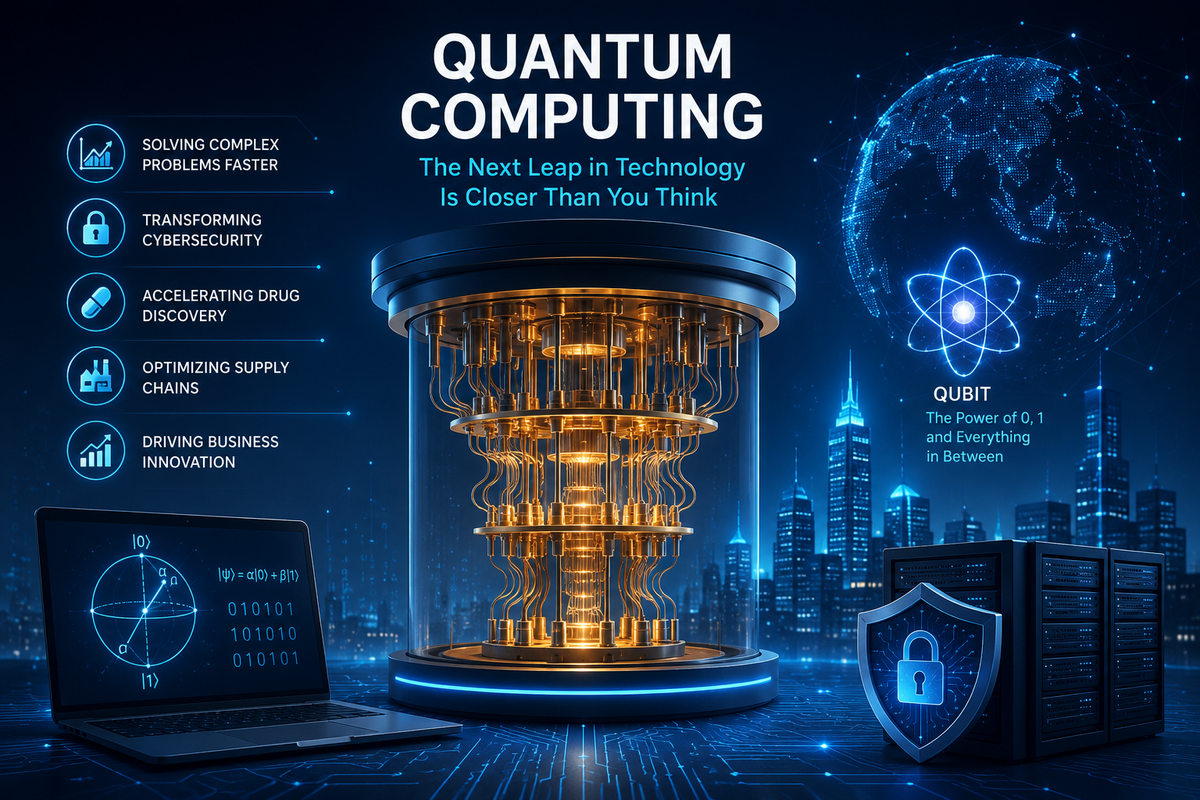
For years, quantum computing has been viewed as a futuristic technology—one reserved for research labs, theoretical discussions, and science fiction. Many business leaders have assumed that practical quantum applications remain decades away. Recent developments, however, suggest a different reality. Governments, technology companies, and research institutions are accelerating investments, while early commercial use cases are beginning to emerge across industries.
The conversation is no longer centered on if quantum computing will influence business. Instead, organizations are starting to ask when they should prepare and how this next wave of computing will reshape industries.
Quantum Computing Moves From Research to Reality
The past year has seen significant momentum in quantum computing research. Leading technology companies have announced improvements in quantum hardware, error correction techniques, and software development platforms designed to make quantum systems more reliable and accessible. Governments across North America, Europe, and Asia have also expanded funding for national quantum initiatives, recognizing the technology as a strategic priority for economic growth and national security.
Although large-scale, fault-tolerant quantum computers are still under development, experts increasingly agree that businesses should begin preparing today rather than waiting for complete commercial maturity.
This shift mirrors previous technological revolutions. Cloud computing, artificial intelligence, and generative AI all spent years in development before reaching widespread adoption. Organizations that invested early often gained a lasting competitive advantage.
Why Businesses Should Start Paying Attention
Unlike traditional computers that process information using binary bits, quantum computers use quantum bits, or qubits, enabling them to perform certain calculations exponentially faster. While classical systems remain highly effective for everyday business operations, quantum computing has the potential to solve highly complex optimization and simulation problems that are currently beyond the reach of conventional computing.
Industries that rely on advanced mathematical modeling stand to benefit first. Financial institutions could optimize investment portfolios and improve fraud detection. Pharmaceutical companies may accelerate drug discovery through molecular simulations. Manufacturers could refine production processes, while logistics providers may optimize supply chains containing thousands of constantly changing variables.
For business leaders, the opportunity extends beyond faster computing. Quantum technology could fundamentally change how organizations approach decision-making, research, and innovation.
Cybersecurity Faces a New Challenge
One of the most widely discussed implications of quantum computing is its potential impact on cybersecurity.
Current encryption standards that protect online banking, digital communications, healthcare records, and enterprise data rely on mathematical problems that are extremely difficult for classical computers to solve. Quantum computers, once sufficiently advanced, could significantly reduce the time required to break some of these encryption methods.
Recognizing this possibility, cybersecurity agencies and technology vendors are already developing post-quantum cryptography designed to withstand future quantum attacks. Organizations handling sensitive customer data are increasingly evaluating their long-term security strategies to ensure they remain protected as quantum capabilities continue to evolve.
Preparing for quantum-safe security has become an important discussion even before large-scale quantum computers become commercially available.
Investment Is Accelerating Worldwide
Quantum computing is attracting unprecedented levels of public and private investment.
Major technology companies continue expanding their quantum research programs while startups focused exclusively on quantum hardware, networking, and software have attracted significant venture capital funding. Governments are supporting university research, workforce development, and public-private partnerships aimed at strengthening national quantum ecosystems.
This growing investment demonstrates increasing confidence that quantum technologies will become commercially valuable over the coming decade. Rather than competing solely on processing power, organizations are building complete quantum ecosystems that include cloud access, software platforms, development tools, and industry-specific applications.
The rapid expansion of these ecosystems is making quantum experimentation more accessible to businesses without requiring them to purchase specialized hardware.
Preparing for the Quantum Economy
Although quantum computing has not yet reached mainstream enterprise deployment, forward-looking organizations are already exploring its strategic implications.
Many companies have established innovation teams responsible for monitoring quantum developments, identifying potential business applications, and evaluating future workforce requirements. Others are partnering with universities, research institutions, and technology providers to build internal expertise before commercial adoption accelerates.
Preparing early does not necessarily mean investing heavily in quantum hardware today. Instead, businesses can begin by understanding which processes could benefit from quantum optimization, assessing cybersecurity readiness, and developing long-term technology roadmaps that account for future advancements.
As with artificial intelligence, organizations that build knowledge early will likely adapt more effectively when the technology matures.
Looking Beyond the Hype
Quantum computing continues to generate excitement, but it is important to separate genuine progress from unrealistic expectations.
Industry experts acknowledge that several technical challenges remain before fault-tolerant quantum computers become widely available. Improving qubit stability, reducing computational errors, and scaling hardware remain active areas of research.
However, these challenges should not be mistaken for a lack of progress. The technology is advancing steadily, and each breakthrough moves quantum computing closer to practical commercial applications.
Businesses that dismiss quantum computing as a distant possibility risk overlooking one of the most significant technological shifts currently underway.
Final Thoughts
Quantum computing may not replace classical computing anytime soon, but it is steadily moving from theoretical research toward practical business applications. As investments increase, hardware improves, and software ecosystems mature, organizations will face growing pressure to understand how quantum technologies could influence their industries.
For business leaders, the priority today is not immediate adoption but informed preparation. Monitoring developments, evaluating cybersecurity readiness, and identifying future opportunities can help organizations respond more effectively as the technology evolves.
History has shown that transformative technologies often appear to arrive gradually—until they suddenly become impossible to ignore. Quantum computing seems to be following that same path, making now the right time for businesses to start paying attention rather than waiting for the future to arrive.