

For the past two years, artificial intelligence has dominated nearly every technology headline. Every major announcement, product launch, and investment seemed to revolve around smarter chatbots, larger language models, or increasingly capable AI assistants. Yet beneath the constant stream of AI news, another transformation has been unfolding—one that could have a far greater impact on businesses over the next decade.
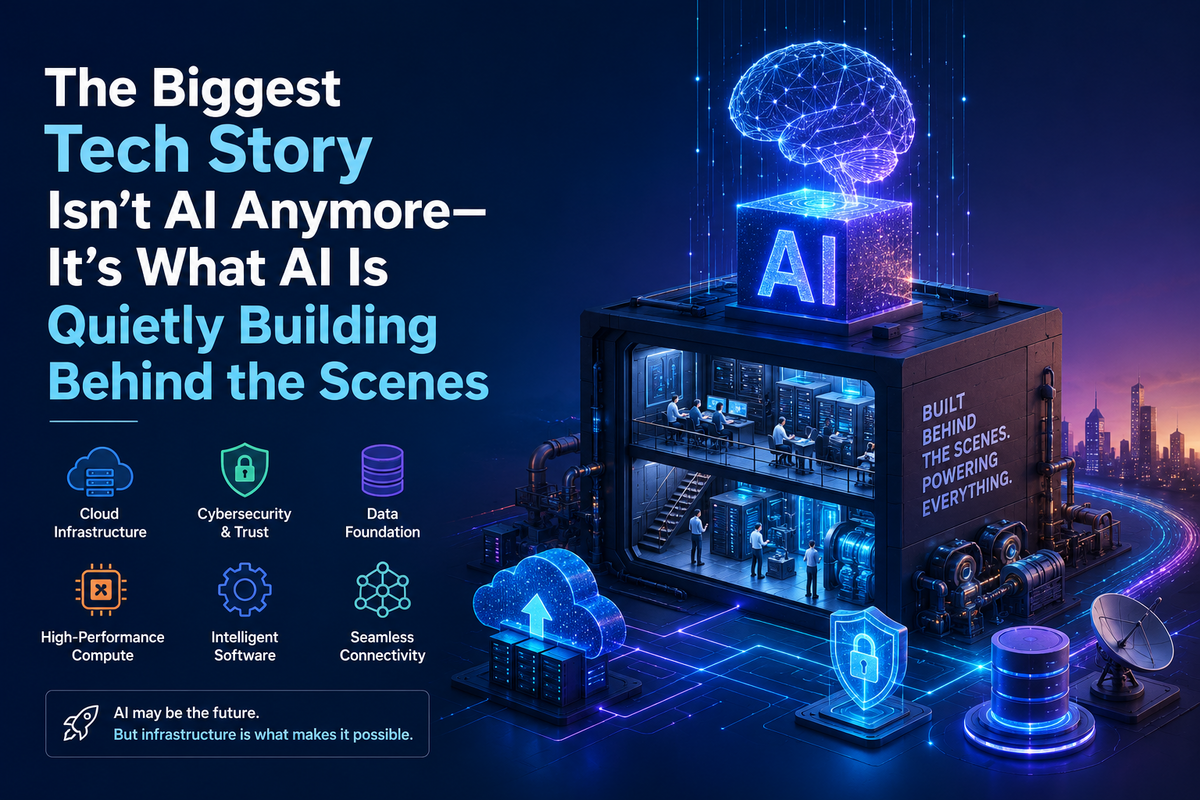
The real story is no longer about AI itself. It is about the digital infrastructure AI is forcing organizations to build. From cloud computing and cybersecurity to data centers, networking, and enterprise software, businesses are quietly redesigning their technology foundations to support a future where intelligent systems become part of everyday operations.
This shift is creating one of the most significant enterprise technology upgrades seen in years.
The first sign of this transformation is happening inside corporate data centers. Organizations that once focused primarily on storage capacity are now investing in high-performance computing environments capable of processing enormous AI workloads. Graphics processing units (GPUs), specialized AI accelerators, and advanced cooling technologies have become strategic assets rather than niche infrastructure components.
Technology leaders are realizing that purchasing an AI platform is only the beginning. Without modern infrastructure, even the most advanced AI applications struggle to deliver meaningful business value. As a result, infrastructure modernization has become a boardroom discussion instead of an IT-only concern.
Cloud providers are experiencing the ripple effects as well. Enterprises are expanding their cloud strategies beyond simple migration projects. Instead, they are creating hybrid environments that combine public cloud services, private infrastructure, and edge computing resources to support increasingly intelligent applications.
This evolution reflects a broader understanding that AI is not replacing existing systems overnight. Rather, it is becoming another critical workload that requires flexibility, scalability, and resilience. Businesses that build adaptable cloud environments today are likely to be better positioned for tomorrow's innovations.
Cybersecurity is evolving just as rapidly.
As AI becomes integrated into enterprise operations, attackers are also using intelligent technologies to automate phishing campaigns, generate convincing deepfakes, and identify software vulnerabilities at unprecedented speed. Traditional security tools are finding it increasingly difficult to keep pace with these sophisticated threats.
Organizations are responding by investing in AI-powered security platforms capable of detecting unusual behavior, identifying emerging attack patterns, and responding to incidents before they escalate. Instead of relying solely on human analysts, security teams are increasingly working alongside intelligent systems that continuously monitor networks around the clock.
This changing threat landscape is transforming cybersecurity from a defensive function into a proactive business strategy.
Another area experiencing rapid change is enterprise software itself.
Applications that once required extensive manual configuration are becoming increasingly autonomous. Customer relationship management systems now recommend next actions for sales teams. Human resource platforms can identify potential skill gaps before they affect productivity. Financial software detects anomalies in spending patterns in real time.
The value of these platforms is no longer measured simply by automation. Businesses now expect software to generate insights, anticipate challenges, and assist employees in making better decisions.
This represents a significant shift in enterprise technology expectations. Organizations are no longer asking whether software can complete repetitive tasks. They are asking whether it can actively contribute to strategic growth.
Data has also become more valuable than ever.
For years, enterprises accumulated enormous amounts of information without fully utilizing it. AI has changed that equation by making data immediately actionable. However, this opportunity comes with a challenge. Poor-quality, fragmented, or inconsistent data can limit the effectiveness of even the most advanced AI models.
Consequently, organizations are placing renewed emphasis on data governance, quality management, and integration strategies. Clean, secure, and accessible data is emerging as one of the most important competitive advantages in modern business.
Companies that successfully organize their information today will likely see stronger AI performance tomorrow.
Perhaps the most interesting development is the rise of digital ecosystems rather than isolated technologies.
Instead of purchasing individual software products to solve separate problems, organizations are building interconnected technology environments where cloud platforms, analytics tools, cybersecurity solutions, collaboration software, and AI systems operate together.
This integrated approach improves efficiency while giving leadership greater visibility into business performance. Information flows more easily across departments, reducing operational silos and enabling faster decision-making.
Technology investments are becoming less about individual applications and more about creating unified digital experiences.
For enterprise leaders, this changing landscape presents both opportunity and responsibility. Investing in AI without modern infrastructure, strong cybersecurity, or reliable data management can produce disappointing results. Conversely, businesses that strengthen these foundational capabilities may discover that future innovations become easier to adopt.
The technology headlines may continue focusing on the latest AI breakthroughs, but experienced decision-makers are increasingly paying attention to what those breakthroughs demand behind the scenes. Infrastructure, cloud architecture, cybersecurity, intelligent software, and data management are quietly becoming the defining technologies of the next business era.
The biggest technology story, therefore, may not be another AI model launch or chatbot update. It is the silent transformation of enterprise technology itself—a transformation that is reshaping how organizations build, secure, and scale their digital operations.
For businesses planning their next phase of digital transformation, understanding these foundational shifts will be just as important as following the latest AI announcement. The companies that invest in the technologies supporting intelligence, rather than chasing every new trend, are likely to be the ones defining the future of enterprise innovation.