

A loan application is approved in seconds. A cross-border payment reaches another continent before the sender finishes their coffee. An investment portfolio is rebalanced automatically based on changing market conditions. FinTech has transformed financial services into something faster, smarter, and more accessible than ever before.
Yet behind every instant transaction lies a far less glamorous reality—contracts, regulations, compliance checks, identity verification, risk assessments, and legal documentation. These are the invisible systems that determine whether financial innovation can scale or come to a halt.
For years, legal operations were viewed as the unavoidable slowdown in an otherwise fast-moving financial ecosystem. Today, however, that perception is changing. LegalTech is emerging as one of the most influential forces behind the next generation of financial innovation, quietly becoming the infrastructure that allows FinTech companies to move faster without sacrificing trust or compliance.
The future of finance isn't just about better banking apps or smarter algorithms. It's about making legal processes as intelligent as the financial products they support.
Compliance Is Becoming a Competitive Advantage
Regulation has always been one of FinTech's biggest challenges. Every new payment service, lending platform, digital wallet, or investment application must comply with an increasingly complex web of regional and international regulations.
Historically, compliance has been reactive. Businesses expanded first and addressed legal requirements as they encountered them. That approach is becoming increasingly risky in an era where regulators expect continuous monitoring rather than occasional audits.
Modern LegalTech platforms are changing this model by embedding compliance directly into financial operations. AI-powered systems can monitor regulatory updates, flag potential violations, automate reporting, and maintain detailed audit trails in real time.
Instead of slowing innovation, compliance is becoming an enabler of growth. Financial institutions that automate legal oversight can enter new markets more confidently while reducing the risk of costly regulatory penalties.
Contracts Are Becoming Intelligent Assets
Contracts have traditionally been static documents stored away after signing. But in today's digital economy, contracts are evolving into living business assets.
Smart contract management platforms now use artificial intelligence to analyze legal language, identify obligations, monitor renewal deadlines, detect hidden risks, and even recommend negotiation strategies before agreements are finalized.
For FinTech organizations managing thousands of vendor agreements, lending contracts, partnership documents, and customer terms, this level of automation dramatically reduces legal bottlenecks.
Rather than waiting weeks for manual contract reviews, businesses can accelerate partnerships while maintaining greater legal accuracy.
Embedded Finance Demands Embedded Legal Intelligence
The rise of embedded finance has fundamentally changed how financial services are delivered. Retailers offer installment payments, software companies launch digital wallets, and healthcare providers introduce financing options—all without becoming traditional banks.
This shift creates entirely new legal complexities.
Every embedded financial product introduces licensing requirements, consumer protection obligations, data privacy considerations, and contractual relationships involving multiple stakeholders.
LegalTech platforms are increasingly designed to manage these interconnected legal ecosystems automatically. Instead of relying on fragmented documentation and manual reviews, businesses gain centralized visibility across every compliance obligation tied to embedded financial services.
As embedded finance continues expanding into new industries, embedded legal intelligence will become equally essential.
AI Is Reshaping Both Industries Simultaneously
Artificial intelligence is often discussed as a customer-facing innovation in financial services, powering fraud detection, personalized recommendations, credit scoring, and predictive analytics.
Its impact behind the scenes may be even more transformative.
Legal AI can summarize lengthy agreements, identify missing clauses, compare regulatory changes across jurisdictions, generate standardized documentation, assist due diligence, and support litigation risk analysis.
When combined with FinTech AI systems, organizations gain a much more comprehensive view of operational risk.
Imagine a lending platform where AI doesn't simply determine creditworthiness—it also verifies regulatory compliance, validates contractual obligations, and automatically updates documentation whenever laws change.
This convergence allows legal and financial intelligence to operate together rather than in isolation.
Trust Is Becoming the New Currency
Consumers increasingly expect financial services to be instant, digital, and personalized. At the same time, they are becoming more concerned about data privacy, transparency, and ethical AI.
Trust is no longer built solely through strong cybersecurity or recognizable brands. It depends equally on how organizations manage legal responsibilities.
Businesses capable of demonstrating transparent governance, explainable AI, responsible data handling, and regulatory compliance will gain a significant competitive advantage.
LegalTech provides much of the infrastructure required to build that trust. Automated documentation, digital audit trails, consent management systems, and policy monitoring help organizations prove—not simply claim—that they operate responsibly.
For financial institutions navigating growing public scrutiny, trust is becoming one of their most valuable business assets.
Cross-Border Growth Requires Smarter Legal Infrastructure
FinTech is inherently global. A startup launched in Singapore can serve customers in Europe, North America, and the Middle East within months.
The challenge isn't technology.
It's regulation.
Every jurisdiction introduces unique licensing rules, tax obligations, consumer protection laws, anti-money laundering (AML) requirements, and data privacy standards.
LegalTech platforms increasingly provide jurisdiction-specific guidance, automate compliance documentation, and maintain centralized governance across multiple markets.
Rather than building separate legal processes for every expansion, organizations can establish scalable compliance frameworks that grow alongside the business.
For ambitious FinTech companies, scalable legal infrastructure is becoming just as important as scalable cloud infrastructure.
The Next Generation of Innovation Will Be Built Together
The conversation around FinTech has traditionally focused on customer experience, faster payments, blockchain, digital banking, and AI-powered financial services.
LegalTech was rarely included in that discussion.
That is beginning to change.
Investors, regulators, enterprise buyers, and technology leaders increasingly recognize that sustainable financial innovation depends as much on legal intelligence as technological innovation.
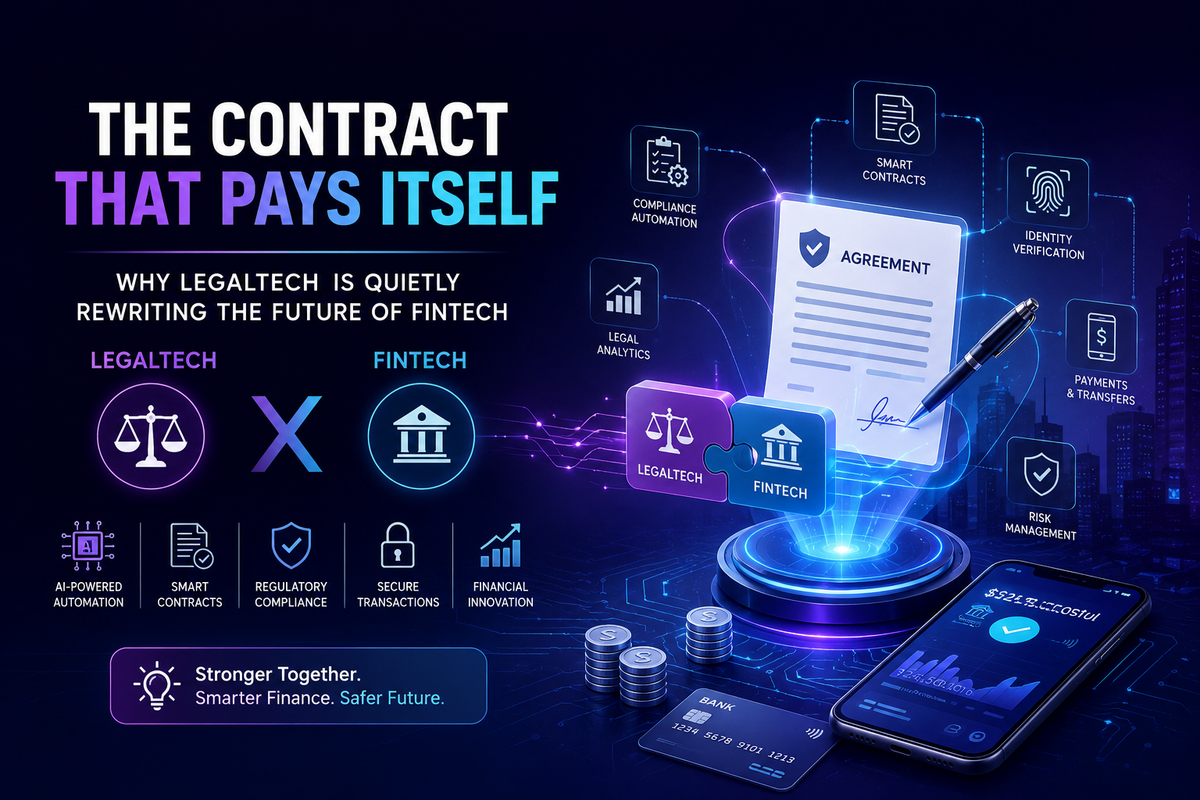
Rather than operating as separate business functions, legal and financial technology are becoming deeply interconnected ecosystems.
Organizations are already building integrated workflows where customer onboarding, identity verification, compliance monitoring, contract lifecycle management, risk assessment, and payment processing operate within unified digital environments.
This convergence doesn't simply improve operational efficiency—it fundamentally changes how businesses design financial products.
Conclusion
The most important transformation happening in financial services isn't always the one customers see.
Behind every frictionless payment, digital loan approval, automated investment platform, and embedded financial service lies an increasingly intelligent legal infrastructure that keeps innovation compliant, secure, and trustworthy.
The future belongs to organizations that recognize LegalTech isn't merely supporting FinTech—it is actively shaping it. As artificial intelligence continues redefining both industries, the strongest competitive advantage will come from integrating legal intelligence directly into financial innovation rather than treating it as an afterthought.
For business leaders, investors, and technology decision-makers, the question is no longer whether LegalTech belongs in FinTech. The real question is how quickly organizations can bring the two together before competitors do.