

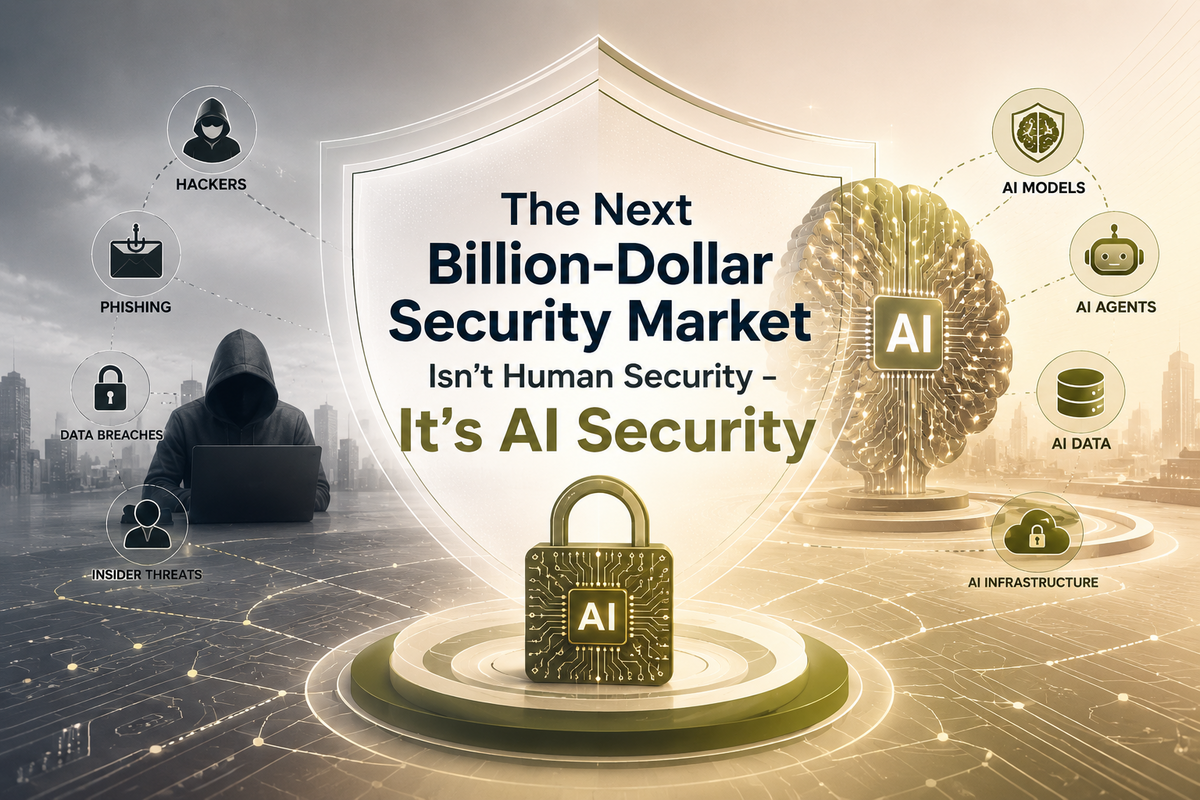
For decades, enterprise cybersecurity has centered on protecting people, devices, applications, and networks. Organizations invested heavily in endpoint protection, identity management, firewalls, and security awareness training because human users represented the largest attack surface. That assumption is rapidly changing.
Today, artificial intelligence is no longer simply a productivity tool sitting alongside employees. AI models, copilots, and autonomous agents are becoming active participants in business operations. They analyze sensitive data, generate software, automate workflows, make recommendations, and increasingly perform multi-step tasks with minimal human intervention. As organizations deploy AI across finance, healthcare, manufacturing, retail, and customer service, a new reality is emerging: businesses must now secure AI itself.
Recent industry developments have accelerated this conversation. Major technology companies are introducing specialized AI security initiatives and agentic cybersecurity capabilities, while new collaborations are forming to build open AI security frameworks in response to the growing complexity of AI-powered threats.
For B2B decision-makers, the next major cybersecurity investment may not be focused on employees. It will focus on protecting the AI systems that employees increasingly rely on.
AI Has Become Both the Defender and the Target
Artificial intelligence has transformed cybersecurity faster than almost any other enterprise technology. Security teams now use AI to identify anomalies, prioritize vulnerabilities, automate investigations, and accelerate incident response. These capabilities allow organizations to respond to threats at machine speed rather than human speed.
Unfortunately, attackers have embraced the same technology.
Cybercriminals are using AI to create sophisticated phishing campaigns, automate malware development, identify software vulnerabilities, and scale attacks that previously required large teams of skilled operators. Instead of manually probing networks, attackers can now deploy intelligent systems capable of adapting their tactics in real time.
The challenge extends beyond external threats. Organizations are rapidly adopting AI assistants, internal copilots, and autonomous agents that interact directly with proprietary business data. Every AI application introduces new risks, including prompt injection, model manipulation, unauthorized access, sensitive data leakage, and insecure integrations between AI systems and enterprise applications. As a result, organizations are increasingly investing in advanced cyber security tools that provide continuous monitoring, AI-specific threat detection, identity protection, runtime security, and automated risk management across AI ecosystems. Analysts increasingly expect AI security platforms to become standard enterprise infrastructure as AI adoption accelerates.
This changing landscape explains why security strategies are evolving from protecting users alone to protecting AI workloads, AI identities, and AI-driven business processes.
Why AI Security Is Becoming a Standalone Enterprise Market
Every major technology shift has created an entirely new security category. Cloud computing produced cloud security. Mobile devices created mobile security. Remote work accelerated zero-trust architecture.
Artificial intelligence is following the same pattern.
Organizations are discovering that traditional cybersecurity tools cannot fully address risks unique to AI environments. AI systems require continuous monitoring for model integrity, protection against adversarial attacks, governance over training data, visibility into autonomous decision-making, and controls that ensure AI operates within approved business policies.
At the same time, governments and regulators are increasing expectations around responsible AI deployment. Businesses must demonstrate transparency, accountability, data protection, and governance throughout the AI lifecycle. Security is becoming inseparable from compliance, making AI risk management a board-level discussion rather than simply an IT responsibility.
Recent announcements from Microsoft and other technology leaders highlight this shift. Specialized AI security models and autonomous cyber defense capabilities are being developed specifically to identify AI-generated threats, analyze vulnerabilities faster, and support security analysts with intelligent automation.
The market opportunity extends well beyond software vendors. Consulting firms, managed security providers, cloud platforms, governance specialists, identity providers, and compliance technology companies are all expanding their AI security capabilities. What was once considered a niche discipline is quickly becoming one of the fastest-growing segments of enterprise cybersecurity.
The Organizations That Secure AI Will Build Greater Trust
AI adoption is no longer limited to experimentation. Enterprises are embedding intelligent systems into customer support, software development, financial operations, supply chain management, marketing, and executive decision-making. As AI becomes responsible for increasingly important business functions, confidence in these systems becomes a competitive advantage.
Customers want assurance that AI-generated recommendations are trustworthy. Regulators expect organizations to demonstrate governance and accountability. Boards want visibility into AI risks before approving enterprise-wide deployments. Investors increasingly recognize that secure AI adoption reduces operational and reputational risk. As organizations evaluate AI security solutions, whitepaper syndication has become an important channel for educating enterprise buyers, sharing expert insights, and helping decision-makers understand emerging AI governance, compliance, and cybersecurity best practices before making strategic investments.
This is why AI security should not be viewed solely as defensive technology. It is becoming a business enabler that allows organizations to innovate with greater confidence while maintaining resilience against emerging threats.
The cybersecurity industry has historically focused on protecting people from technology. The next chapter is about protecting technology that increasingly acts like people. AI systems are becoming decision-makers, collaborators, and autonomous operators across the enterprise, and they require security designed specifically for their unique capabilities and risks.
The companies that invest early in AI governance, model protection, intelligent threat detection, and continuous AI monitoring will be better positioned to scale innovation safely. As autonomous AI becomes embedded across every industry, one thing is becoming increasingly clear: the next billion-dollar security market will not be human security alone. It will be AI security