

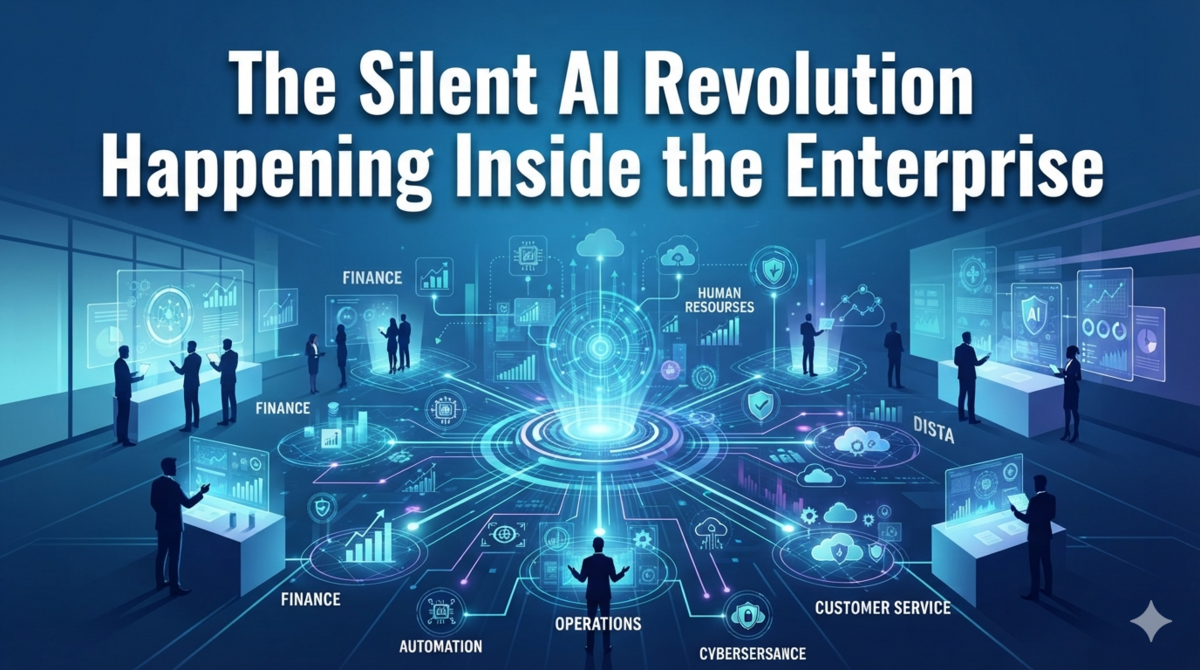
Artificial intelligence has dominated headlines for the past few years, often with stories about chatbots, image generators, and virtual assistants. While these innovations have captured public attention, a quieter transformation is unfolding behind the scenes. Inside enterprises, AI is no longer a novelty or an experimental tool—it is becoming an integral part of everyday business operations.
This silent AI revolution isn't defined by flashy product launches or viral demonstrations. Instead, it's happening in finance departments that automate invoice processing, supply chains that predict disruptions before they occur, cybersecurity teams that identify threats in real time, and HR platforms that personalize employee experiences. These changes may not always be visible to customers, but they are fundamentally reshaping how organizations operate, compete, and grow.
For business leaders, the conversation has shifted from "Should we adopt AI?" to "How can AI create measurable business value?" The enterprises finding the greatest success are those embedding intelligence into the core of their operations rather than treating AI as a standalone initiative.
AI Is Becoming Part of Everyday Business
The first wave of enterprise AI focused on experimentation. Organizations launched pilot projects, tested generative AI tools, and explored automation opportunities across departments. While these initiatives generated valuable insights, many remained isolated from broader business strategies.
Today, enterprises are moving beyond experimentation. AI is increasingly integrated into existing workflows, allowing teams to make faster decisions, automate repetitive tasks, and uncover insights from vast amounts of data.
Customer service teams use AI to prioritize support requests. Finance departments automate expense verification. Marketing teams analyze customer behavior to deliver personalized campaigns. Operations managers rely on predictive analytics to optimize inventory and production schedules.
The result is not a dramatic replacement of employees but a steady evolution in how work gets done.
From Automation to Intelligent Decision-Making
Traditional automation was designed to execute predefined tasks. Modern AI goes several steps further by analyzing information, recognizing patterns, and recommending actions based on changing business conditions.
For example, instead of simply generating reports, AI can identify unusual spending patterns before they become financial risks. Rather than waiting for equipment failures, predictive maintenance systems can forecast issues and recommend preventive action. In customer support, AI can route inquiries based on urgency and historical outcomes, helping teams resolve issues more efficiently.
This transition from automation to intelligent decision-making enables organizations to respond faster, reduce operational costs, and improve business agility.
As enterprises continue investing in intelligent automation and enterprise AI, decision-making itself is becoming more proactive and data-driven.
AI Is Powering Every Department
One of the defining characteristics of today's AI revolution is its reach across the enterprise.
Human Resources is using AI to improve talent acquisition, personalize learning programs, and analyze workforce trends. Sales teams leverage predictive analytics to identify high-value prospects and prioritize opportunities. Procurement teams forecast demand more accurately, while cybersecurity professionals use AI to detect suspicious activities before they escalate into major incidents.
Even legal and compliance departments are beginning to use AI to review contracts, identify regulatory risks, and streamline documentation.
Instead of existing within a single department, AI is becoming a shared capability that supports every business function.
Data Is the Engine Behind Enterprise AI
Artificial intelligence is only as effective as the information it can access. This has placed renewed importance on enterprise data strategies.
Organizations are investing in cloud infrastructure, modern data platforms, and business intelligence solutions to ensure AI systems receive reliable, high-quality information. Clean, connected, and well-governed data enables AI to generate meaningful insights rather than inaccurate recommendations.
Businesses that successfully combine AI with strong data management are gaining a significant competitive advantage. They can identify trends faster, anticipate customer needs, and make informed decisions with greater confidence.
Without a solid data foundation, even the most advanced AI models struggle to deliver consistent business value.
Trust Will Determine AI Success
As AI becomes embedded within business processes, trust is emerging as one of the most important factors influencing adoption.
Employees want to understand how AI reaches its recommendations. Customers expect transparency regarding the use of their data. Regulators increasingly require organizations to demonstrate responsible AI governance.
Successful enterprises recognize that technological capability alone is not enough. They are establishing governance frameworks that address fairness, explainability, privacy, security, and human oversight.
Responsible AI is no longer simply a compliance exercise—it has become a business imperative that strengthens confidence among employees, customers, and stakeholders alike.
Preparing for the Next Phase of Enterprise AI
The next stage of AI adoption will be defined by intelligent collaboration rather than isolated tools.
Emerging technologies such as AI agents, multimodal AI, predictive analytics, and autonomous workflows will increasingly work together across enterprise systems. Instead of employees switching between multiple applications, intelligent platforms will coordinate workflows, recommend actions, and automate routine processes in the background.
This shift will allow professionals to focus more on strategic thinking, innovation, and customer relationships while AI manages repetitive operational tasks.
Organizations that invest in scalable AI infrastructure, workforce training, and digital transformation today will be better prepared for this next phase of enterprise innovation.
Competitive Advantage Will Belong to Quiet Innovators
Some of the most successful AI transformations may never become headline news.
The organizations gaining the greatest competitive advantage are often those making steady, deliberate improvements behind the scenes. They are improving customer experiences through faster service, reducing operational costs through intelligent automation, strengthening cybersecurity with predictive detection, and empowering employees with data-driven insights.
These incremental improvements create lasting business value because they are integrated into everyday operations rather than treated as temporary experiments.
The silent AI revolution is less about replacing people with machines and more about enabling people to make better decisions with smarter technology.
Final Thoughts
The biggest AI transformation happening today is not the one generating social media buzz or dominating technology conferences. It is the quiet integration of intelligent systems into the daily operations of enterprises around the world.
As AI becomes embedded across finance, HR, operations, marketing, cybersecurity, and customer service, it is reshaping how businesses solve problems, serve customers, and compete in an increasingly digital economy. Organizations that combine advanced AI capabilities with trusted data, responsible governance, and a clear business strategy will be best positioned to thrive.
The future of enterprise AI will not be defined by the loudest announcements or the most ambitious experiments. It will be defined by the organizations that quietly embed intelligence into every process, every decision, and every opportunity for growth. That silent revolution is already underway—and it is changing the enterprise from the inside out.