

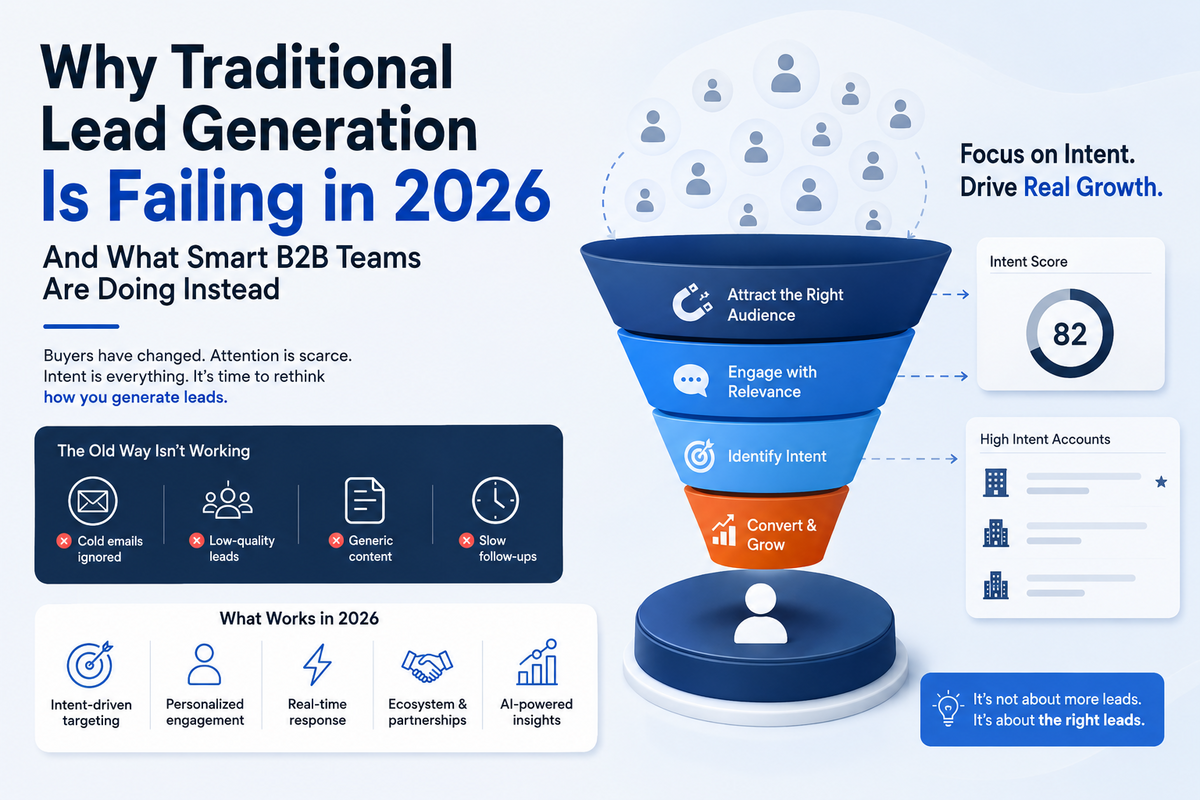
For years, B2B lead generation followed a familiar formula. Build a database, send cold emails, run gated content campaigns, collect form fills, and pass everything to sales.
It worked — until buyers changed.
In 2026, the biggest challenge in lead generation is no longer generating volume. Most companies already have access to thousands of contacts, automation platforms, enrichment tools, and outbound systems. The real problem is something deeper:
attention has become harder to earn, and intent has become harder to identify.
Today’s buyers are more informed, more selective, and far less patient than before. They research independently, compare vendors quietly, and often make decisions before ever speaking to a sales representative. This shift is forcing businesses to rethink not only how they generate leads, but how they define a “qualified opportunity” altogether.
The Decline of Traditional Lead Generation
The old lead generation model was built around quantity. More leads meant more pipeline potential. Marketing success was measured through metrics like:
- number of downloads,
- webinar registrations,
- email open rates,
- or raw MQL volume.
But those metrics no longer tell the full story.
A company can generate thousands of leads and still struggle to create meaningful revenue outcomes. Why? Because most traditional campaigns optimize for activity, not intent.
A webinar attendee is not automatically a buyer.
A content download does not equal purchase readiness.
And a filled contact form does not guarantee interest.
This is where many B2B teams are losing efficiency. Large amounts of time and budget are being spent nurturing contacts that may never convert.
Buyers Have Become Harder to Reach
Modern B2B buyers operate differently from even a few years ago.
They no longer rely heavily on vendor conversations during the early stages of research. Instead, they:
- consume independent content,
- compare solutions anonymously,
- use AI tools for research,
- and evaluate credibility before engaging directly.
By the time a prospect responds to outreach, they may already have a shortlist in mind.
This means traditional cold outreach alone is becoming less effective. Generic messaging, broad targeting, and mass email sequences are increasingly ignored because buyers expect personalization and relevance from the very first interaction.
Intent Is Becoming More Valuable Than Volume
As competition increases, the most successful B2B organizations are shifting from volume-driven marketing to intent-driven marketing.
Instead of asking:
“How many leads did we generate?”
They are asking:
“Which companies are actively showing buying intent right now?”
This change is significant.
Intent-driven lead generation focuses on identifying signals that indicate real interest, such as:
- repeated engagement,
- research behavior,
- topic-level activity,
- buying-stage indicators,
- or high-intent interactions across channels.
The goal is no longer to target everyone.
It’s to identify the right opportunities earlier.
Why Speed Matters More Than Ever
Another major shift in lead generation is the importance of timing.
In highly competitive markets, the first company to engage meaningfully often gains a major advantage. Buyers move quickly, and attention windows are shorter than ever.
This means delayed follow-ups, slow qualification processes, and disconnected workflows can directly impact conversions.
Companies are now investing heavily in:
- real-time lead routing,
- automated engagement systems,
- AI-powered qualification,
- and faster sales-marketing alignment.
Because in 2026, lead generation is no longer just about finding prospects — it’s about responding at the exact moment interest exists.
The Rise of Ecosystem-Led Growth
Another trend transforming lead generation is the rise of collaborative ecosystems and marketplaces.
Businesses are increasingly looking beyond isolated outreach strategies and moving toward:
- partnership-driven growth,
- vendor ecosystems,
- publisher collaborations,
- and B2B marketplaces.
Why?
Because trust has become one of the biggest differentiators in modern buying decisions. Buyers are more likely to engage through trusted networks, communities, and verified ecosystems than through random cold outreach.
This is especially visible in industries like:
- SaaS,
- IT services,
- cybersecurity,
- demand generation,
- and enterprise technology.
The future of lead generation is becoming more relationship-oriented and ecosystem-driven rather than purely transactional.
AI Is Reshaping Lead Qualification
Artificial intelligence is also changing how businesses identify and prioritize leads.
Modern AI systems can now:
- analyze behavioral patterns,
- predict buying likelihood,
- score opportunities dynamically,
- and automate parts of the qualification process.
This helps sales teams focus on higher-probability accounts instead of spending time manually filtering large datasets.
However, the companies benefiting the most from AI are not simply automating outreach. They are using AI to improve decision-making and reduce inefficiencies across the funnel.
The Future of Lead Generation
The lead generation industry is entering a new phase.
The companies that continue relying only on high-volume outreach and generic campaigns will find it increasingly difficult to stand out. Meanwhile, businesses that prioritize:
- intent,
- timing,
- relevance,
- personalization,
- and ecosystem-driven relationships
will gain a stronger competitive advantage.
Lead generation in 2026 is no longer about reaching the maximum number of people.
It’s about reaching the right people, at the right moment, with the right context.
That shift may sound subtle, but it is fundamentally changing how modern B2B growth works.