
HRIS Systems BattleCard―ADP Workforce Now vs. BambooHR vs. Workday HCM vs. Rippling
Published on 08 Apr 2026
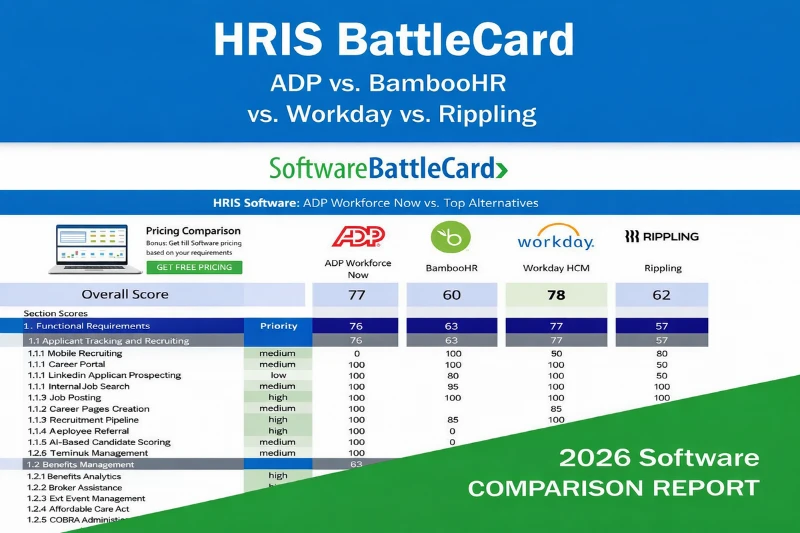
Selecting the right HRIS platform is no longer just an operational decision—it’s a strategic one that directly impacts workforce efficiency, employee experience, and long-term scalability. With multiple platforms offering overlapping features, automation capabilities, and varying levels of complexity, making the right choice can quickly become overwhelming.
This BattleCard introduces a structured way to evaluate leading HRIS solutions, helping decision-makers move beyond surface-level comparisons. While it highlights key capabilities, the deeper insights lie in understanding how each platform performs in real-world scenarios—and where trade-offs exist.
Understanding the HRIS Evaluation Challenge
Too Many Features, Not Enough Clarity
Modern HR platforms promise end-to-end solutions, but this often leads to confusion rather than clarity. Organizations frequently struggle to determine:
- Which system aligns with their operational workflows
- How intuitive the platform is for daily use
- Whether integrations will support existing tools
- How well the system scales with business growth
Without a clear evaluation framework, decisions risk being driven by features rather than actual business needs.
A Closer Look at Leading HRIS Platforms
What Differentiates Each Solution
Each platform offers a distinct approach to HR management, combining strengths with certain limitations.
ADP Workforce Now
A comprehensive solution focused on payroll, compliance, and workforce insights. It offers strong automation and reporting capabilities but may require careful implementation planning.
BambooHR
Known for its simplicity and user-friendly interface, BambooHR excels in onboarding and employee self-service. However, some advanced capabilities may depend on external integrations.
Rippling
A unified platform that combines HR, IT, and finance functions with automation at its core. Its flexibility is a major advantage, though it may require time for teams to fully adapt.
Workday HCM
An enterprise-grade platform offering advanced analytics, reporting, and scalability. It supports complex organizational needs but often involves a steeper learning curve.
Balancing Strengths and Trade-Offs
Why One Size Doesn’t Fit All
No single HRIS solution is perfect for every organization. The real challenge lies in balancing key considerations:
Functionality vs. Ease of Use
Feature-rich systems may introduce complexity, while simpler tools may lack depth.
Integration vs. Built-In Capabilities
Some platforms rely on integrations, while others offer more comprehensive native features.
Scalability vs. Investment
Systems designed for growth may require higher upfront and ongoing commitment.
Recognizing these trade-offs is essential to selecting a platform that fits both immediate and future needs.
Moving Toward a Smarter Selection Strategy
What Decision-Makers Should Prioritize
A thoughtful selection process goes beyond feature comparison. Organizations should focus on:
- Aligning software capabilities with business objectives
- Ensuring ease of adoption across teams
- Evaluating long-term scalability and flexibility
- Understanding how data and insights can drive decisions
This approach enables more confident and informed decision-making.
What This BattleCard Helps You Uncover
A Deeper Layer of Insight
This BattleCard combines analyst research, user feedback, and comparative insights to provide a clearer picture of each platform. It helps uncover not just what each system offers, but how those features translate into operational impact.
Still, the most valuable insights lie within the detailed comparisons, scoring frameworks, and evaluation criteria included in the full report.
Download the Full BattleCard
Choosing the right HRIS platform requires more than a surface-level comparison—it requires clarity, context, and confidence.
Download now to learn more and explore the complete HRIS comparison in detail.