

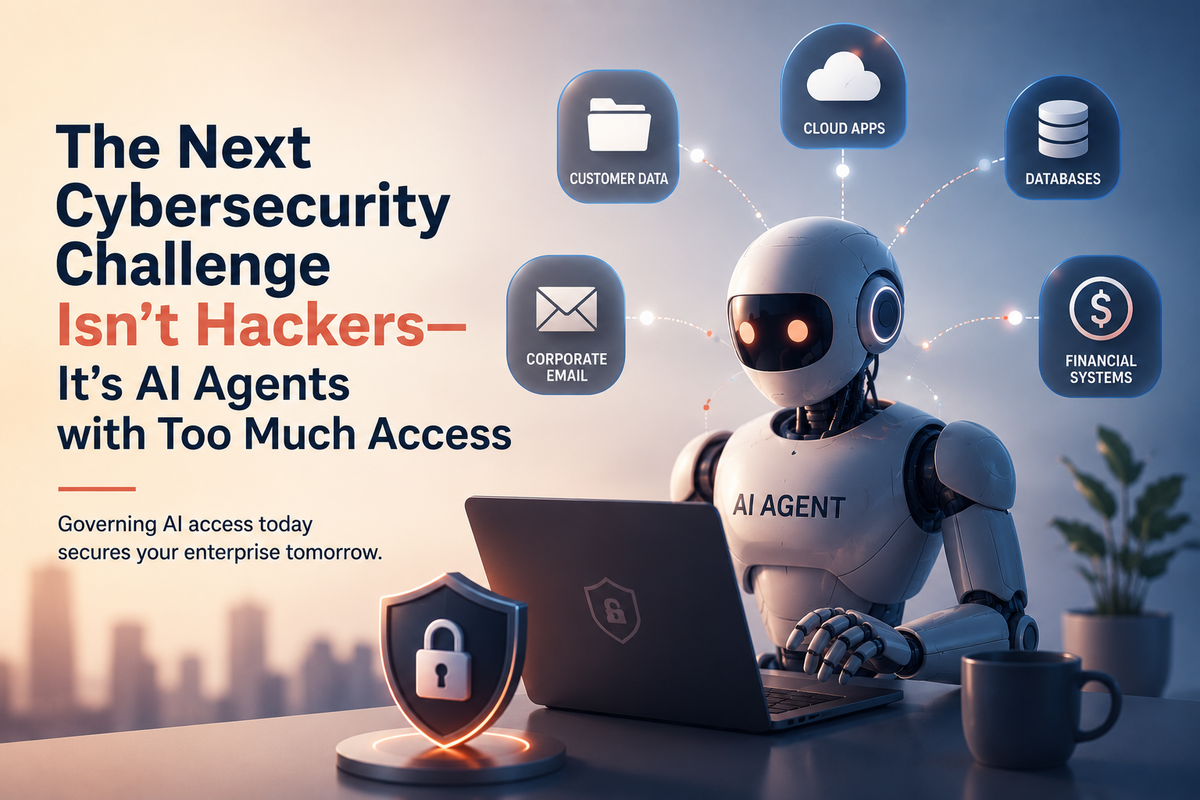
For decades, enterprise cybersecurity strategies have been built around a familiar threat model. Organizations invested in stronger passwords, firewalls, endpoint protection, identity management, and threat detection to defend against external attackers attempting to gain unauthorized access. While these risks remain, a new challenge is rapidly emerging inside the enterprise—one that doesn't always originate from malicious actors but from trusted AI systems with increasing levels of autonomy.
The rise of agentic AI is transforming how businesses operate. Unlike traditional AI assistants that respond to prompts, AI agents can perform tasks independently, connect with multiple enterprise applications, analyze information across departments, and even initiate actions on behalf of employees. Technology leaders including Microsoft, Google, Salesforce, ServiceNow, and OpenAI have all accelerated investments in AI agents over the past year, signaling a broader shift toward autonomous digital workforces.
This evolution promises significant productivity gains, but it also introduces a fundamental cybersecurity question. If an AI agent has permission to access customer records, financial systems, procurement platforms, internal communications, and cloud applications simultaneously, what happens when that agent makes an incorrect decision, exposes sensitive information, or operates beyond its intended boundaries?
For B2B decision-makers, the challenge is no longer limited to preventing hackers from breaking into enterprise systems. It is increasingly about ensuring AI agents do not unintentionally create new pathways for risk.
The New Insider Risk Isn't Always Human
Traditional cybersecurity assumes that every user accessing enterprise systems is either a trusted employee or an external threat. AI agents introduce a third category. They are neither human nor malicious, yet they often possess broad permissions to complete complex workflows.
Consider a marketing AI agent that automatically generates campaign reports by pulling data from a CRM, customer data platform, analytics software, and cloud storage. A finance agent might review invoices, approve expenses, and update accounting systems. A customer support agent could access knowledge bases, support tickets, and customer histories to resolve issues without human intervention.
Each individual task appears harmless. However, the combination of these permissions creates an entirely new attack surface.
Security experts are increasingly warning that excessive privileges granted to AI agents could become one of the biggest governance challenges facing enterprises. Recent discussions across the cybersecurity industry have emphasized that AI systems should follow the same principle of least privilege applied to human employees. An AI agent responsible for scheduling meetings should not automatically gain access to confidential financial reports or executive communications simply because those systems are connected.
Unlike human employees, AI agents can perform thousands of actions in minutes, continuously interact with multiple applications, and make decisions without fatigue. While these capabilities improve efficiency, they also amplify the consequences of configuration errors, permission gaps, or flawed reasoning.
The future of enterprise security will therefore depend not only on securing identities but also on governing machine identities with the same level of scrutiny.
AI Governance Is Becoming a Boardroom Conversation
The rapid adoption of AI agents has shifted cybersecurity beyond the IT department. It is becoming a strategic issue that demands executive oversight.
Organizations are increasingly deploying AI across sales, marketing, finance, human resources, procurement, and customer service. As these systems gain access to more business-critical information, leadership teams must establish clear governance frameworks defining what AI can access, what it can decide, and where human approval remains essential.
Recent enterprise AI developments have reinforced this direction. Technology vendors are introducing permission management, audit trails, policy controls, and AI governance features as standard components of their platforms rather than optional add-ons. The industry is recognizing that trust in AI depends as much on accountability as it does on intelligence.
This is particularly relevant for regulated industries where data privacy, compliance, and intellectual property protection are non-negotiable. AI agents capable of retrieving information across multiple enterprise systems must operate within clearly defined boundaries that align with organizational policies and regulatory requirements.
The conversation is therefore evolving from "Can AI automate this process?" to "Should AI be allowed to make this decision independently?" The distinction is subtle but significant. Automation focuses on efficiency. Governance focuses on responsibility.
Organizations that treat AI governance as a strategic business capability rather than a technical checklist will be better prepared as autonomous systems become integral to daily operations.
Building Trust Will Matter More Than Building Smarter AI
The next phase of enterprise AI adoption will not be determined solely by model performance or automation capabilities. It will be shaped by confidence.
Employees need confidence that AI agents will act within approved limits. Customers need confidence that their information remains secure. Executives need confidence that autonomous systems can accelerate operations without introducing unacceptable business risks.
Achieving this balance requires organizations to rethink cybersecurity for an AI-first workplace. Identity management will increasingly extend beyond employees to include AI agents. Permission models will need to become more dynamic as AI systems take on new responsibilities. Continuous monitoring will focus not only on suspicious human behavior but also on unusual AI activity that could signal misconfigurations or unintended actions.
Perhaps the most important shift is cultural. Enterprises have traditionally viewed cybersecurity as protecting systems from outsiders. The future requires viewing cybersecurity as governing trusted intelligence operating from within.
AI agents are poised to become valuable digital colleagues capable of transforming productivity across every business function. Yet, like any employee entrusted with sensitive information, they require oversight, accountability, and clearly defined responsibilities.
Hackers will continue to evolve, and organizations must remain vigilant against external threats. But as autonomous AI becomes embedded across enterprise software, one of the most significant cybersecurity challenges may not involve someone trying to break into the business. It may involve ensuring that the AI already inside the business never has more access than it truly needs.
In the age of agentic AI, competitive advantage will not belong only to organizations that deploy autonomous systems quickly. It will belong to those that deploy them responsibly, combining innovation with governance to build trust that lasts well beyond the next technological breakthrough.