

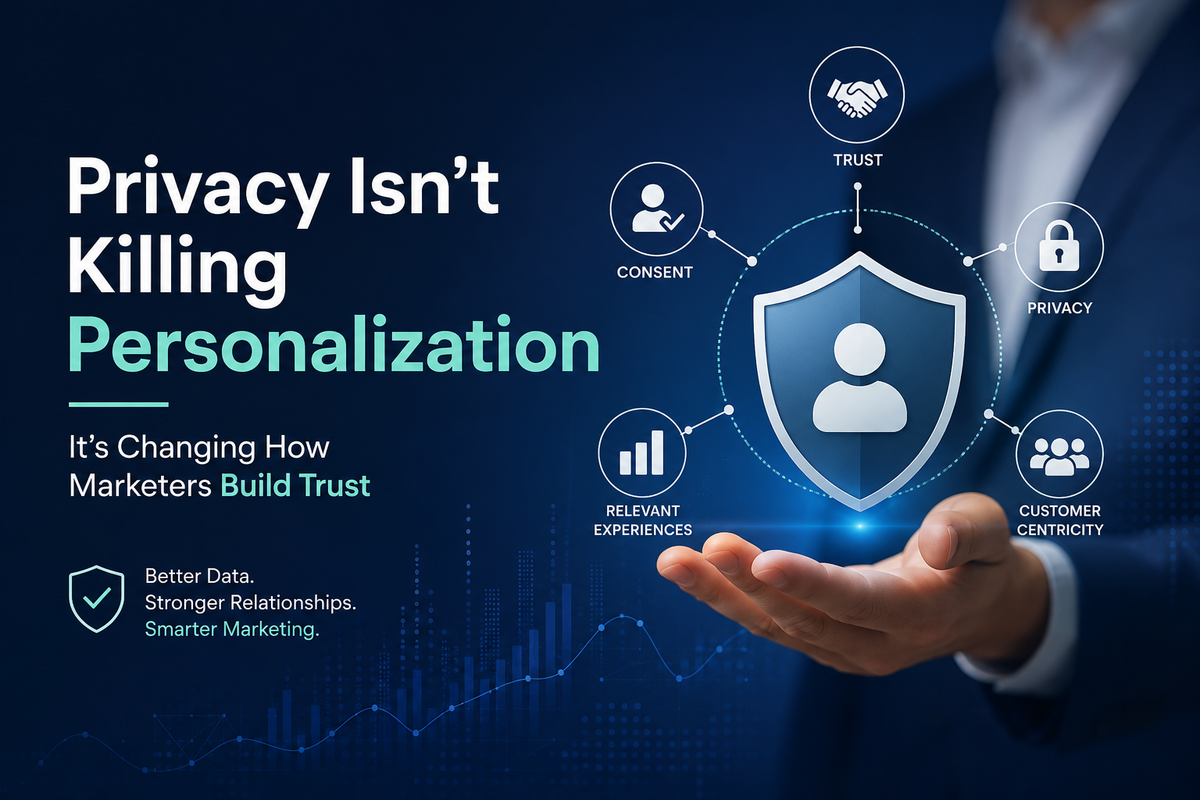
For years, personalization and privacy were often portrayed as opposing forces. The more data marketers collected, the more personalized customer experiences they could deliver. As global privacy regulations tightened and third-party cookies began disappearing, many believed personalized marketing would become less effective.
That prediction hasn't come true.
Instead, personalization is evolving. It's moving away from excessive tracking and toward trust-based engagement, where customers willingly share information because they see clear value in doing so. For B2B organizations, this shift represents more than a compliance challenge—it's an opportunity to build stronger, longer-lasting customer relationships.
Today's buyers are more informed than ever. They expect relevant experiences, but they also expect transparency about how their data is collected and used. Recent updates across the marketing ecosystem, from Google's continued transition toward privacy-centric advertising technologies to growing investments in first-party data strategies, indicate that the industry is adapting rather than retreating. Privacy is no longer limiting personalization; it is redefining the rules under which it succeeds.
The Era of Invisible Tracking Is Giving Way to Transparent Marketing
The digital marketing landscape has undergone significant transformation over the past few years. Regulations such as GDPR and evolving privacy laws across multiple regions have established higher expectations for consent, accountability, and data protection. At the same time, browsers and technology platforms continue reducing reliance on third-party tracking mechanisms, encouraging marketers to rethink how they understand customer behavior.
For B2B organizations, this doesn't mean losing visibility into customer journeys. It means relying more heavily on relationships rather than surveillance.
Modern buyers are increasingly willing to share business information when they receive meaningful value in return. Downloading an industry report, registering for a webinar, subscribing to thought leadership content, or participating in research are all examples of customers voluntarily providing information because the exchange feels fair and beneficial.
This transition has accelerated the importance of first-party data. Rather than purchasing audience segments or depending on external tracking technologies, organizations are investing in customer data collected directly through their own digital properties and interactions. These insights are often more accurate, more relevant, and significantly more sustainable over the long term.
Trust has become a measurable marketing asset. Buyers are more likely to engage with brands that clearly explain how information will be used and consistently demonstrate respect for customer preferences. In many cases, transparency itself has become part of the customer experience.
Personalization Is Becoming Smarter, Not More Intrusive
One of the biggest misconceptions about privacy-first marketing is that personalization must become generic. The opposite is happening.
Today's personalization strategies rely less on knowing everything about every visitor and more on understanding intent within the context of each interaction. Instead of following users across the internet, marketers are focusing on behavioral signals generated within their own ecosystems. Content consumption, webinar attendance, product interest, account engagement, and previous interactions often provide enough context to deliver highly relevant experiences without compromising privacy.
This approach aligns closely with how enterprise buying decisions actually unfold. B2B purchasing cycles are rarely driven by a single individual. Buying committees conduct extensive research across multiple channels before engaging with vendors. They expect educational resources that address their specific challenges rather than advertisements that appear based on their browsing history.
Recent developments in customer data platforms and marketing automation reflect this shift. Rather than functioning solely as repositories of customer information, these platforms increasingly help organizations activate consented, first-party data across marketing, sales, and customer success teams. The objective is not simply personalization but consistency. Buyers expect every interaction to acknowledge previous conversations without crossing the line into uncomfortable overfamiliarity.
Successful personalization today feels helpful instead of intrusive. It anticipates business needs rather than exposing how much data has been collected.
The Future of Marketing Will Be Built on Permission and Credibility
As privacy expectations continue evolving, marketers are beginning to recognize that sustainable growth depends less on collecting more data and more on earning continued access to customer attention.
This has important implications for B2B decision-makers planning future marketing investments. Content quality is becoming increasingly valuable because it encourages customers to willingly engage. Educational webinars, original research, industry reports, newsletters, and expert insights create opportunities for buyers to share information voluntarily, allowing organizations to develop richer first-party data without relying on invasive tracking methods.
Measurement strategies are evolving as well. Marketing success is no longer determined solely by impression volume or anonymous website traffic. Organizations are placing greater emphasis on meaningful engagement, account progression, customer lifetime value, revenue contribution, and whitepaper performance metrics to understand how content influences buying decisions throughout the customer journey. Together, these indicators provide a clearer picture of business impact while remaining aligned with modern privacy expectations.
Perhaps the most significant change is cultural rather than technical. Privacy is no longer viewed as a legal obligation managed exclusively by compliance teams. It has become an essential component of brand reputation. Every interaction communicates whether a company respects customer preferences, protects sensitive information, and delivers value worthy of continued trust.
For B2B organizations operating in competitive markets, this distinction matters. Buyers increasingly choose partners they believe will handle both their business challenges and their data responsibly.
Trust Is Becoming Marketing's Most Valuable Currency
Marketing has always been about understanding people, but the methods for achieving that understanding are changing. The future does not belong to brands with the largest datasets or the most sophisticated tracking technologies. It belongs to organizations that build meaningful relationships based on transparency, relevance, and mutual value.
Privacy has not diminished the power of personalization. Instead, it has encouraged marketers to become more intentional about how they collect information, how they communicate with customers, and how they earn trust over time.
For B2B decision-makers, this is an encouraging shift. As buyers become more selective and privacy expectations continue to rise, the organizations that prioritize credibility alongside personalization will be better positioned to create lasting customer relationships. In the years ahead, the strongest competitive advantage may not be how much a company knows about its customers, but how confidently customers choose to share that knowledge in the first place.