

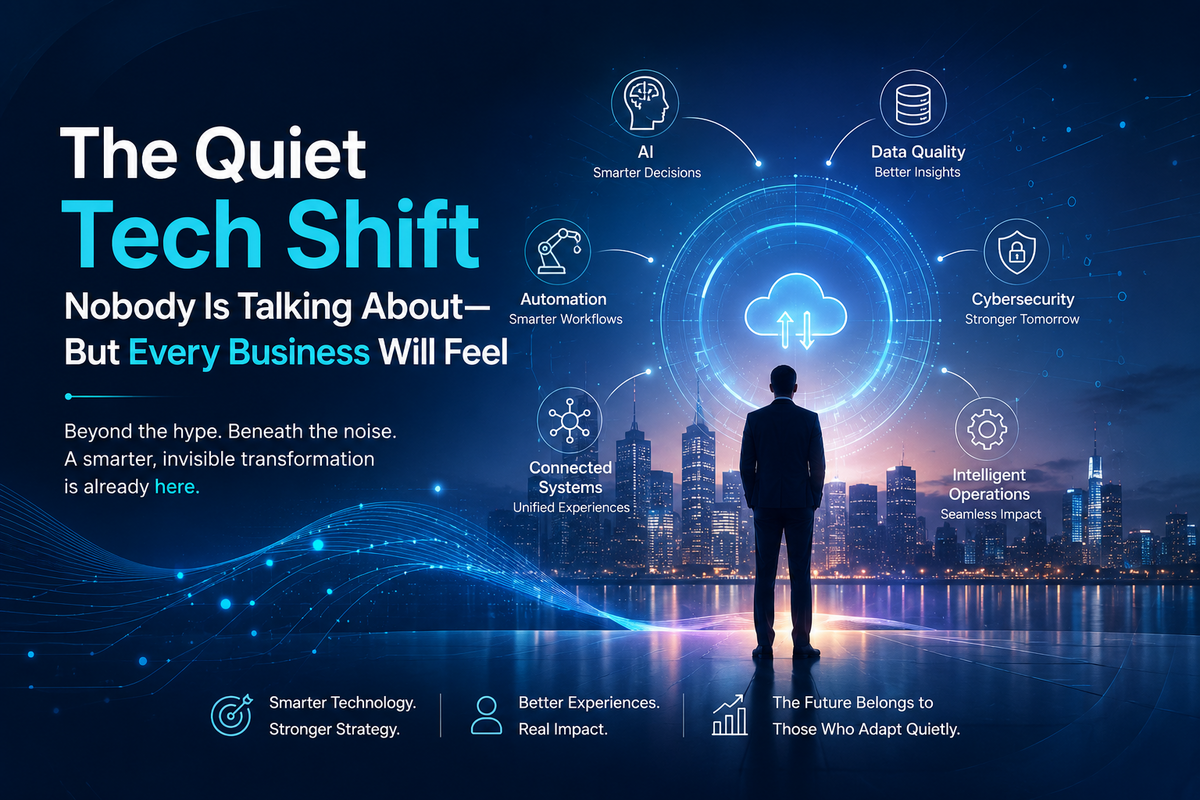
For years, the technology industry has been obsessed with the next big thing. Every few months, headlines declare a new revolution, artificial intelligence, quantum computing, autonomous systems, edge computing, spatial computing, or the latest breakthrough chip. While these innovations deserve attention, they often distract from a quieter transformation that is reshaping businesses at a much deeper level.
The biggest technology story of 2026 isn't a single product launch or breakthrough algorithm. It's the growing realization that technology itself is becoming invisible.
Instead of asking, "What new software should we buy?" business leaders are beginning to ask a far more strategic question: "How can technology disappear into the background while making every business process smarter?"
This subtle shift is changing how enterprises invest, how employees work, and how customers experience brands. It may not dominate social media conversations, but it is quietly redefining the future of digital transformation.
From Digital Transformation to Intelligent Operations
For more than a decade, digital transformation meant replacing paper with software and manual workflows with automation. Companies invested billions in cloud platforms, ERP systems, customer relationship management software, and marketing automation tools.
Today, those investments are no longer enough.
Organizations have discovered that simply digitizing operations doesn't automatically create competitive advantage. Many enterprises now operate dozens of disconnected platforms, generating enormous amounts of data that rarely translate into better business decisions.
The next phase of transformation focuses less on adopting new technology and more on connecting existing technology intelligently.
Instead of adding another dashboard, businesses want systems that proactively surface insights. Instead of managing dozens of applications, leaders want platforms that communicate seamlessly with one another. The objective is no longer digital maturity, it's operational intelligence.
AI Is Becoming an Infrastructure Layer
Artificial intelligence continues to dominate technology conversations, but its role is quietly evolving.
Rather than existing as a standalone product, AI is becoming an embedded capability across enterprise software. Collaboration platforms summarize meetings automatically. Customer service applications draft responses in real time. Security systems detect anomalies before human analysts notice them. Supply chain software predicts disruptions before they affect production.
Users often don't even realize AI is powering these experiences.
This transition marks an important milestone. The most valuable technologies rarely demand attention, they simply make work easier.
Much like cloud computing eventually became an invisible foundation for modern business, AI is beginning to follow the same path.
Data Quality Is Replacing Data Quantity
For years, organizations competed to collect as much information as possible.
Today, executives are learning that more data does not necessarily create better decisions.
Duplicate records, outdated customer profiles, inconsistent reporting standards, and disconnected databases continue to limit the effectiveness of advanced analytics. Even the most sophisticated AI systems struggle when built upon unreliable information.
As a result, technology investments are increasingly shifting toward governance, integration, and data quality rather than raw data acquisition.
Clean, trustworthy information is becoming one of the most valuable competitive assets an organization can possess.
Cybersecurity Is No Longer Just an IT Responsibility
The modern enterprise operates across hybrid work environments, cloud infrastructure, connected devices, and increasingly sophisticated digital ecosystems.
This expanded attack surface has fundamentally changed cybersecurity.
Security is no longer confined to IT departments. Executive leadership, legal teams, HR, operations, finance, and marketing now play critical roles in protecting organizational assets.
At the same time, attackers are leveraging artificial intelligence to automate phishing campaigns, identify vulnerabilities, and create increasingly convincing social engineering attacks.
Defending against these threats requires more than advanced software. It demands continuous education, cross-functional collaboration, and proactive risk management.
Technology alone cannot solve a people problem.
The Rise of Decision Intelligence
Another emerging trend gaining momentum is decision intelligence.
Rather than overwhelming executives with endless dashboards and reports, modern platforms are beginning to recommend actions instead of merely presenting information.
Imagine a supply chain platform that not only identifies inventory shortages but also recommends alternative suppliers. Or a financial platform that detects unusual spending patterns and suggests corrective actions before budgets are exceeded.
This evolution transforms technology from a reporting tool into a strategic advisor.
Organizations that embrace decision intelligence are likely to respond faster to market changes while reducing operational uncertainty.
Knowledge Is Becoming the New Competitive Currency
In today's economy, access to reliable information often determines competitive advantage.
Business leaders are increasingly relying on whitepapers, industry research, analyst reports, technical case studies, and expert insights to guide technology investments. Quick headlines rarely provide enough context for high-value decisions involving cybersecurity, cloud migration, AI adoption, or enterprise modernization.
This growing demand for authoritative content has elevated the importance of trusted knowledge platforms.
Rather than chasing trending opinions across social media, professionals are returning to comprehensive research that explains not only what is happening but why it matters.
The quality of information is becoming just as important as the technology itself.
Technology Is Finally Becoming More Human
Perhaps the most significant change isn't technical at all.
For years, organizations measured success through implementation timelines, software adoption rates, and system uptime. Increasingly, they are evaluating technology through a different lens.
Does it simplify work?
Does it reduce employee frustration?
Does it help customers solve problems faster?
Does it enable better decision-making?
Technology is no longer judged solely by features, it is judged by experience.
The companies leading this shift understand that innovation should remove complexity rather than create it.
The Businesses That Adapt First Will Shape the Next Decade
Technology has entered a new chapter, one defined less by dramatic breakthroughs and more by thoughtful integration.
Artificial intelligence will continue to evolve. Cloud infrastructure will expand. Cybersecurity will remain a boardroom priority. Data strategies will mature. Yet the organizations that thrive won't necessarily be those with the largest technology budgets.
They will be the businesses that know how to combine innovation with clarity.
The quiet tech shift unfolding today may not generate the loudest headlines, but its impact will be impossible to ignore. As intelligent systems become embedded into everyday operations and knowledge becomes the foundation of strategic decision-making, enterprises will discover that the future belongs not to those chasing every emerging trend, but to those who understand how technology can serve people, not overshadow them.
In a world overflowing with digital noise, that may be the most important innovation of all.