

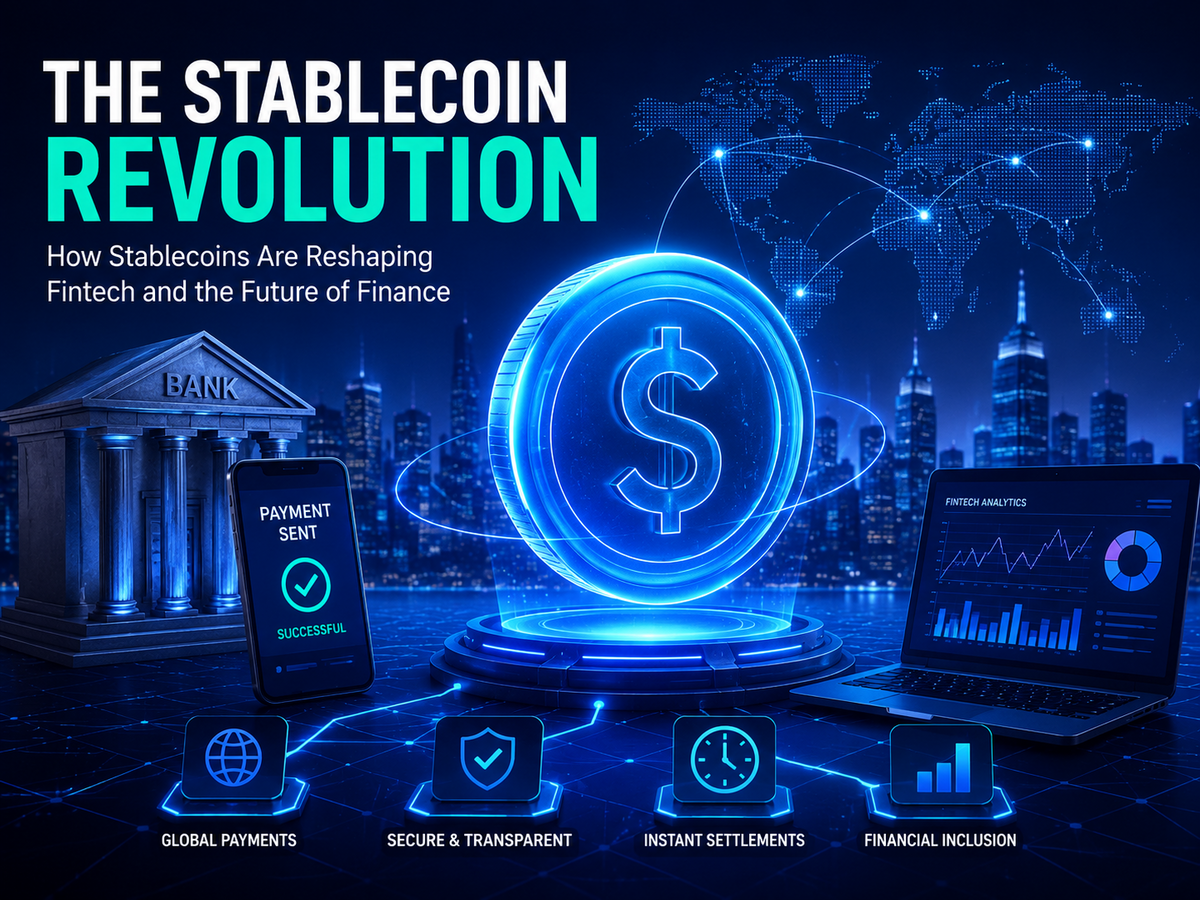
For years, fintech innovation has been associated with digital wallets, instant payments, and AI-powered financial assistants. But beneath the surface, a much larger transformation is unfolding, one that could redefine how money moves across the global economy.
Stablecoins, once viewed as niche cryptocurrency assets, are steadily entering mainstream finance. Regulators are accelerating policy discussions, financial institutions are testing blockchain-powered settlement systems, and global payment providers are exploring tokenized money as a practical alternative to conventional banking rails.
Unlike previous crypto cycles driven by speculation, today's conversation revolves around infrastructure, efficiency, and trust. The biggest question is no longer whether stablecoins will survive. It is whether the existing financial system can evolve quickly enough to coexist with them.
As fintech enters its next chapter, stablecoins may become one of the most influential technologies shaping digital finance over the coming decade.
From Crypto Experiment to Financial Infrastructure
Only a few years ago, stablecoins were largely associated with cryptocurrency trading platforms. Their primary purpose was to provide digital assets that maintained a relatively stable value compared to volatile cryptocurrencies. Today, however, the narrative has shifted dramatically. Financial institutions increasingly view stablecoins as programmable money capable of reducing settlement delays, lowering transaction costs, and enabling near-instant international payments.
Unlike traditional cross-border transfers that often require multiple intermediaries and several business days to complete, blockchain-powered settlements can significantly reduce friction while improving transparency. This shift is attracting attention from banks, payment providers, enterprise technology companies, and regulators alike. Rather than replacing conventional banking systems overnight, stablecoins are gradually positioning themselves as complementary infrastructure that can enhance the way money moves around the world.
Regulation Is Becoming the Catalyst Instead of the Roadblock
Regulatory uncertainty has long been considered the biggest hurdle preventing institutional adoption of digital assets. That narrative is beginning to change. Across several major economies, governments and financial regulators are introducing clearer frameworks surrounding reserve-backed stablecoins, digital asset custody, and blockchain-based payment systems.
Rather than slowing innovation, these developments are encouraging established financial institutions to participate with greater confidence. Banks that once maintained a cautious distance from blockchain technology are now investing in research, pilot programs, and strategic partnerships focused on digital finance. For fintech companies, regulatory clarity creates a far more predictable environment for innovation while simultaneously strengthening public trust. In many ways, regulation is evolving from a barrier into the very foundation that could accelerate mainstream adoption.
Cross-Border Payments May Finally Be Entering a New Era
Despite rapid advances in digital banking, international payments remain surprisingly inefficient. Businesses still encounter multiple intermediaries, high processing costs, limited transaction visibility, and settlement periods that often stretch across several days.
Stablecoin-powered payment networks offer a compelling alternative by allowing transactions to settle almost instantly on blockchain infrastructure while operating around the clock. This capability is especially valuable for multinational companies, freelancers, international marketplaces, and supply chain businesses that increasingly depend on real-time financial operations. As global commerce continues expanding, improving payment efficiency has become one of the strongest practical use cases for blockchain technology within the fintech ecosystem.
Banks Are Choosing Collaboration Over Competition
Contrary to the assumption that traditional banks are resisting digital assets, many are actively exploring ways to integrate blockchain into their own operations. Financial institutions across the world are developing tokenized deposits, blockchain settlement platforms, and secure digital asset custody solutions designed specifically for enterprise customers.
Instead of viewing fintech startups solely as competitors, banks are increasingly forming partnerships that combine regulatory expertise with technological innovation. This collaborative approach reflects a significant evolution in financial services. The future may not belong exclusively to fintech disruptors or traditional banks, but rather to organizations capable of combining the strengths of both to build more efficient financial ecosystems.
Enterprise Finance Is Becoming More Intelligent
One of the most exciting opportunities presented by stablecoins extends well beyond payments. Programmable financial transactions allow businesses to automate recurring payments, supplier settlements, escrow services, treasury operations, and complex financial agreements using smart contracts.
By reducing manual intervention, organizations can improve operational efficiency while minimizing reconciliation challenges and administrative overhead. For enterprises managing thousands of financial transactions every day, automation offers measurable improvements in both speed and accuracy. As programmable finance continues to mature, fintech platforms are evolving beyond user-friendly applications into intelligent financial infrastructures capable of supporting increasingly sophisticated business operations.
The Road Ahead Still Comes with Challenges
Although momentum continues to grow, widespread adoption is not guaranteed. Several important challenges remain before stablecoins can become an everyday component of global finance. Questions surrounding cybersecurity, interoperability between blockchain networks, consumer protection, reserve transparency, regulatory consistency, and integration with existing banking infrastructure still require careful attention.
Technology alone cannot solve these issues. Financial institutions, regulators, and technology providers must work together to establish governance frameworks that balance innovation with stability. The success of stablecoins will depend not only on technological capability but also on the confidence they inspire among businesses, consumers, and policymakers.
Why This Story Matters Beyond Fintech
The implications of this transformation extend far beyond financial services. Industries such as healthcare, manufacturing, logistics, insurance, e-commerce, and international trade increasingly rely on faster, more transparent payment systems to support their global operations. As digital commerce becomes more interconnected, financial infrastructure itself is becoming a strategic business advantage rather than simply an operational necessity.
Organizations that understand these developments today may be better positioned to adapt to tomorrow's digital economy. Stablecoins are no longer just another fintech innovation—they represent a broader shift toward a financial system that prioritizes speed, transparency, accessibility, and automation.
Conclusion
The fintech industry has experienced numerous waves of innovation over the past decade, from mobile banking and digital wallets to AI-powered financial services. Yet few developments have generated as much long-term strategic interest as stablecoins are beginning to attract today.
Their significance lies not in replacing traditional banking but in modernizing the infrastructure that powers it. Faster settlements, programmable transactions, greater transparency, and increasingly mature regulatory frameworks are transforming stablecoins from speculative assets into practical financial tools capable of supporting global commerce.
Whether this transformation unfolds gradually or accelerates more rapidly remains uncertain. What is becoming increasingly clear, however, is that digital finance is entering a new era, one defined less by disruption for its own sake and more by meaningful improvements in efficiency, trust, and accessibility.
For business leaders, investors, financial institutions, and technology innovators, the most important fintech story may not be the next mobile application or digital wallet. It may be the quiet rebuilding of the financial rails beneath the global economy, one blockchain-powered transaction at a time.