

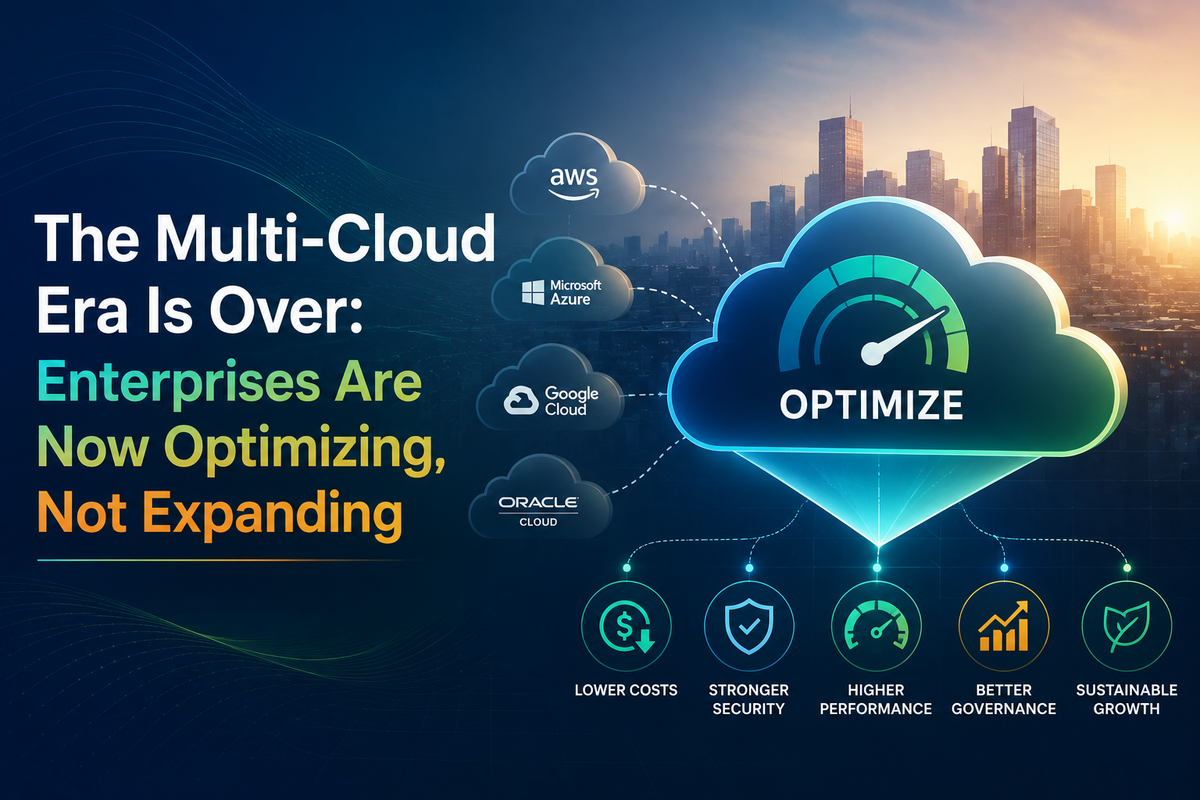
For years, adopting multiple cloud providers was seen as the hallmark of a modern enterprise IT strategy. Organizations embraced multi-cloud environments to avoid vendor lock-in, improve resilience, and gain access to specialized capabilities from different providers. Expansion was the priority, and adding another cloud platform often felt like the natural next step in digital transformation.
That mindset is changing.
Today, enterprise leaders are asking a different question: not "Which cloud should we add next?" but "How do we maximize the value of the cloud investments we already have?" As economic pressures, AI workloads, governance requirements, and sustainability initiatives reshape technology priorities, optimization has become the defining objective of cloud strategy.
Recent enterprise technology trends reflect this shift. Organizations are consolidating workloads, improving cloud governance, modernizing application architectures, and focusing on operational efficiency instead of simply increasing their cloud footprint. For B2B decision-makers, the competitive advantage no longer comes from having the largest cloud ecosystem, but rather from running the smartest one, an insight often highlighted in thought-leadership resources like a whitepaper lead generation campaign.
Cloud Complexity Has Reached a Tipping Point
The rapid expansion of cloud services over the past decade delivered tremendous flexibility, but it also introduced an unexpected level of operational complexity. Different security models, inconsistent identity policies, fragmented monitoring tools, duplicated data, and rising infrastructure costs have become common challenges across enterprise environments.
The acceleration of generative AI has only intensified these pressures. AI applications demand high-performance computing resources, massive datasets, and reliable infrastructure, making inefficient cloud architectures significantly more expensive to operate. Organizations that once viewed multi-cloud as a growth strategy are now discovering that unmanaged complexity can slow innovation rather than accelerate it.
This shift has become increasingly visible across the technology industry. Major cloud providers continue introducing tools focused on workload optimization, FinOps, unified security management, and AI infrastructure efficiency. Industry analysts are also observing a growing emphasis on cloud rationalization, where enterprises evaluate whether every application truly belongs across multiple cloud environments or whether consolidation can improve performance and reduce operational overhead.
Instead of expanding indiscriminately, technology leaders are building architectures that prioritize interoperability, automation, and governance. Success is increasingly measured by efficiency, resilience, and business outcomes rather than by the number of cloud platforms in use.
Optimization Is Becoming a Business Strategy
Cloud optimization is no longer limited to reducing infrastructure costs. It has evolved into a strategic business initiative that influences operational agility, cybersecurity, compliance, sustainability, and customer experience.
Organizations are investing in intelligent workload placement, ensuring applications run where they deliver the greatest value instead of simply distributing them across multiple providers. Business-critical workloads may remain in specialized cloud environments, while less demanding applications are consolidated into more cost-effective platforms.
Artificial intelligence is also changing how cloud environments are managed. Predictive analytics can identify underutilized resources, recommend infrastructure adjustments, and automate scaling decisions based on changing business demands. Instead of relying on manual capacity planning, enterprises increasingly use AI-driven insights to improve efficiency without compromising performance.
At the same time, governance has become central to cloud optimization. As regulations around data privacy, digital sovereignty, and cybersecurity continue to evolve globally, organizations require greater visibility into where data resides, how applications communicate, and who has access to critical resources using advanced cybersecurity tools. Optimization therefore extends beyond infrastructure to include security policies, identity management, compliance reporting, and operational consistency.
This broader perspective is particularly important as organizations support hybrid workforces, global operations, and AI-powered business processes that depend on trusted, connected cloud ecosystems.
The Future Belongs to Intelligent Cloud Operations
The next phase of cloud transformation will be defined less by expansion and more by intelligence. Enterprises are moving toward environments where automation continuously optimizes workloads, AI predicts infrastructure demands before problems occur, and security policies adapt dynamically as business conditions change.
Rather than treating cloud providers as isolated technology platforms, organizations are viewing them as interconnected components within a unified operating model. Observability platforms, centralized governance frameworks, and AI-powered operational tools are making it possible to manage increasingly complex environments without increasing administrative burden.
Sustainability is becoming another major influence on cloud strategy. Many organizations now evaluate cloud decisions not only by financial return but also by energy efficiency and environmental impact. Optimized workloads consume fewer computing resources, reduce unnecessary processing, and contribute to broader corporate sustainability objectives. This makes optimization beneficial for both operational performance and long-term business responsibility.
Cloud optimization also strengthens business resilience. Enterprises that fully understand workload dependencies, automate recovery processes, and continuously monitor infrastructure health can respond more effectively to unexpected disruptions. In an environment where cyber threats, regulatory changes, and shifting market conditions remain constant, operational agility has become just as valuable as scalability.
For B2B decision-makers, this evolution represents a significant strategic opportunity. The organizations that will lead the next generation of digital transformation are unlikely to be those with the most cloud platforms. Instead, they will be the ones that have the greatest visibility into their technology environments, the strongest governance practices, and the ability to continuously optimize infrastructure in response to changing business needs.
The multi-cloud era is not disappearing. Enterprises will continue to leverage multiple cloud providers where doing so creates genuine business value. What is changing is the underlying philosophy. Expansion for its own sake is giving way to purposeful optimization.
In the years ahead, cloud success will be measured less by how many platforms an organization operates and more by how intelligently those platforms work together. Enterprises that embrace optimization as a continuous business capability, not simply an IT initiative, will be better positioned to control costs, accelerate innovation, strengthen security, and build resilient digital foundations for an AI-driven future.