

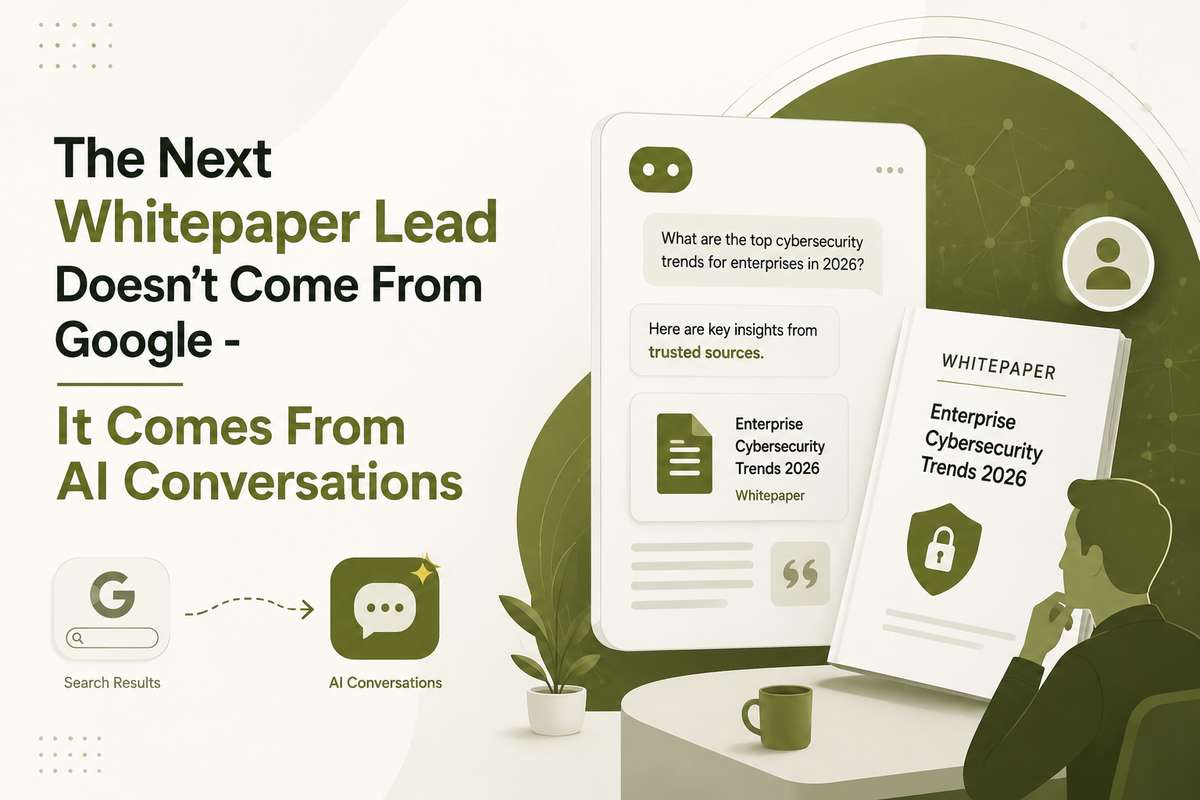
For years, Google has been the starting point for B2B buyers researching solutions, comparing vendors, and discovering valuable content. White papers, in particular, have relied heavily on search visibility, SEO, and gated landing pages to attract qualified leads. But that journey is changing faster than many organizations expected.
Today, enterprise buyers are increasingly turning to AI assistants such as ChatGPT, Microsoft Copilot, Google Gemini, and Perplexity to answer complex business questions before they ever open a traditional search engine. Instead of scrolling through pages of links, decision-makers are asking conversational questions and receiving synthesized answers supported by multiple trusted sources. This shift is redefining how prospects discover thought leadership, making whitepaper lead generation less dependent on ranking in search results and more dependent on becoming part of AI-powered conversations.
The change is not simply another marketing trend. It reflects a broader transformation in how professionals consume information, evaluate vendors, and make purchasing decisions. Organizations that recognize this evolution early have an opportunity to reach buyers before competitors even appear on the shortlist.
AI Conversations Are Rewriting the B2B Research Journey
The traditional B2B buying journey has always involved multiple searches, dozens of web pages, analyst reports, customer reviews, and downloadable resources. While that process still exists, AI is compressing much of the initial research into a single conversation.
Instead of searching "best cloud security solutions" or "enterprise compliance platforms," buyers are now asking AI assistants to compare vendors, summarize industry trends, explain regulations, or recommend resources that support strategic decisions. AI then presents concise answers, often referencing authoritative reports, research papers, trusted publishers, and expert content.
Recent developments across major AI platforms reinforce this direction. Google's AI-powered search experiences continue expanding conversational responses, Microsoft is embedding Copilot deeper into workplace productivity, and enterprise AI assistants are becoming common tools inside organizations. Together, these innovations are changing where business research begins.
For marketers, this creates an important realization. The first interaction with a potential buyer may no longer happen through a search result or company website. Instead, it may occur when an AI assistant references your insights while answering a business question.
That evolution makes credibility, expertise, and discoverability increasingly important for organizations investing in whitepaper lead generation.
Why Authority Matters More Than Rankings
Traditional SEO focused heavily on keywords, backlinks, and search rankings. While those fundamentals still contribute to online visibility, AI assistants evaluate information differently. They prioritize trustworthy sources, well-structured content, factual accuracy, and signals of expertise when generating responses.
This means that publishing another keyword-heavy whitepaper is no longer enough. Modern white papers must provide original perspectives, reliable data, industry analysis, and actionable insights that AI systems can confidently reference when answering user queries.
The growing importance of Generative Engine Optimization (GEO) reflects this change. Rather than optimizing solely for search engine rankings, organizations are beginning to optimize content for AI retrieval, citation, and summarization. Clear structure, meaningful headings, authoritative statistics, and comprehensive explanations increase the likelihood that AI platforms will surface relevant content during conversations.
At the same time, content distribution is becoming just as valuable as content creation. Whitepapers published across trusted industry platforms, media publications, research libraries, and syndication networks establish broader digital authority. When AI systems encounter consistent expertise across multiple reputable sources, the visibility of that content naturally improves.
This shift encourages marketers to think beyond downloads. Instead of measuring success only by form submissions, forward-looking organizations are evaluating how frequently their research contributes to industry discussions, influences AI-generated answers, and builds long-term trust with prospective buyers.
Whitepaper Lead Generation Is Becoming an AI Visibility Strategy
The next generation of whitepaper lead generation will be driven by visibility across AI ecosystems rather than visibility on a single search results page.
That does not mean websites, SEO, or landing pages are becoming obsolete. Instead, they are becoming one part of a much broader discovery ecosystem where AI assistants, content syndication, knowledge graphs, publisher authority, and enterprise research platforms all influence buyer decisions.
This evolution also changes how organizations should approach content creation for whitepaper lead generation. Rather than producing promotional assets designed primarily to generate downloads, successful brands are investing in educational research that answers meaningful industry questions. Original data, executive insights, market analysis, regulatory updates, and practical frameworks are more likely to earn citations, recommendations, and trust.
Content syndication is playing an increasingly important role in this environment. By extending the reach of white papers through reputable industry publications and specialized B2B platforms, businesses improve both human visibility and AI discoverability. Every credible publication expands the digital footprint of a white paper, increasing the opportunities for AI assistants to identify and reference authoritative information.
As enterprise buying committees continue relying on AI for early-stage research, marketers will need to measure success differently. Influence, visibility, engagement quality, and AI citations will become valuable indicators alongside traditional lead generation metrics.
Ultimately, the future belongs to organizations that create research worth discussing, not simply downloading. Buyers are no longer beginning every journey with a search engine. They are beginning with conversations, and AI is increasingly guiding those conversations.
For B2B decision-makers, this represents more than a technological shift. It is an opportunity to rethink how expertise is shared, how authority is established, and how valuable insights reach the right audience. In a world where AI is becoming the first point of contact, the most successful white papers will not merely rank well they will become trusted sources that AI confidently brings into every relevant conversation.