
CYVXAI OS: Hyper-Intelligent Autonomous Operating System
Published on 19 May 2026
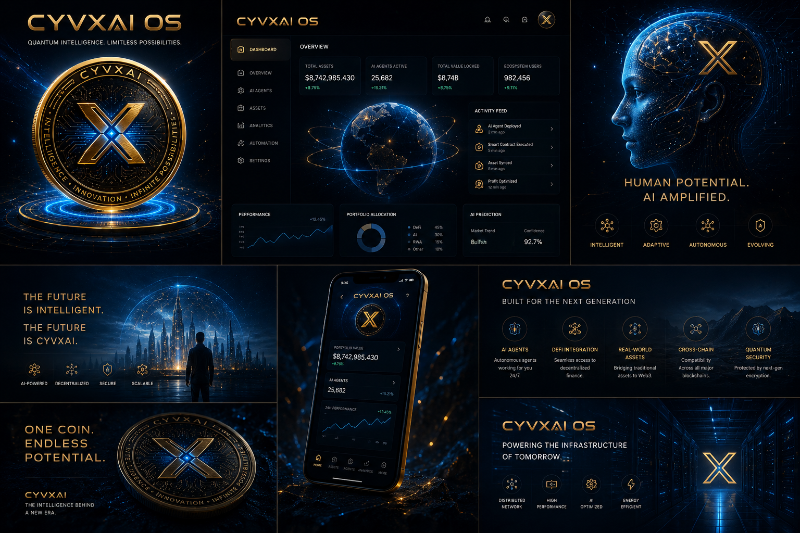
CYVXAI OS is designed as a self-evolving cognitive infrastructure where compute, intelligence, and automation converge into a unified autonomous system. Its core principle is that systems should think, adapt, and self-optimize without human intervention.
The whitepaper explores:
- System Architecture: Discover the layered architecture comprising the Kernel, Agent Mesh, Compute Fabric, Cognitive Memory Layer, and Interface Layer, enabling distributed reasoning across autonomous agents operating in parallel compute environments.
- CYVX Kernel: Explore the system-level kernel responsible for scheduling, predictive task allocation, memory abstraction, and system optimization using probabilistic forecasting.
- AI Agent Mesh: Understand the swarm intelligence layer of autonomous agents capable of reasoning, planning, tool execution, and inter-agent communication.
- Distributed Compute Fabric: Examine the elastic infrastructure inspired by Kubernetes and enhanced with AI-driven workload balancing and predictive scaling.
- Cognitive Memory Layer: Explore how raw data is transformed into semantic knowledge graphs to support contextual reasoning and long-term intelligence.
- Security Model: Learn about the proposed zero-trust AI security model, including behavioral anomaly detection and continuous identity validation across agents.
- Self-Optimization Loop: Understand the feedback-driven evolution loop through which system performance is continuously analyzed and improved by internal agents.
- Use Cases: Explore applications across enterprise automation, autonomous cloud operations, robotics control systems, financial intelligence systems, and AI-driven DevOps.
- Roadmap: Follow the four proposed development phases, from Core OS and Distributed Intelligence Mesh to Autonomous Infrastructure and a Self-Evolving AGI-Aligned OS Layer.
Download the full whitepaper to explore the CYVXAI OS architecture, autonomous agent mesh, distributed compute fabric, cognitive memory, security model, self-optimization framework, use cases, and development roadmap.