

Introduction
The financial industry is experiencing one of the most significant transformations in modern history.
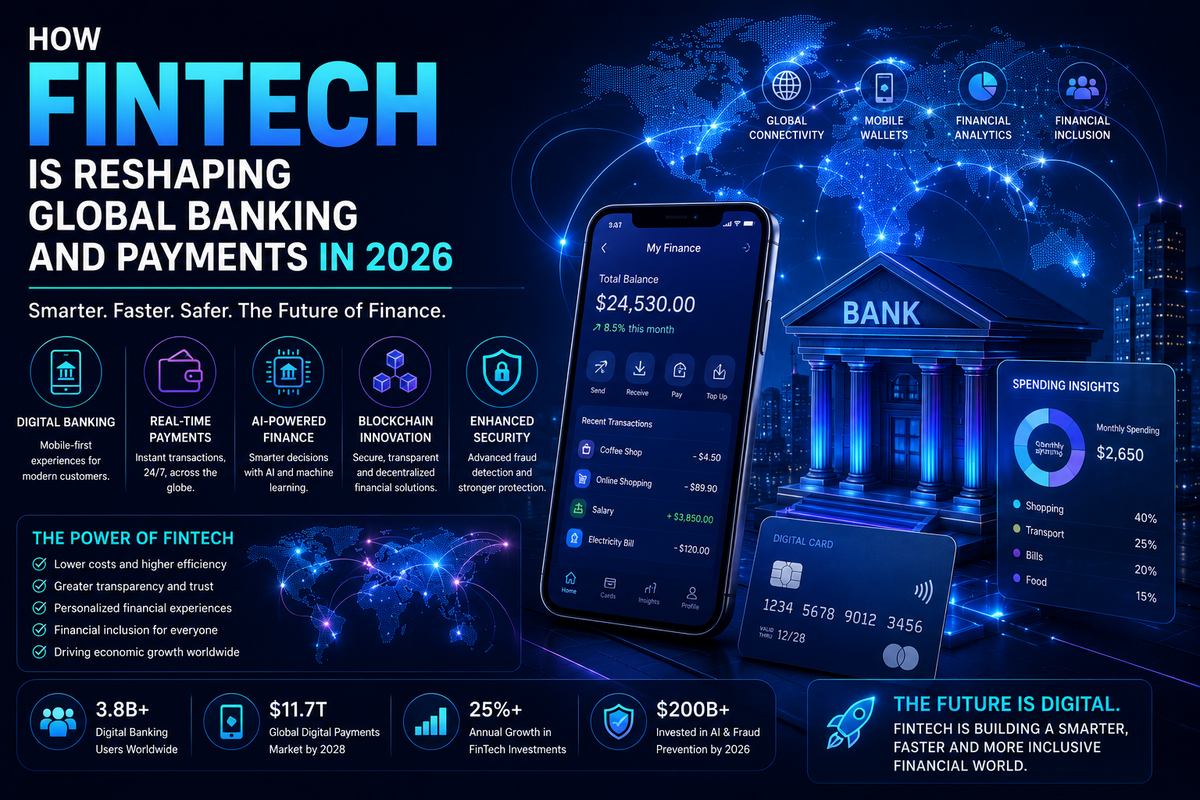
Driven by artificial intelligence, digital banking, blockchain technology, embedded finance, and real-time payments, FinTech is fundamentally changing how consumers and businesses interact with money in 2026.
Traditional banking models are rapidly evolving as financial technology companies introduce faster, smarter, and more personalized financial services. Consumers no longer expect banking to happen only inside physical branches or during business hours.
They expect:
- Instant transactions
- Mobile-first experiences
- AI-powered financial insights
- Seamless digital payments
- Automated financial management
- Secure online banking
As a result, banks, startups, and technology companies worldwide are investing heavily in FinTech innovation to remain competitive in an increasingly digital economy.
This blog explores how FinTech is reshaping banking and payments globally in 2026 and why digital finance is becoming central to the future of the global economy.
What is FinTech?
FinTech, short for Financial Technology, refers to technology-driven innovations designed to improve and automate financial services.
FinTech solutions include:
- Digital banking
- Mobile payment systems
- Cryptocurrency platforms
- AI-powered investing
- Peer-to-peer lending
- Buy Now Pay Later (BNPL)
- Embedded finance
- Fraud detection systems
- Digital wallets
- Automated financial planning
The goal of FinTech is to make financial services faster, more accessible, secure, and user-friendly.
Why FinTech is Growing Rapidly in 2026
Several factors are driving rapid FinTech adoption worldwide.
1. Rising Demand for Digital Banking
Consumers increasingly prefer mobile-first financial experiences over traditional branch banking.
Digital banking apps now allow users to:
- Open accounts instantly
- Transfer funds globally
- Apply for loans online
- Monitor spending in real time
- Invest digitally
- Access AI-driven financial insights
Convenience has become a major competitive advantage.
2. Growth of Cashless Economies
Countries worldwide are accelerating the transition toward cashless payment ecosystems.
Digital wallets, QR-code payments, contactless cards, and instant bank transfers are becoming the standard for both consumers and businesses.
Real-time payment systems are significantly reducing transaction delays and improving customer experiences.
3. AI is Revolutionizing Financial Services
Artificial intelligence is transforming how financial institutions operate.
AI-powered systems now support:
- Fraud detection
- Credit scoring
- Customer service chatbots
- Risk management
- Personalized investment recommendations
- Automated compliance monitoring
Banks are using AI to improve both operational efficiency and customer experiences.
4. Embedded Finance is Expanding
Embedded finance is becoming one of the biggest FinTech trends in 2026.
Non-financial platforms now integrate financial services directly into their ecosystems.
Examples include:
- E-commerce platforms offering loans
- Ride-sharing apps providing digital wallets
- SaaS companies integrating payment systems
- Retail platforms offering Buy Now Pay Later options
This allows businesses to create smoother customer experiences while opening new revenue streams.
Key FinTech Trends Transforming Banking in 2026
1. Real-Time Payments are Becoming Standard
Consumers and businesses increasingly expect instant transactions.
Modern payment infrastructure now enables:
- Instant bank transfers
- Cross-border payments
- Real-time settlements
- 24/7 payment processing
This is reducing reliance on traditional slow banking systems.
2. Digital Wallet Adoption is Surging
Mobile wallets are becoming central to digital commerce.
Consumers now use digital wallets for:
- Online shopping
- Contactless retail payments
- Travel bookings
- Utility payments
- Peer-to-peer transfers
The convenience and speed of digital wallets are driving widespread adoption globally.
3. Blockchain and Digital Assets Continue Evolving
Blockchain technology continues to influence financial innovation.
Financial institutions are exploring:
- Tokenized assets
- Central Bank Digital Currencies (CBDCs)
- Blockchain-powered settlements
- Smart contracts
- Decentralized finance infrastructure
While regulations continue evolving, blockchain remains a major area of FinTech development.
4. Open Banking is Expanding Competition
Open banking frameworks allow third-party providers to securely access banking data with customer consent.
This encourages:
- Greater innovation
- Personalized financial services
- Improved customer experiences
- Increased competition among financial providers
Consumers benefit from more flexible and integrated financial ecosystems.
5. Cybersecurity is Becoming Critical
As digital financial services grow, cybersecurity risks are also increasing.
Financial institutions are investing heavily in:
- AI-powered fraud detection
- Multi-factor authentication
- Behavioral analytics
- Biometric verification
- Zero-trust security models
Protecting customer data and transaction security is now a top industry priority.
Benefits of FinTech for Businesses and Consumers
Faster Transactions
Digital payment systems significantly reduce transaction processing times.
Better Customer Experience
Personalized digital experiences improve convenience and accessibility.
Lower Operational Costs
Automation helps financial institutions reduce administrative expenses.
Greater Financial Inclusion
Digital banking services are helping underserved populations access financial tools globally.
Enhanced Data Insights
AI and analytics provide deeper visibility into financial behavior and risk management.
Challenges Facing the FinTech Industry
Despite rapid growth, FinTech companies face several challenges.
Regulatory Complexity
Financial regulations vary significantly across regions and continue evolving rapidly.
Cybersecurity Threats
Digital financial systems remain attractive targets for cybercriminals.
Data Privacy Concerns
Protecting sensitive financial data is becoming increasingly important.
Competition Pressure
The market is becoming highly competitive as traditional banks and startups compete aggressively.
The Future of FinTech
The future of FinTech will likely focus on deeper automation, intelligent financial ecosystems, and hyper-personalized banking experiences.
Emerging innovations may include:
- AI financial assistants
- Autonomous investing platforms
- Fully digital banks
- Voice-driven banking
- Biometric payment authentication
- AI-powered wealth management
- Advanced fraud prevention systems
Financial institutions that embrace innovation early will be better positioned to succeed in the next phase of digital banking evolution.
Conclusion
FinTech is fundamentally reshaping global banking and payments in 2026.
From AI-powered financial services and real-time payments to digital wallets and embedded finance, technology is transforming how money moves across the world.
As consumer expectations evolve and digital finance becomes increasingly mainstream, financial institutions must continue innovating to remain competitive.
The future of banking is no longer just digital.
It is intelligent, automated, connected, and built around seamless customer experiences.