

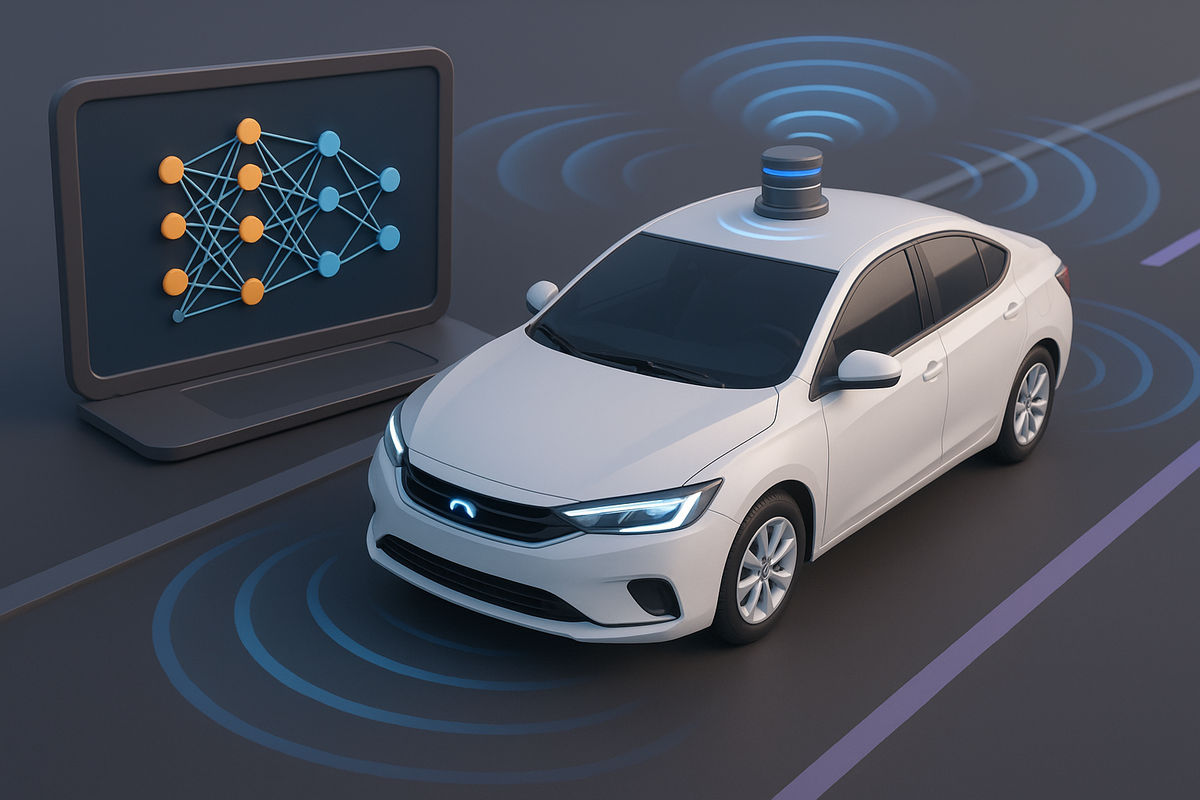
Autonomous vehicles are no longer a futuristic idea. They are rapidly becoming a reality thanks to major breakthroughs in artificial intelligence and machine learning. From lane detection and object recognition to predictive decision-making and real-time navigation, machine learning has become the core engine behind modern self-driving technology.
As automakers, tech companies, and mobility startups race toward fully autonomous vehicles, machine learning continues to shape how self-driving cars learn, adapt, and make safe decisions on the road. This article explores how machine learning works in autonomous vehicles, the models powering the technology, and why it represents the next frontier in automotive innovation.
What Machine Learning Means in the Context of Self-Driving Cars
Machine learning enables a vehicle to learn from data, identify patterns, and make decisions without being explicitly programmed for every possible situation. Self-driving cars must understand complex environments, interpret unpredictable human behavior, and respond in real time. Traditional software cannot handle this complexity, which is why machine learning becomes essential.
A self-driving car equipped with machine learning can:
-
Detect objects such as pedestrians, vehicles, and traffic signs
-
Predict behavior on the road
-
Plan the safest path
-
Adapt to new driving environments
-
Improve performance with every mile driven
Machine learning models continuously process large datasets collected from sensors, cameras, LiDAR, radar, and GPS. The more data they receive, the better these systems become at driving autonomously.
Key Machine Learning Techniques Used in Autonomous Vehicles
Self-driving technology uses several types of machine learning models to understand and navigate the world.
1. Computer Vision
Computer vision allows cars to interpret visual information from cameras. Machine learning models identify road markings, detect obstacles, read traffic signs, and recognize traffic lights.
Techniques used include:
-
Convolutional Neural Networks (CNNs)
-
Semantic segmentation
-
Image classification
-
Object detection models such as YOLO and Faster R CNN
Without computer vision, self-driving cars would not be able to understand the road.
2. Deep Learning for Sensor Fusion
Self-driving cars gather data from multiple sensors. Deep learning models merge this data to create an accurate, 360 degree view of the surroundings.
Sensor fusion combines:
-
Camera input
-
Radar reflections
-
LiDAR scans
-
Ultrasonic sensor readings
This results in precise distance estimation, smoother navigation, and safer obstacle detection.
3. Reinforcement Learning for Decision Making
Reinforcement learning enables vehicles to learn the best driving behavior through trial and error. The system receives rewards for correct decisions and penalties for incorrect ones.
Examples of decisions learned through reinforcement learning:
-
When to slow down
-
How to take sharp turns
-
How to merge into traffic
-
How to respond at intersections
Over time, the vehicle becomes better at driving autonomously.
4. Predictive Machine Learning Models
Predictive algorithms help self-driving cars understand what may happen next.
These models can forecast:
-
When a pedestrian might cross the road
-
When a nearby vehicle may change lanes
-
Traffic flow patterns
-
Weather-related risks
Predictive analytics ensures safer and more defensive driving.
5. Natural Language Processing (NLP)
Some autonomous cars integrate voice assistants that help passengers interact with the vehicle. NLP models interpret voice instructions such as:
-
Take me to the nearest charging station
-
Avoid highways
-
Find a parking spot
This improves convenience and enhances the user experience.
How Self-Driving Cars Use Machine Learning in Real Time
Machine learning powers the entire autonomous driving pipeline from perception to navigation.
1. Perception Layer
Self-driving cars process raw sensor data to understand their environment. Machine learning models detect:
-
Road boundaries
-
Curbs
-
Pedestrians
-
Cyclists
-
Obstacles
-
Traffic signals
Accurate perception is the foundation of safe navigation.
2. Localization and Mapping
Machine learning helps autonomous vehicles know their exact position on the road.
Techniques include:
-
Simultaneous Localization and Mapping (SLAM)
-
3D mapping
-
GPS correction models
These models allow the car to maintain precise lane-level accuracy.
3. Path Planning
Once the environment is understood, machine learning models determine the best route.
Path planning includes:
-
Lane changes
-
Turns and merges
-
Speed adjustments
-
Avoiding obstacles
The goal is to drive efficiently while ensuring maximum safety.
4. Control and Execution
Machine learning ensures smooth and safe execution of driving commands.
This includes:
-
Steering
-
Braking
-
Accelerating
-
Maintaining distance
These actions must occur within milliseconds to prevent accidents.
Real-World Applications of Machine Learning in Self-Driving Cars
Companies like Tesla, Waymo, Cruise, and Mercedes Benz are actively using machine learning in their autonomous systems.
Tesla Autopilot and FSD
Uses deep learning and vision based models trained on billions of real-world miles.
Waymo Driver
Relies heavily on LiDAR, deep learning, and reinforcement learning for robotic taxi fleets.
Cruise Origin
Uses AI powered sensor fusion for urban navigation.
Mercedes Drive Pilot
Integrates machine learning for conditional Level 3 autonomy on highways.
These companies continuously gather data to improve safety, making autonomous driving more reliable each year.
Benefits of Machine Learning in Autonomous Vehicles
Machine learning unlocks significant advantages for the automotive industry.
1. Safer Roads
ML systems react faster than humans and reduce accidents caused by distraction or fatigue.
2. Better Traffic Flow
Predictive driving smooths congestion and minimizes roadblocks.
3. Improved Fuel and Energy Efficiency
Smart routing and smoother acceleration reduce fuel consumption and battery drain.
4. Reduced Human Error
Driver mistakes are minimized, improving overall road safety.
5. Scalability and Continuous Learning
The more data the system processes, the better and smarter it becomes.
Challenges and Limitations
Despite significant progress, self-driving cars face challenges.
Technical challenges
-
Complex city environments
-
Poor visibility conditions
-
Unpredictable human drivers
Ethical concerns
-
Decision-making in unavoidable collision scenarios
Regulatory restrictions
-
Different countries have different laws
Data requirements
-
Autonomous systems need enormous amounts of data for training
However, ongoing innovation continues to reduce these barriers.
The Future of Machine Learning in Self-Driving Cars
Over the next decade, machine learning will support:
-
Fully autonomous Level 5 vehicles
-
Smarter vehicle to vehicle communication
-
AI driven traffic systems
-
Autonomous public transport
-
Data sharing across fleets for faster learning
Self-driving cars will become safer, more reliable, and more energy efficient as machine learning models mature.