

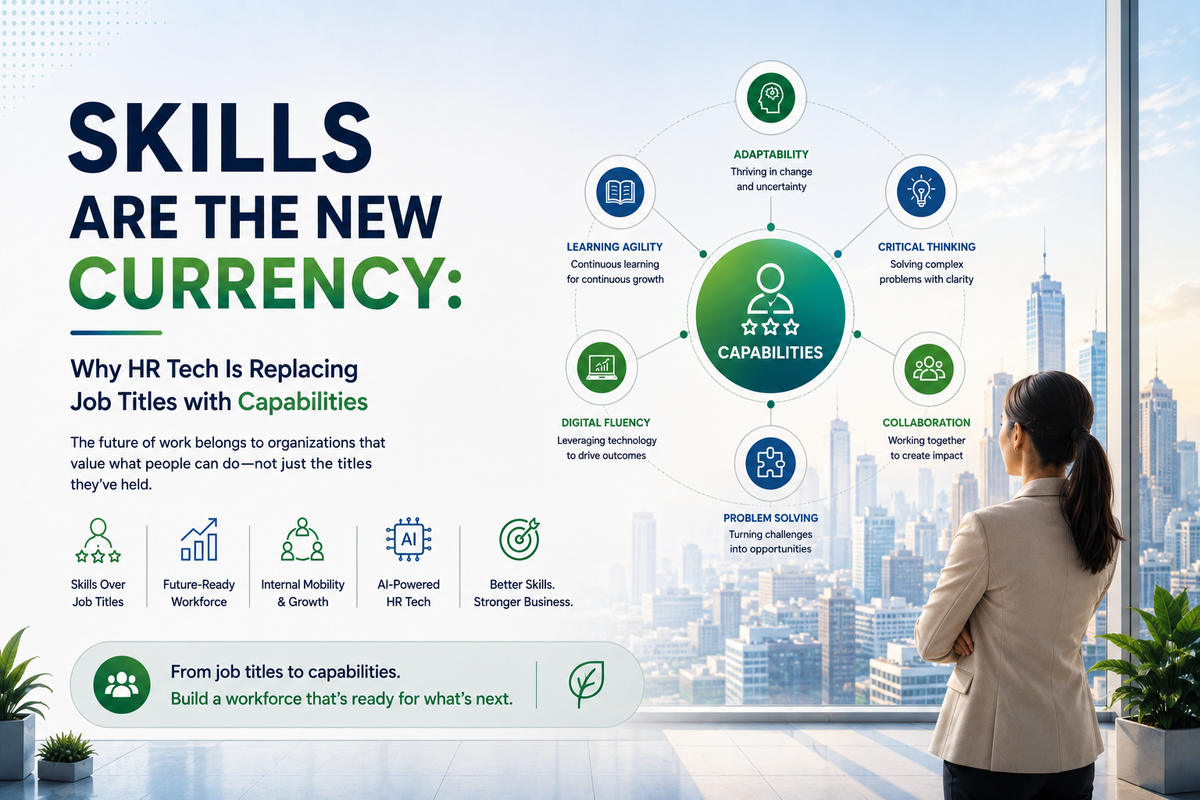
For decades, hiring revolved around a simple formula: define a job title, list the required qualifications, and recruit candidates who matched the description. It was a system built for stability, where career paths were predictable and business needs evolved gradually. Today, that model is rapidly becoming outdated.
Artificial intelligence, automation, digital transformation, and shifting workforce expectations are forcing organizations to rethink how they identify, develop, and retain talent. Instead of asking whether a candidate has held a particular role, business leaders are increasingly asking a more important question: What capabilities can this person bring to the organization?
This shift is redefining the purpose of HR technology. Modern HR platforms are no longer just repositories for employee records or recruitment workflows. They are becoming intelligent workforce platforms designed to understand skills, predict capability gaps, recommend career paths, and align talent with future business priorities. For B2B organizations navigating constant change, capabilities are becoming a more valuable asset than job titles.
Why HR Tech Is Driving the Shift to Skills-Based Organizations
The momentum behind skills-based organizations has accelerated significantly over the past year. Across industries, enterprises are investing in AI-powered talent intelligence platforms that map employee capabilities instead of relying solely on resumes or traditional job descriptions. HR leaders are recognizing that static roles cannot keep pace with rapidly evolving technologies, especially as AI reshapes almost every business function. Industry analysts continue to identify skills-based hiring, workforce intelligence, and AI-driven talent management as defining HR technology trends.
Recent hiring data further reinforces this transition. Organizations increasingly value adaptability, curiosity, critical thinking, and interdisciplinary knowledge alongside technical expertise. A recent survey found that nearly seven in ten HR professionals now prioritize broader capabilities over narrowly specialized educational backgrounds when evaluating early-career talent.
This evolution reflects a larger business reality. Technology changes faster than organizational structures. New AI tools emerge every month, new business models reshape industries, and customer expectations continue to evolve. Hiring exclusively for predefined job titles limits organizational agility. Hiring for transferable capabilities creates a workforce that can continuously adapt.
Artificial intelligence is making this transition possible. Rather than manually reviewing resumes, modern HR tech platforms analyze thousands of data points to identify skills across internal employees and external candidates. They recommend learning opportunities, suggest career mobility paths, identify adjacent capabilities, and help managers assemble project teams based on expertise rather than organizational hierarchy. HR is moving beyond talent acquisition to workforce intelligence.
This capability-first approach is also transforming internal mobility. Instead of replacing employees whenever new business needs arise, organizations are increasingly identifying existing talent that can be reskilled or redeployed. AI-powered skills mapping allows businesses to uncover hidden expertise across departments, reducing recruitment costs while improving employee retention. At a time when specialized talent remains difficult to find, internal capability development is becoming a significant competitive advantage.
Another important trend is the growing integration of HR technology with business planning. Workforce decisions are no longer made independently from operational strategy. HR leaders now collaborate closely with finance, operations, and technology teams to forecast future capability requirements based on business objectives. This enables organizations to prepare for emerging technologies before skill shortages become business constraints.
Beyond Job Titles: Building Capability-Driven Workforces
The rise of generative AI has accelerated this transformation even further. Organizations are discovering that while AI can automate repetitive tasks, it cannot replace human judgment, collaboration, creativity, and strategic thinking. Instead of eliminating jobs, AI is changing the nature of work itself. HR technology is increasingly focused on identifying uniquely human capabilities that complement intelligent automation rather than compete with it. Recent research shows that most HR leaders expect AI to create entirely new roles while increasing demand for adaptability, problem-solving, and continuous learning.
This explains why job descriptions themselves are beginning to evolve. Rather than emphasizing years of experience or rigid qualifications, many organizations now describe outcomes, competencies, and capability expectations. Skills are becoming dynamic rather than fixed. Employees are encouraged to continuously build new expertise through personalized learning pathways powered by AI recommendations.
The impact extends beyond recruitment. Performance management is increasingly measuring capability development instead of annual role-based objectives. Learning platforms are recommending personalized development journeys based on emerging business needs. Succession planning is shifting from identifying replacement candidates for individual positions to building future leadership capabilities across the organization.
Global Capability Centers (GCCs) provide another clear example of this shift. Despite fluctuations in broader hiring markets, organizations continue expanding AI-focused hiring because future competitiveness depends on building specialized capabilities rather than simply filling vacancies. Recent workforce reports indicate that AI skills now account for a significant share of new hiring across India's GCC ecosystem, reflecting the growing emphasis on capability-driven talent strategies.
Technology vendors are responding quickly. The latest generation of HR tech solutions combines skills intelligence, people analytics, workforce planning, AI agents, internal talent marketplaces, and predictive analytics into unified platforms. Instead of managing employees through organizational charts, businesses are increasingly managing dynamic networks of capabilities that evolve alongside changing market demands.
For B2B decision-makers, this transformation extends far beyond HR. Every digital transformation initiative, AI deployment, cybersecurity investment, or business expansion ultimately depends on workforce capabilities. Organizations that understand their skills landscape can adapt faster, innovate more confidently, and respond more effectively to market disruption than competitors still organized around static job titles.
The future of work will not be defined by the positions employees hold but by the capabilities they continuously develop. HR technology is enabling that future by shifting attention from credentials to competencies, from organizational hierarchy to workforce intelligence, and from hiring for today's vacancies to building tomorrow's business capabilities.
In the years ahead, competitive advantage will belong to organizations that see talent as an evolving portfolio of skills rather than a collection of job descriptions. As AI continues to reshape industries, skills will become the most valuable currency in the enterprise, and HR technology will be the platform that helps organizations invest, measure, and grow that currency.