

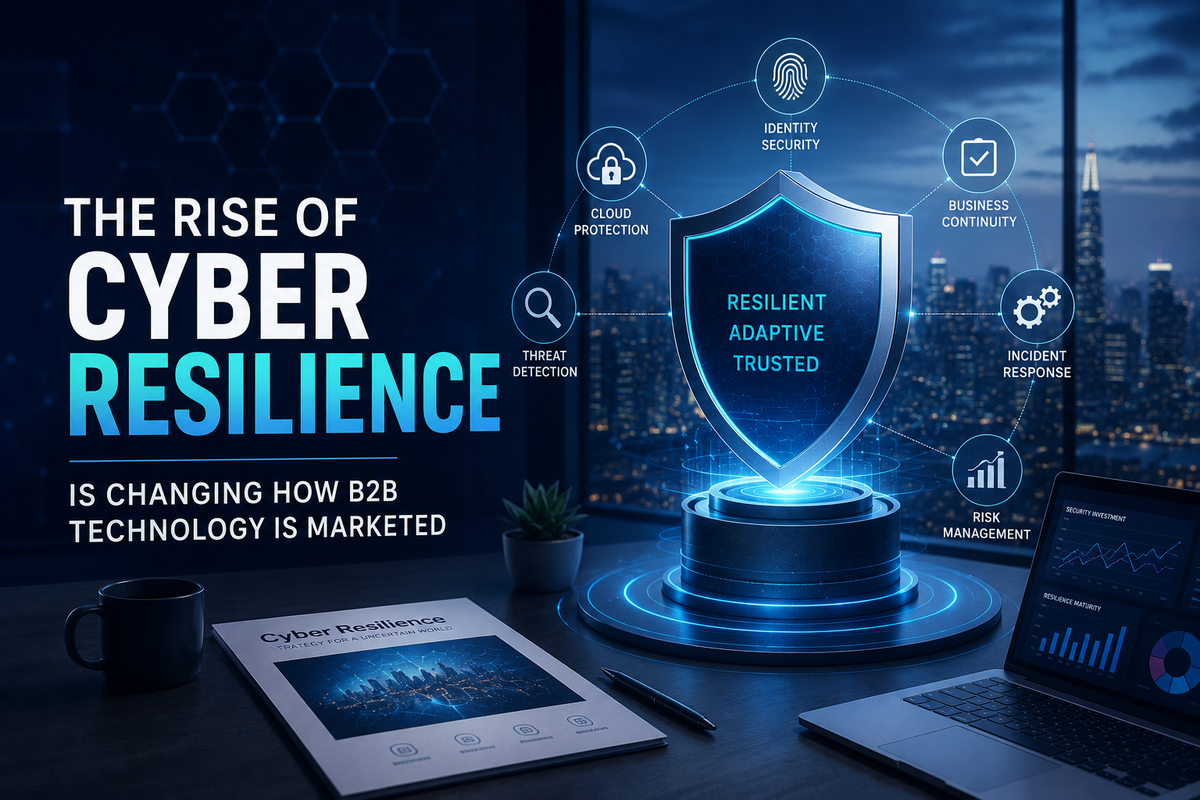
For years, cybersecurity conversations in B2B technology centered around prevention. Organizations invested heavily in firewalls, endpoint protection, identity management, and network security with the expectation that strong defenses could keep threats out entirely. That mindset is changing. Today, enterprises recognize that cyberattacks are not a matter of if but when. As a result, cyber resilience has emerged as one of the defining priorities for modern businesses, shifting the focus from simply preventing attacks to ensuring organizations can withstand, recover from, and continue operating during cyber incidents.
This evolution is influencing far more than IT strategies. It is reshaping how technology companies communicate with buyers, position their solutions, and build trust in increasingly complex purchasing environments. At the same time, regulatory developments, supply chain attacks, and growing board-level involvement in cybersecurity decisions are changing what enterprise buyers expect from technology vendors.
For B2B marketers, the implications are significant. Marketing cybersecurity solutions is no longer about promoting product features or technical capabilities alone. Buyers are looking for confidence, education, transparency, and evidence that vendors understand today's risk landscape.
Cyber Resilience Is Becoming a Business Conversation
Recent global cybersecurity incidents have reinforced a simple reality: operational continuity has become just as important as threat prevention. Governments across North America, Europe, and Asia continue introducing stronger cyber resilience frameworks, while organizations are expanding investments in incident response, disaster recovery, cloud security, and business continuity planning.
The increasing adoption of regulations such as the European Union's Digital Operational Resilience Act (DORA) and continued emphasis on software supply chain security demonstrate how cybersecurity has become an executive and boardroom priority rather than a purely technical responsibility. Enterprises are asking broader questions about resilience, vendor accountability, compliance readiness, and long-term operational stability.
This shift has transformed the buyer journey. Technology leaders no longer evaluate cybersecurity vendors based only on product specifications. They want to understand implementation strategies, industry expertise, recovery capabilities, customer success stories, and measurable business outcomes.
Consequently, educational content is becoming one of the most influential assets throughout the purchasing process.
Buyers Want Knowledge Before They Want a Product Demo
Enterprise technology purchases rarely happen after a single interaction. Decision-makers spend weeks or even months researching emerging threats, comparing vendors, reviewing analyst reports, and seeking validation from trusted industry sources before engaging with sales teams.
This behavior has accelerated as cyber risks become more sophisticated. Buyers are searching for practical guidance that explains evolving regulations, emerging attack vectors, resilience strategies, cloud security architectures, and real-world implementation experiences.
Traditional advertising alone cannot satisfy these information needs. Organizations that consistently publish research-driven content, technical whitepapers, expert opinions, and independent industry analysis are better positioned to establish credibility long before purchasing conversations begin.
This is where whitepaper syndication has become increasingly valuable. Rather than relying solely on owned channels or organic website traffic, businesses can distribute educational resources across trusted technology publications, professional communities, industry newsletters, and specialized content networks. This allows valuable insights to reach security professionals and enterprise decision-makers while they are actively researching solutions, creating multiple opportunities to influence buying decisions before vendor evaluations formally begin.
As enterprise buying journeys become longer and more distributed, the ability to place authoritative content in front of the right audience at the right stage has become a meaningful competitive advantage.
Trust Is Becoming the Strongest Marketing Asset
The cybersecurity industry has become increasingly crowded. New startups emerge every year while established vendors continue expanding their portfolios through acquisitions and platform consolidation. At the same time, buyers face growing uncertainty as threat landscapes evolve almost daily.
In this environment, trust has become one of the most valuable differentiators.
Recent industry trends show that buyers are placing greater importance on transparency around security practices, responsible vulnerability disclosure, independent certifications, customer education, and ongoing communication. Marketing teams are responding by investing less in product-centric messaging and more in thought leadership that helps customers navigate uncertainty.
Rather than leading with technical specifications, successful campaigns increasingly begin by addressing business challenges. Topics such as ransomware preparedness, cyber resilience planning, AI governance, third-party risk management, identity security, and regulatory compliance resonate because they reflect the conversations already taking place inside enterprise organizations.
This approach positions vendors as strategic partners instead of software providers.
Technology companies are also recognizing that educational content performs best when supported by strong distribution strategies. Publishing valuable research is only the first step. Ensuring that decision-makers actually discover and engage with that content has become equally important. Whitepaper syndication, executive interviews, virtual events, research partnerships, and industry publications all contribute to extending the reach of high-value content beyond company websites.
The objective is no longer to generate immediate conversions from every interaction. Instead, marketers are building familiarity and trust throughout a buyer's research journey so their brand is already recognized when purchasing decisions accelerate.
The Future of B2B Technology Marketing Will Be Built on Resilience
Cyber resilience is no longer simply a cybersecurity framework. It represents a broader shift in how organizations think about technology investments, operational continuity, digital transformation, and business risk.
As enterprises continue modernizing cloud infrastructure, embracing connected ecosystems, and adopting increasingly intelligent technologies, cybersecurity tools will play an even greater role in protecting digital operations while cybersecurity conversations become more integrated into overall business strategy. Buyers will continue demanding greater transparency, stronger educational resources, and more evidence of long-term value before making purchasing decisions.
For B2B technology marketers, this means evolving alongside their audiences. The brands that succeed will be those that consistently educate rather than simply promote, prioritize trust over short-term campaigns, and invest in distributing valuable knowledge wherever enterprise buyers are actively seeking answers.
In a market where resilience has become a defining business priority, marketing resilience through credible insights, meaningful education, and strategic whitepaper syndication may prove just as important as building resilient technology itself.