

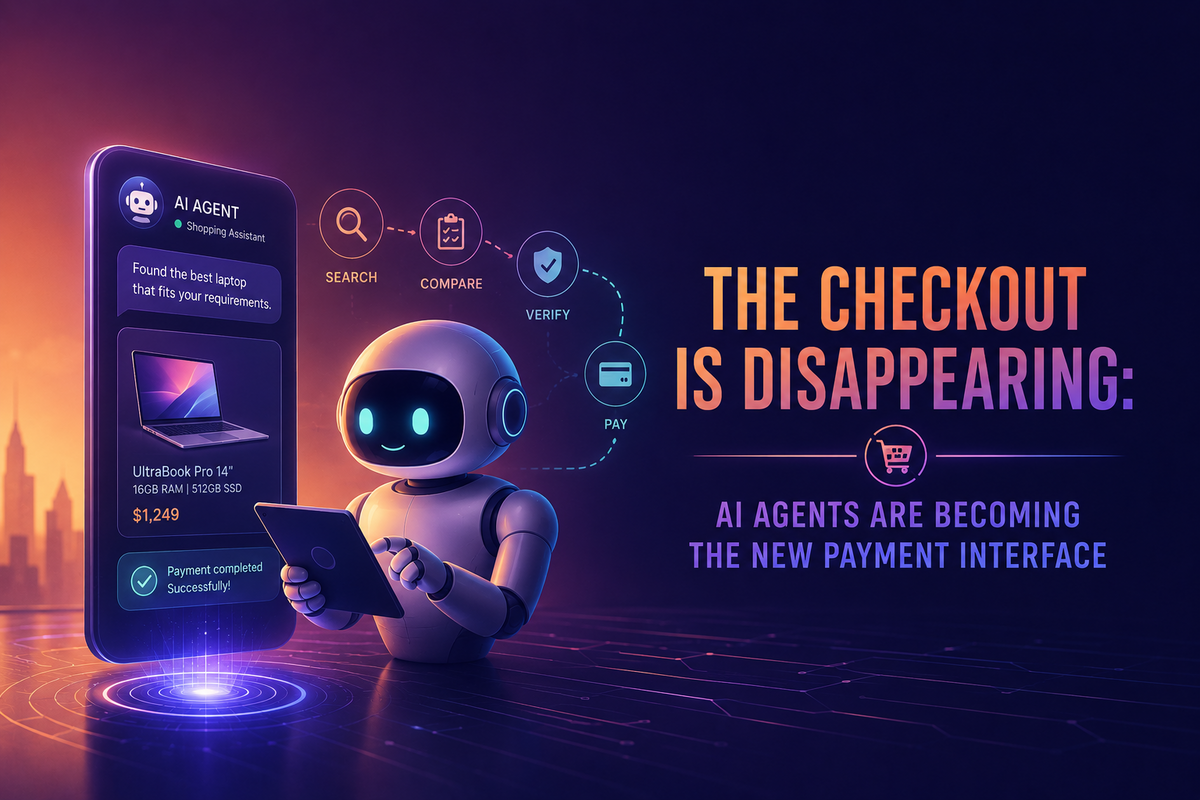
For decades, the checkout page has been one of the most optimized experiences in digital commerce. Businesses invested heavily in reducing cart abandonment, improving payment speed, and streamlining user journeys. Yet the next transformation may not involve making checkout faster, it may involve making it disappear entirely.
The rise of AI agents is introducing a fundamentally different way for consumers and businesses to interact with commerce. Instead of manually browsing websites, comparing products, filling shopping carts, and completing payment forms, users are beginning to delegate these tasks to intelligent AI agents capable of researching options, making recommendations, and completing purchases within approved limits.
This shift represents more than another payment innovation. It signals the emergence of agentic commerce, where the payment interface is no longer a webpage or mobile application but an autonomous AI system acting on behalf of a customer or business. Global payment networks, financial institutions, and technology companies are already investing heavily in the infrastructure required to make this transition secure and trustworthy.
From User Experience to Agent Experience
Digital payments have evolved through several generations. Businesses first optimized desktop checkouts, then mobile wallets, followed by one-click purchasing and embedded payments. The next stage focuses less on improving the customer interface and more on enabling AI agents to become trusted participants in the transaction process.
Imagine a procurement manager asking an AI assistant to source software licenses that meet specific compliance, pricing, and integration requirements. As autonomous work becomes more common across enterprises, AI agents are increasingly taking on routine procurement responsibilities. Instead of presenting dozens of vendor pages, the AI evaluates available options, negotiates pricing where possible, verifies company purchasing policies, and completes the transaction using predefined spending permissions.
A similar transformation is emerging in consumer commerce. Rather than searching multiple travel websites, an AI agent can compare flights, hotels, loyalty benefits, cancellation policies, and payment methods before completing the booking automatically after receiving user approval.
Major payment providers have already begun building this future. Mastercard's Agent Pay initiative, for example, focuses on enabling verified AI agents to execute secure, consent-driven purchases while preserving identity verification, fraud controls, and payment authorization. The company is also expanding partnerships across the AI ecosystem to support trusted agentic commerce.
The conversation is therefore shifting from "How do we simplify checkout?" to "How do we enable AI to complete checkout safely?"
Why Fintech Is Rethinking Payment Infrastructure
The emergence of AI-driven purchasing creates challenges that traditional payment systems were never designed to solve. Payment infrastructure has historically focused on authenticating people. Agentic commerce requires authenticating both the customer and the software acting on their behalf.
This introduces entirely new requirements around digital identity, delegated permissions, transaction boundaries, explainability, and liability. Businesses need confidence that an AI agent is acting within approved policies, while financial institutions need assurance that transactions remain compliant and secure.
These challenges explain why payment innovation is increasingly centered on trust rather than speed alone. Secure authentication frameworks, verifiable user intent, programmable payment permissions, and continuous monitoring are becoming essential components of modern payment infrastructure.
The momentum behind this shift is growing rapidly. Mastercard has expanded authenticated agentic commerce initiatives across multiple markets, while Visa and other payment providers are introducing platforms that allow merchants to accept AI agent-initiated payments through unified integrations. Industry analysts increasingly view these developments as the foundation of the next generation of digital commerce rather than experimental projects.
At the same time, enterprises are recognizing that AI agents will influence more than customer purchases. Procurement, expense management, treasury operations, subscription management, and supplier payments are all becoming candidates for autonomous financial workflows.
The Strategic Opportunity for Business Leaders
For B2B decision-makers, the disappearance of checkout is not simply a user experience story. It represents a broader shift in how businesses design digital products, payment systems, and customer engagement.
Organizations that continue optimizing only human interfaces may overlook a rapidly emerging customer segment: AI agents acting on behalf of users. Future commerce experiences may require machine-readable pricing, structured product data, programmable purchasing rules, and secure payment APIs designed specifically for autonomous systems.
This evolution also changes competitive differentiation. Success will depend less on who builds the most attractive checkout page and more on who creates the most trustworthy payment ecosystem for autonomous decision-making.
Banks are already embracing this direction. Recent deployments of agentic AI across wealth management, treasury, onboarding, and internal financial operations demonstrate that financial institutions increasingly see autonomous agents as productivity partners rather than experimental technology. As banks continue modernizing their infrastructure in the multicloud era, AI agents are becoming increasingly integrated across distributed financial systems to improve agility, scalability, and decision-making. Human oversight remains essential, but the trajectory is clear: AI is moving closer to executing financial decisions rather than merely recommending them.
Of course, new opportunities bring new responsibilities. Questions surrounding fraud prevention, regulatory compliance, accountability, and governance will become increasingly important as AI agents begin initiating real financial transactions. Enterprises that establish strong governance frameworks today will be better positioned to scale autonomous commerce tomorrow.
The disappearance of checkout does not mean payments become invisible. Instead, payments become embedded within intelligent decision-making systems that understand user intent, evaluate context, verify permissions, and execute transactions securely.
That subtle shift could redefine digital commerce over the next decade. Businesses will no longer compete solely for customer attention at checkout, they will compete to become the preferred destination for AI agents making purchasing decisions on behalf of customers. In that future, trust, identity, security, and intelligent payment infrastructure will matter just as much as price or convenience, making AI-powered payment interfaces one of the most significant fintech transformations now taking shape.