

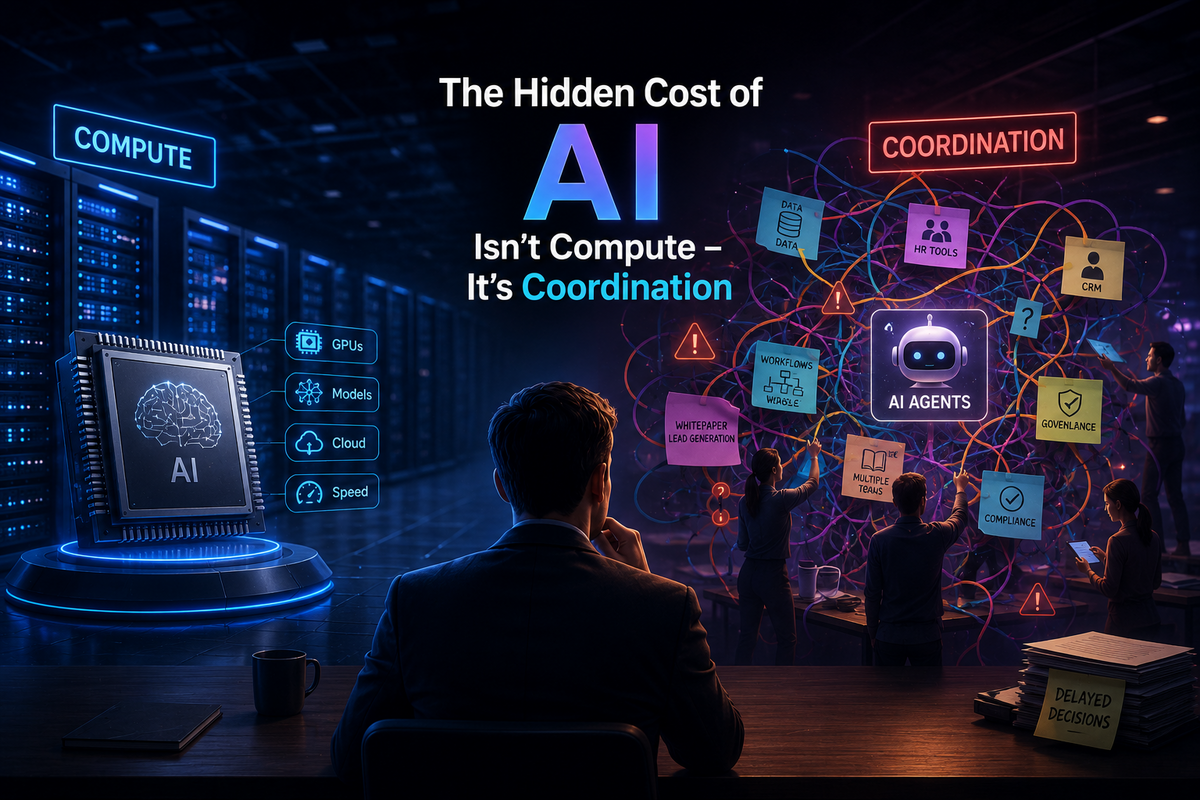
Enterprise AI conversations have changed dramatically over the past year. Just a short time ago, executives were primarily asking which large language model to adopt, whether their cloud provider offered the latest AI capabilities, or how much GPU capacity they would need to support ambitious AI initiatives. Today, those questions are still important but they are no longer the hardest ones to answer.
Organizations are discovering that the biggest obstacle to enterprise AI isn't processing power or model performance. It's coordination.
Across industries, companies are investing heavily in AI assistants, intelligent agents, automation platforms, and predictive analytics. Yet many initiatives struggle to move beyond successful pilots. The technology works. The models generate impressive outputs. Employees are willing to experiment. Still, measurable business value often remains elusive because AI is being introduced into organizations that were never designed to coordinate hundreds of intelligent systems working alongside people.
As enterprises continue expanding AI deployments, coordination is quietly becoming the defining competitive advantage.
AI Success Depends Less on Models and More on Organizational Alignment
The first wave of enterprise AI focused on individual productivity. Teams adopted AI to summarize documents, generate content, automate coding, analyze data, or assist customer support. Each department found its own preferred tools, vendors, and workflows.
The result was rapid innovation but also fragmentation.
Marketing uses one AI platform to create campaigns. Sales relies on another for customer intelligence. Finance introduces AI for forecasting. HR deploys AI-powered recruiting and HR tools to streamline hiring, workforce planning, and employee experiences. IT manages infrastructure while legal develops governance frameworks. Each initiative may deliver value independently, yet very few are designed to work together.
This growing disconnect creates an invisible coordination challenge. AI systems increasingly depend on shared data, common policies, integrated workflows, and consistent governance. Without those foundations, organizations begin creating isolated pockets of intelligence rather than an intelligent enterprise.
Recent enterprise AI trends reflect this shift. Rather than announcing standalone AI features, major technology providers are increasingly introducing platforms that connect AI agents, enterprise applications, business data, and security controls into unified ecosystems. The conversation is moving beyond model capabilities toward orchestration, interoperability, and enterprise-wide AI operations.
For business leaders, this represents an important mindset change. AI transformation is becoming less about deploying another intelligent application and more about enabling different systems and the people using them, to operate together effectively.
Coordination Is Becoming the New Enterprise Infrastructure
Traditional digital transformation focused on connecting software. AI transformation focuses on coordinating decisions.
Unlike conventional automation, modern AI systems continuously interpret information, generate recommendations, interact with multiple applications, and increasingly collaborate with other AI agents. That creates far more complexity than simply integrating software through APIs.
Consider a customer service request. An AI agent may retrieve information from CRM platforms, analyze previous conversations, generate responses, verify compliance requirements, recommend products, update internal knowledge bases, support whitepaper lead generation by qualifying and routing prospects, and notify other departments all within seconds. Every action depends on synchronized data, clearly defined responsibilities, governance policies, and consistent business rules.
The challenge isn't whether the AI can perform each task. The challenge is ensuring every system involved shares the same context.
This explains why enterprises are placing greater emphasis on AI governance, identity management, data quality, and workflow orchestration. These capabilities may not generate headlines like the latest foundation model, but they increasingly determine whether AI delivers reliable business outcomes at scale.
The rise of agentic AI further amplifies this need. Autonomous AI agents are beginning to handle increasingly sophisticated workflows, yet organizations quickly realize that coordinating dozens or eventually hundreds of intelligent agents requires a new operational model. AI doesn't simply replace manual work; it introduces an entirely new layer of organizational coordination that few businesses have previously managed.
Competitive Advantage Will Come From AI Coordination, Not AI Adoption
AI adoption is becoming easier. Virtually every enterprise software vendor now offers AI capabilities, while cloud providers continue lowering technical barriers through managed services and pre-built models. Access to AI is no longer the differentiator it once was.
Execution is.
The organizations creating lasting value from AI are rarely those with the largest model budgets. Instead, they are building environments where technology, employees, governance, and business processes operate in alignment.
This means establishing consistent data standards before deploying autonomous agents. It means ensuring security teams, compliance leaders, and operational departments participate in AI strategy rather than reacting after deployment. It means creating shared governance frameworks that allow AI systems to evolve without introducing unnecessary risk. Most importantly, it means recognizing that successful AI initiatives are organizational transformations, not software implementations.
The next phase of enterprise AI will likely involve multiple intelligent agents working across every business function, continuously exchanging information, making recommendations, and automating increasingly complex decisions. In that environment, compute will become increasingly accessible, models will continue improving, and AI tools will become commodities.
Coordination, however, will remain difficult.
That is precisely why it is becoming one of the most valuable enterprise capabilities of the AI era.
The companies that lead over the next decade may not necessarily be those with the most advanced models. They will be the ones that successfully coordinate people, data, AI agents, governance, and business processes into a single operating system for decision-making. As enterprise AI matures, the question is no longer whether organizations can deploy intelligent technology. The real question is whether they can coordinate it well enough to turn intelligence into sustained business value.