
Scaling Agentic AI with Federated Governance
Published on 07 Mar 2026
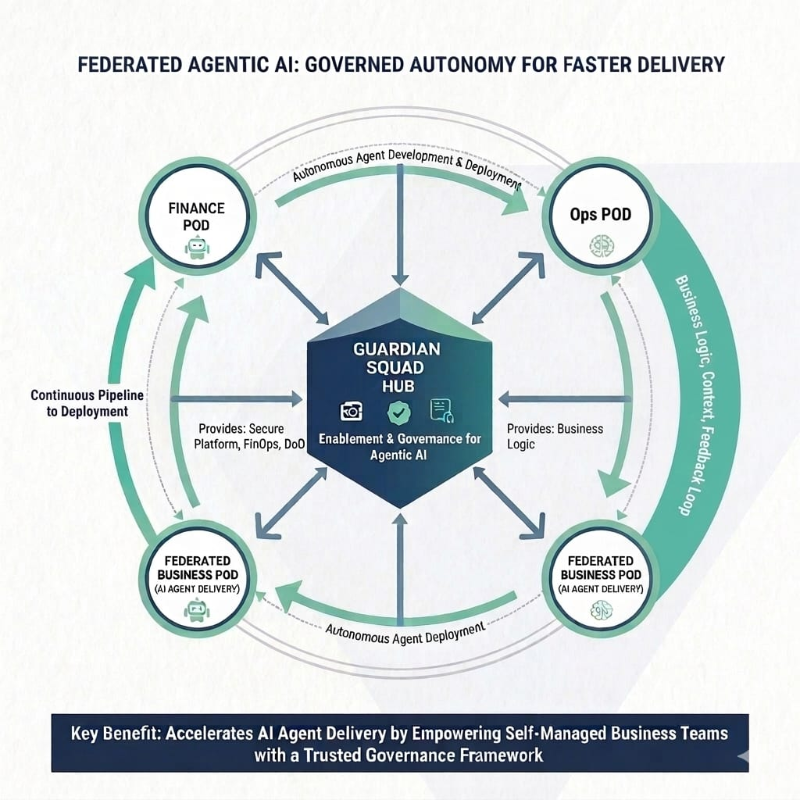
As enterprises increasingly adopt Agentic AI, many organizations are discovering that traditional governance structures are not designed to support autonomous AI systems. Conventional AI initiatives often rely on a centralized Center of Excellence (CoE) to oversee development and deployment. While this approach worked for earlier AI programs, it is becoming a bottleneck in environments where rapid experimentation and domain-specific decision-making are critical.
Agentic AI introduces systems that can perform tasks autonomously, adapt to changing inputs, and operate continuously across business workflows. Because of this probabilistic nature, these systems require fast feedback loops, strong domain context, and decentralized innovation. A rigid, command-and-control model slows down these processes and prevents organizations from unlocking the full value of AI agents.
This shift is prompting organizations to rethink how AI governance and delivery should be structured.
The Limitations of Centralized AI Governance
When Centralization Creates Operational Friction
In many enterprises, the centralized AI model places responsibility for building and managing AI systems within a dedicated team. This team typically handles model selection, governance policies, compliance checks, and infrastructure management.
While this structure provides consistency and oversight, it can create significant challenges when organizations attempt to scale AI solutions across multiple departments.
Business teams often rely on centralized AI specialists to implement changes, adjust prompts, or deploy new agents. As demand grows, these teams become overloaded, slowing down delivery cycles and limiting experimentation. In environments where AI agents must evolve rapidly, this dependency can hinder innovation.
The Growing Need for Domain Expertise
Another challenge arises from the complexity of business-specific knowledge. AI agents frequently interact with specialized processes, datasets, and operational rules unique to each department.
Without direct access to domain expertise, centralized teams may struggle to design solutions that truly address real-world business needs. As a result, organizations must explore structures that empower domain teams while still maintaining governance and control.
Introducing a Federated Approach to Agentic AI
Decentralizing Innovation While Maintaining Standards
A federated organizational model provides an alternative approach to scaling AI across an enterprise. Instead of concentrating all AI responsibilities within a central team, this model distributes the development and integration of AI agents across cross-functional product teams.
These teams incorporate AI capabilities directly into their own workflows and product backlogs. Because they already possess the necessary business context, they can build and iterate on AI-driven solutions more efficiently.
However, decentralization does not mean abandoning governance. To maintain consistency and security, a specialized enablement team defines shared standards and operational guidelines that all AI agents must meet before deployment.
Governance, Security, and Reliability in AI Agents
Ensuring Responsible Deployment
As AI agents become embedded in core business processes, governance becomes a critical requirement. Organizations must ensure that AI systems operate reliably, respect privacy regulations, and remain transparent in their decision-making.
Effective governance frameworks typically address several key areas, including architecture integrity, security controls, operational monitoring, and cost management. For instance, agents must follow defined guidelines for model selection, data handling, and response accuracy. They must also demonstrate reliable performance across a range of real-world scenarios before being considered production-ready.
These safeguards ensure that organizations can scale AI responsibly while maintaining trust and compliance.
Managing Cost and Operational Visibility
Another important aspect of enterprise AI adoption is cost governance. Because modern AI services operate on consumption-based pricing models, organizations need mechanisms to track usage and prevent uncontrolled spending.
Monitoring frameworks, token limits, and transparent reporting can help teams maintain control over operational costs while enabling responsible experimentation with AI technologies.
Building the Foundation for Scalable AI Systems
Scaling Agentic AI requires more than advanced models or powerful infrastructure. It requires a governance structure that balances innovation, accountability, and operational control.
Organizations that successfully adopt federated AI models can enable teams to experiment rapidly while maintaining consistent standards across the enterprise. By combining decentralized development with centralized governance, businesses can create an environment where AI agents evolve safely and efficiently.
However, implementing such a framework requires careful planning, clear roles, and well-defined operational guidelines.
Download the Full Whitepaper
This excerpt introduces the key principles behind the Federated Guardian Squad framework for scaling Agentic AI. The full whitepaper explores the detailed governance structure, operational criteria, evaluation mechanisms, and implementation roadmap organizations can use to deploy AI agents at scale.
Download now to read more and learn how enterprises can balance autonomy, governance, and scalability in the age of Agentic AI.