

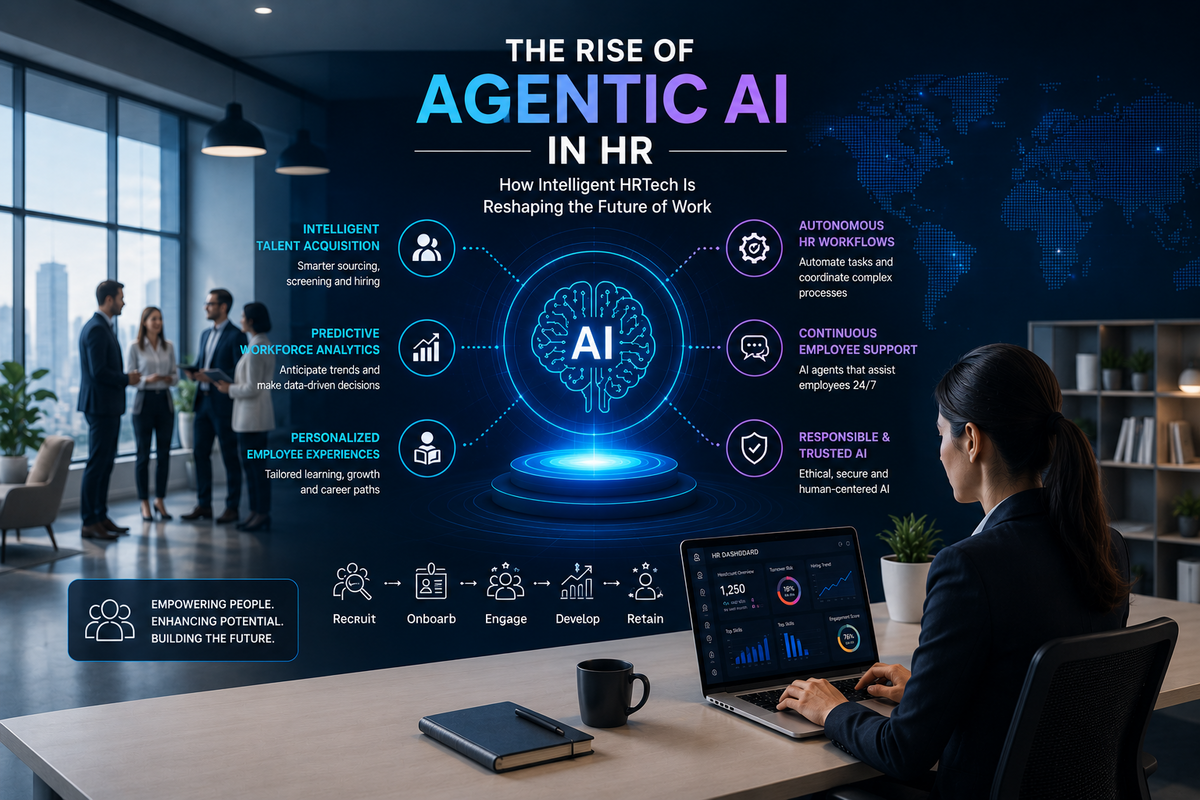
Artificial intelligence has already transformed Human Resources by automating repetitive tasks, improving recruitment workflows, and enhancing workforce analytics. However, a new phase of innovation is rapidly taking shape. Instead of simply responding to commands or generating content, AI systems are beginning to act independently, making informed decisions, coordinating tasks, and supporting business objectives with minimal human intervention. This emerging capability, known as Agentic AI, is redefining what modern HR technology can achieve.
As organizations navigate evolving workforce expectations, talent shortages, and increasing operational complexity, HR leaders are looking beyond automation toward intelligent systems that actively contribute to business outcomes. Agentic AI represents this next evolution, enabling HR teams to become more strategic while delivering faster, data-driven, and highly personalized employee experiences.
What Is Agentic AI?
Unlike traditional AI tools that require constant user prompts, Agentic AI is designed to operate with a greater degree of autonomy. These intelligent agents can interpret objectives, analyze available data, execute multi-step tasks, and adapt their actions based on changing circumstances.
Within HR environments, Agentic AI can coordinate recruitment workflows, recommend learning pathways, monitor workforce trends, identify retention risks, and assist employees throughout their lifecycle without requiring continuous manual intervention.
Rather than replacing HR professionals, these systems act as intelligent collaborators that reduce administrative workloads while enabling more informed decision-making.
Why HR Is Ready for Intelligent Agents
Human Resources has become one of the most data-intensive business functions. Recruitment, onboarding, learning and development, performance management, compliance, payroll, and employee engagement all generate significant volumes of information.
Managing this complexity manually has become increasingly difficult.
Agentic AI helps organizations connect these disconnected processes by continuously analyzing workforce data, identifying patterns, and recommending proactive actions before challenges escalate.
Instead of waiting for quarterly reports to reveal increasing turnover or declining engagement, HR leaders can receive real-time insights that support faster and more strategic decisions.
For enterprises undergoing digital transformation, this level of intelligence creates opportunities to align workforce planning more closely with broader business objectives.
Transforming Talent Acquisition
Recruitment remains one of the most promising applications of Agentic AI.
Beyond screening resumes, intelligent HR systems can identify skill gaps across departments, recommend sourcing strategies, schedule interviews, personalize candidate communications, and even suggest interview questions based on role requirements.
More importantly, these systems continuously learn from hiring outcomes, helping organizations refine recruitment strategies over time.
As skills-based hiring becomes more common, Agentic AI also enables recruiters to evaluate candidates based on competencies, transferable skills, and potential rather than relying solely on traditional job titles or educational backgrounds.
This creates a more inclusive and efficient hiring process while improving the quality of talent acquisition.
Delivering Personalized Employee Experiences
Today's workforce expects more personalized workplace experiences, from onboarding and professional development to wellbeing initiatives and career progression.
Agentic AI enables HR platforms to tailor these experiences at an individual level.
New employees can receive customized onboarding journeys based on their role, location, and previous experience. Existing employees can receive personalized learning recommendations, internal mobility opportunities, and career development suggestions aligned with both organizational priorities and individual aspirations.
Rather than offering the same experience to every employee, intelligent HR platforms adapt continuously, creating greater engagement and long-term retention.
Organizations investing in employee experience technologies are increasingly recognizing personalization as a competitive advantage rather than simply an HR initiative.
Workforce Analytics Become Predictive
Traditional HR reporting often explains what has already happened. Agentic AI shifts the focus toward predicting what is likely to happen next.
By continuously analyzing workforce data, intelligent HR platforms can identify employees at risk of leaving, forecast future hiring needs, evaluate workforce productivity, and recommend interventions before challenges affect business performance.
This predictive capability supports more informed workforce planning while enabling leadership teams to make proactive rather than reactive decisions.
Combined with business intelligence and enterprise analytics platforms, Agentic AI transforms HR data into actionable business insights.
Responsible AI Remains Essential
As intelligent HR systems become more autonomous, governance becomes increasingly important.
Human Resources manages highly sensitive employee information, making transparency, privacy, fairness, and regulatory compliance critical considerations throughout AI implementation.
Organizations adopting Agentic AI should establish clear governance frameworks that include human oversight, bias monitoring, explainable decision-making, and strong data security practices.
Responsible implementation ensures technology strengthens employee trust rather than undermining it.
The most successful organizations will treat Agentic AI as a decision-support system rather than a replacement for human judgment.
Building the Future HR Ecosystem
Agentic AI delivers the greatest value when integrated across the broader enterprise technology ecosystem.
Modern HR platforms increasingly connect with cloud infrastructure, collaboration software, identity management systems, workforce analytics, customer relationship management platforms, and enterprise resource planning solutions.
This integrated approach enables intelligent agents to coordinate workflows across departments while providing HR leaders with a more comprehensive understanding of workforce performance.
As organizations continue investing in enterprise AI, cloud transformation, and intelligent automation, HR will become an increasingly strategic contributor to business growth rather than solely an administrative function.
Final Thoughts
The future of Human Resources is no longer defined by automation alone. It is being shaped by intelligent systems capable of understanding context, coordinating complex workflows, and supporting strategic decision-making across the employee lifecycle.
Agentic AI represents a significant evolution in HR technology, enabling organizations to move beyond efficiency toward intelligence. While these systems can streamline recruitment, personalize employee experiences, strengthen workforce planning, and improve operational agility, people will remain at the center of every successful workplace.
Organizations that combine intelligent HR technologies with responsible governance, continuous learning, and human-centered leadership will be better positioned to attract talent, retain employees, and adapt to an increasingly dynamic world of work. In the years ahead, the competitive advantage will not belong to businesses that simply adopt AI—it will belong to those that use Agentic AI to empower their people, strengthen decision-making, and create workplaces built for the future.