

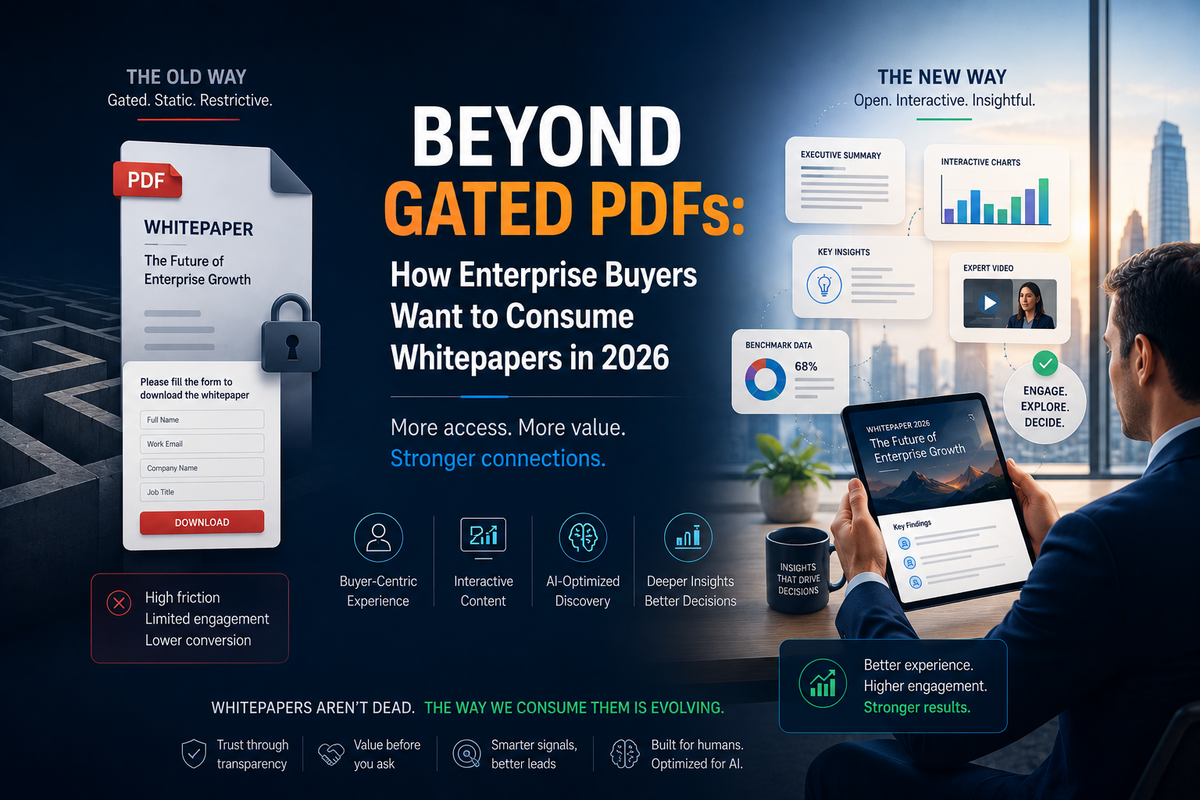
For years, whitepapers have been a cornerstone of B2B marketing. They have educated prospects, supported buying decisions, and generated valuable leads through gated landing pages. Yet in 2026, the relationship between buyers and long-form content is changing rapidly. Artificial intelligence, AI-powered search experiences, and evolving buyer expectations are reshaping how enterprise decision-makers discover, evaluate, and consume information.
The traditional model of asking every visitor to complete a lengthy form before accessing a whitepaper is gradually losing effectiveness. Enterprise buyers now expect faster access to knowledge, richer digital experiences, and content that delivers immediate value before requesting personal information. This does not mean whitepapers are becoming obsolete. Instead, it signals that the way organizations distribute and position them must evolve.
For B2B leaders, the opportunity lies not in abandoning whitepapers but in rethinking how they fit into the modern buying journey.
Enterprise Buyers Want Information Before They Want Sales Conversations
Today's enterprise purchasing decisions involve multiple stakeholders, extended evaluation cycles, and independent research conducted across numerous digital channels. Industry reports continue to show that buyers complete much of their evaluation before engaging with a vendor, while AI search assistants increasingly summarize content directly within search experiences rather than sending users to individual websites.
This shift has created what many marketers describe as the "zero-click research" era. Buyers often gather product knowledge, industry trends, and competitive comparisons without immediately downloading a whitepaper or speaking with sales.
As a result, organizations relying exclusively on gated PDFs risk introducing unnecessary friction into the research process. Decision-makers increasingly expect executive summaries, interactive previews, visual insights, and key findings to be available upfront. These assets help buyers determine whether deeper content is worth exploring.
Rather than treating the whitepaper as the first interaction, leading organizations now position it as the next step in an already informed buying journey.
Whitepapers Are Becoming Knowledge Experiences Instead of Static Documents
One of the most significant shifts in 2026 is that enterprise buyers no longer view whitepapers as standalone PDF files. They expect content to be accessible across multiple formats that fit different research preferences and devices.
Instead of publishing only downloadable documents, organizations are transforming whitepapers into interactive experiences featuring dynamic charts, embedded videos, AI-powered search functionality, executive summaries, personalized recommendations, and modular content sections. This approach allows buyers to consume information at their own pace while exploring the topics most relevant to their business challenges.
At the same time, generative AI has raised the value of original research. Generic content can now be produced within seconds, making proprietary insights, customer data, industry benchmarks, and first-party research the primary differentiators. Enterprise buyers increasingly seek information they cannot obtain from AI-generated summaries alone.
Recent developments across major search platforms also reinforce this trend. AI-powered search experiences increasingly prioritize authoritative, experience-driven content while surfacing concise answers directly within search results. This makes original research and high-quality thought leadership even more valuable for organizations looking to maintain visibility and credibility.
Rather than asking whether buyers will download a whitepaper, marketers should ask whether the content offers enough exclusive insight to justify deeper engagement.
Smarter Lead Generation Begins After Value Is Delivered
The evolution of enterprise content consumption does not mean lead generation is disappearing. It means the exchange of value between buyers and brands is changing.
Forward-thinking organizations are replacing blanket gating strategies with progressive engagement models. Instead of requiring registration before every interaction, they allow visitors to explore summaries, benchmark highlights, methodology sections, or interactive dashboards before offering access to the complete research report.
This approach builds trust while generating stronger buying signals. A prospect who spends several minutes exploring research findings, interacts with industry benchmarks, revisits multiple sections, and returns for additional insights often demonstrates greater purchase intent than someone who simply downloads a PDF and never returns.
Artificial intelligence, customer data platforms, and advanced analytics now enable marketing teams to understand these behavioral patterns with far greater precision. Rather than measuring success solely through download counts, organizations increasingly evaluate engagement quality, content consumption depth, repeat visits, and account-level research activity.
This richer understanding helps sales teams prioritize conversations with prospects demonstrating genuine buying intent instead of relying on form submissions alone.
The result is a lead generation strategy that emphasizes quality over volume while delivering a better experience for enterprise buyers.
The Future Belongs to Buyer-Centric Whitepapers
As AI continues transforming search behavior and enterprise research habits, successful B2B organizations will treat whitepapers as living knowledge assets rather than static downloadable files. They will design content that serves both human readers and AI-powered discovery platforms while focusing on originality, credibility, and practical value. In this evolving landscape, whitepaper lead generation will increasingly depend on delivering valuable research experiences that build trust before capturing buyer interest.
The future of whitepaper marketing is not about removing gates entirely or collecting more form fills. It is about creating research experiences that earn attention before requesting commitment. Enterprise buyers reward organizations that respect their time, answer complex questions, and provide meaningful insights throughout the decision-making process.
In 2026, the most effective whitepapers will not simply generate leads. They will build trust, establish authority, and guide buyers through increasingly sophisticated purchasing journeys. Businesses that embrace this shift will discover that the strongest lead generation strategy begins not with asking for information, but by delivering knowledge that buyers genuinely cannot find anywhere else.