

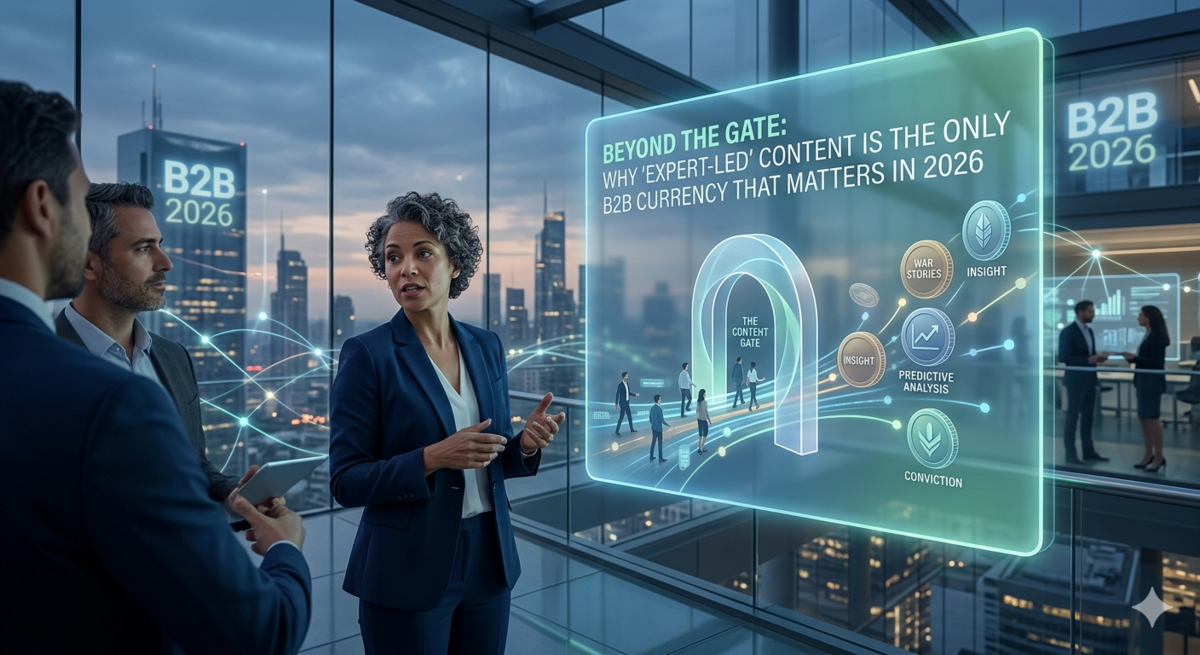
In 2024, the B2B marketing world was obsessed with "Lead Volume." In 2025, we pivoted to "Lead Quality." But as we move through the first quarter of 2026, a new, more ruthless metric has taken center stage: Information Integrity.
The reason is simple: AI has made the "average" white paper free to produce and infinite in supply. When a decision-maker can generate a 10-page "industry report" on cloud security in 30 seconds using a prompt, why would they ever give you their work email for your PDF?
The answer isn't "better marketing"—it's better expertise. At WhitePapersOnline.com, we’ve observed a massive performance gap opening up between generic assets and what we call Expert-Led Research (ELR).
The 2026 Trust Gap: AI Overload vs. Human Authority
The "inbox of 2026" is flooded with synthetic content. AI agents are now drafting 80% of initial B2B outreach, and the result is a cynical buyer. According to recent search data, 2026 is the year where "Expert-Led" content has officially begun outperforming pure AI-generated content in conversion rates by over 40%.
Buyers aren't looking for a summary of what's on the web; they are looking for Primary Intelligence. They want to know:
-
What did the 500 CISOs you surveyed actually say about the new federal AI framework?
-
What are the specific implementation failures your engineers saw in Q4?
-
What is the proprietary ROI logic that your competitors haven't figured out yet?
The Shift from "Gated Assets" to "Interactive Experiences"
The static PDF isn't dead, but it has evolved. In 2026, high-performing white papers are moving from linear documents to Interactive Research Experiences. Instead of a one-size-fits-all report, leading brands are syndicating modular content that allows the user to filter data by their specific industry, region, or company size directly within the asset.
| Feature | The "Legacy" White Paper (2024) | The "Interactive" White Paper (2026) |
| Format | Static 15-page PDF. | Modular, filterable web-experience. |
| Engagement | "Download & Forget." | Real-time data interaction & simulations. |
| Data Type | Secondary research/Summaries. | Proprietary, first-party "Zero-Party" data. |
| Conversion | Hard gate (Form before value). | Soft gate (Value-first, "Pay-with-Data" later). |
3 Rules for Your 2026 White Paper Strategy
If you want your content to cut through the noise on platforms like WhitePapersOnline.com this year, you must adhere to three new rules:
-
Prioritize "Zero-Party" Data: Stop citing Gartner. Start citing yourself. Use surveys, internal platform data, and customer interviews to create insights that an LLM cannot replicate.
-
The "Human-in-the-Loop" Signature: Explicitly highlight the Subject Matter Experts (SMEs) behind the paper. In 2026, the author's pedigree is as important as the data itself.
-
Optimize for "Generative Engine Optimization" (GEO): Structure your white paper with clear, snippet-friendly headers and structured data so that AI assistants (like the one you're talking to right now) can easily find and cite your findings as the authoritative source.
Accelerating Demand with WhitePapersOnline
The hardest part of a "Quality-First" strategy is reach. You can produce the most insightful research in the world, but if it stays on your website, it's a dormant asset.
This is where strategic syndication becomes your multiplier. By leveraging the targeted reach of our lead gen capabilities, you aren't just "buying leads"—you are placing your expertise directly in the path of decision-makers who are actively navigating the mid-funnel. In 2026, the winners won't be the companies that publish the most; they will be the ones whose expertise is the most accessible.