

For years, the financial services industry has relied on dashboards, historical reports, and predictive analytics to make critical business decisions. Banks studied customer behavior, insurers analyzed claims, investment firms monitored market movements, and fintech startups measured every click to optimize their digital experiences. The assumption was simple: the more data an organization collected, the better its decisions would become.
That assumption is beginning to change.
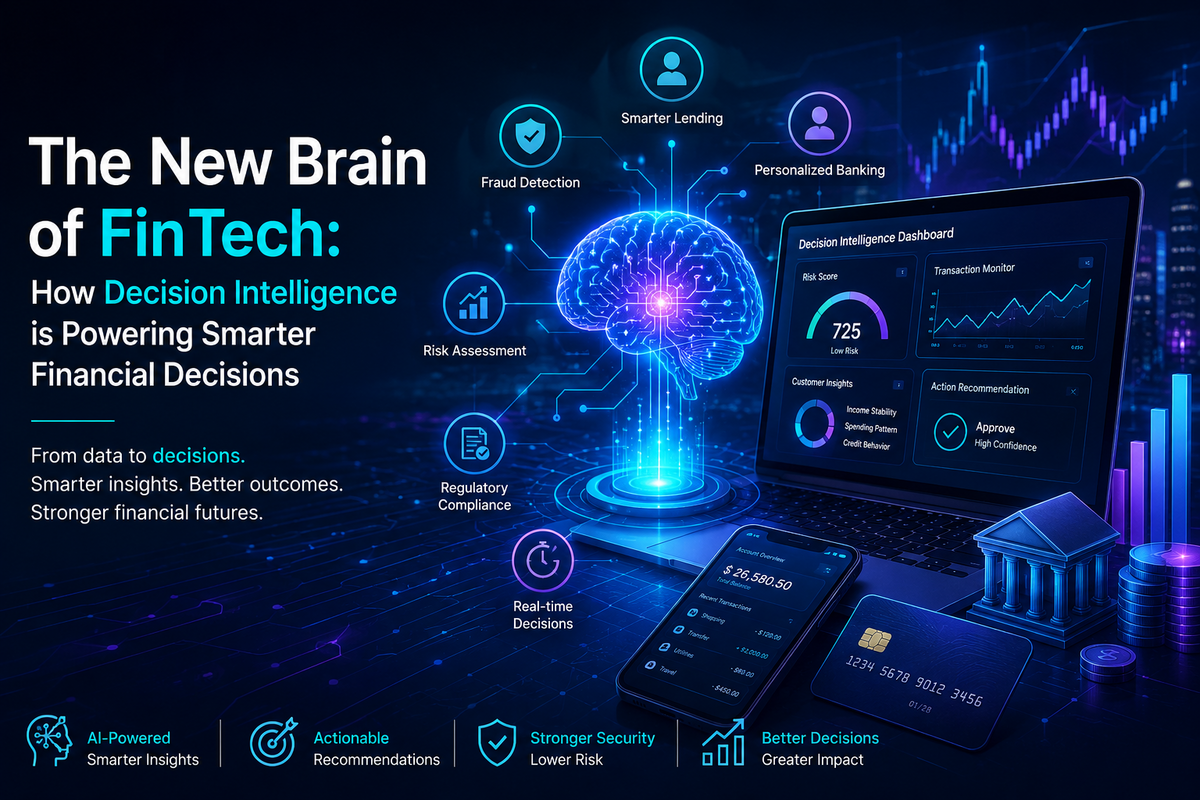
A new wave of enterprise technology is transforming financial services—not by generating more data, but by helping organizations make better decisions with the data they already have. This shift is being driven by Decision Intelligence (DI), a discipline that combines artificial intelligence, machine learning, predictive analytics, business rules, and human expertise to recommend the best course of action rather than simply presenting information.
While AI has dominated technology headlines, Decision Intelligence is quietly becoming one of the most influential innovations in modern FinTech. It represents a move away from passive reporting toward proactive, intelligent decision-making, and its impact is already being felt across lending, fraud detection, wealth management, insurance, and digital banking.
From Analytics to Action
Traditional business intelligence platforms excel at answering one question:
"What happened?"
Decision Intelligence goes much further.
It asks:
- What is likely to happen next?
- Why is it happening?
- What actions should the business take?
- Which decision creates the best possible outcome?
Instead of requiring executives to interpret multiple dashboards, Decision Intelligence platforms synthesize enormous volumes of structured and unstructured data into actionable recommendations.
For financial institutions operating in highly competitive markets, this dramatically shortens decision cycles while improving consistency and reducing human bias.
Why FinTech Is the Perfect Environment for Decision Intelligence
Few industries generate as much real-time data as financial services.
Every second, payment processors, banks, lending platforms, investment firms, and digital wallets capture millions of customer interactions, transactions, risk indicators, behavioral signals, and market updates.
Managing this data has become increasingly difficult.
Modern FinTech companies no longer struggle with information shortages—they struggle with information overload.
Decision Intelligence solves this challenge by connecting customer behavior, operational data, regulatory requirements, market conditions, and historical trends into unified decision models.
Rather than forcing employees to analyze hundreds of variables manually, the system continuously evaluates possibilities and highlights the most effective response.
Smarter Lending Decisions Without Sacrificing Speed
One of the most significant applications of Decision Intelligence is digital lending.
Traditional credit decisions relied heavily on credit scores and predefined underwriting rules. While effective in many scenarios, these models often overlooked broader financial behaviors and emerging risk patterns.
Decision Intelligence expands the evaluation process by incorporating alternative data sources, transaction histories, income stability, spending behavior, and evolving market conditions.
The result is faster loan approvals, more accurate risk assessments, and improved financial inclusion for applicants who may have been underserved by conventional credit models.
Instead of replacing underwriters, Decision Intelligence equips them with deeper insights to make more informed lending decisions.
Fighting Financial Fraud Before It Happens
Fraud has become increasingly sophisticated as cybercriminals adopt AI-powered techniques to automate attacks and bypass traditional security controls.
Static fraud detection rules are no longer sufficient.
Decision Intelligence enables financial institutions to identify unusual behavioral patterns in real time by combining transaction history, device intelligence, location data, customer behavior, and contextual information.
Rather than reacting after fraudulent activity occurs, institutions can intervene during suspicious transactions, reducing financial losses while minimizing unnecessary disruptions for legitimate customers.
This balance between security and customer experience is becoming one of FinTech's greatest competitive advantages.
Personalized Banking Moves Beyond Recommendations
Most consumers have grown accustomed to generic product recommendations.
Decision Intelligence is pushing personalization much further.
Instead of recommending financial products based solely on demographics, modern banking platforms analyze spending habits, financial goals, life events, and changing customer circumstances to deliver highly relevant guidance.
Imagine receiving proactive advice about refinancing opportunities, investment diversification, savings strategies, or subscription optimization before you even begin searching for solutions.
This evolution transforms financial institutions from service providers into trusted financial advisors.
Decision Intelligence Strengthens Regulatory Compliance
Regulatory requirements continue to evolve across global financial markets.
Compliance teams often spend significant time reviewing transactions, generating reports, monitoring suspicious activities, and ensuring adherence to changing regulations.
Decision Intelligence helps automate many of these responsibilities by identifying compliance risks, monitoring policy changes, prioritizing investigations, and recommending corrective actions before regulatory issues escalate.
Rather than replacing compliance professionals, the technology enables them to focus on higher-value investigations that require human judgment.
Human Judgment Still Matters
Despite its growing capabilities, Decision Intelligence is not designed to replace financial professionals.
Investment strategies, lending approvals, regulatory investigations, and customer relationships often involve ethical considerations, market uncertainty, and contextual nuances that algorithms cannot fully understand.
The strongest Decision Intelligence systems recognize this balance.
They provide recommendations while keeping humans firmly in control of final decisions.
This partnership between intelligent automation and experienced professionals creates stronger governance while maintaining accountability.
The Future of FinTech Will Be Defined by Better Decisions
As artificial intelligence becomes embedded across financial platforms, competitive advantage will no longer depend solely on who has the most advanced algorithms.
Success will increasingly belong to organizations that consistently make better, faster, and more transparent decisions.
Decision Intelligence represents that next evolution.
It transforms data into strategy, automation into meaningful action, and technology into a genuine business partner. For FinTech companies navigating volatile markets, rising customer expectations, and growing regulatory complexity, the ability to make intelligent decisions at scale may prove more valuable than any single technological breakthrough.
The financial institutions that embrace Decision Intelligence today are not simply modernizing their technology stacks—they are redefining how decisions are made. In an industry where every decision carries financial, operational, and reputational consequences, that shift could become one of the defining competitive advantages of the decade.