

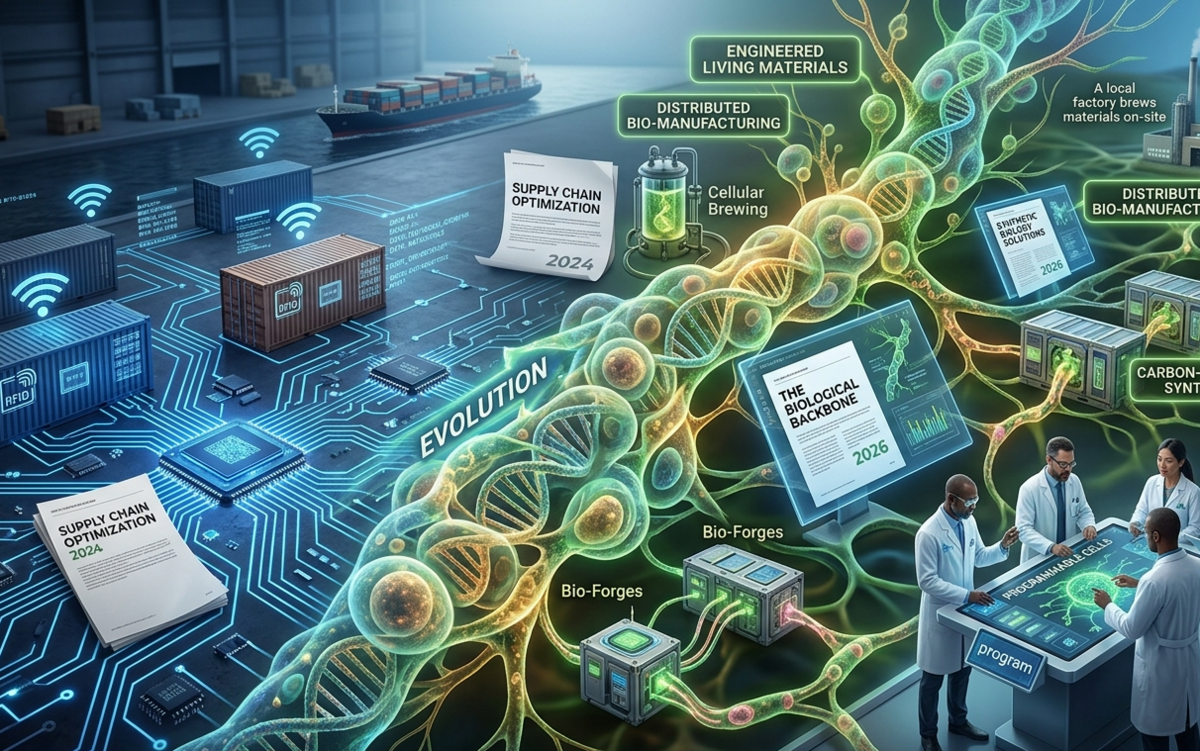
For the last decade, "Supply Chain Innovation" was synonymous with faster chips and smarter software. We optimized the digital layer to manage the physical world. But as we move deeper into 2026, the most disruptive frontier isn't digital—it's Biological.
With the global annual market for bio-manufacturing projected to reach $30 trillion by 2030, the B2B world is undergoing a "Biological Reset." We are moving from a world where we extract and assemble materials to a world where we program and grow them. The white papers now surfacing on WhitePapersOnline.com are no longer just about logistics software; they are about Synthetic Biology (SynBio) as a Supply Chain Solution.
The Crisis: The "Extractive" Ceiling
In 2024, supply chains were fragile because they relied on finite raw materials—lithium, cobalt, petroleum-based plastics—and a complex, high-carbon logistics web to move them. In 2026, geopolitical volatility and strict carbon-border taxes have made this "extractive" model a financial liability.
The solution? Distributed Bio-Manufacturing. Instead of shipping a plastic component across an ocean, companies are using Programmable Cells to "brew" the same material locally using air, water, and industrial waste as feedstock.
2026 White Paper Hot Topic: "The Bio-Forge: Replacing Global Logistics with Localized, Carbon-Negative Synthesis."
3 "Bio-Tech" Themes Transforming B2B Research
If you are a logistics leader, a materials scientist, or a sustainability officer, your 2026 research must address these "Living" pillars:
1. Engineered Living Materials (ELMs)
We are seeing the rise of Self-Healing Infrastructure. * The Angle: "Programmable Concrete: Using Cyanobacteria to Create Regenerative, Carbon-Sequestering Building Materials."
-
The Value: White papers that prove how "Living Materials" can reduce maintenance costs by 40% because the material literally "grows" to fill cracks and damage.
2. The "Cell-as-a-Factory" (CaaF)
In 2026, the "factory" isn't a building; it's a Microbe.
-
The Angle: "Scaling Synthetic Biology: Transitioning from Lab-Scale Fermentation to Industrial-Scale Bio-Production."
-
The Value: Helping manufacturers move beyond small batches to 40,000-liter "Bio-Forges" that produce everything from jet fuel to medical-grade silk at room temperature with zero waste.
3. DNA Data Storage for Supply Chain Traceability
Traditional RFID tags can be tampered with. In 2026, we are seeing Molecular Labeling.
-
The Angle: "The DNA Ledger: Using Synthetic Genetic Sequences to Create Immutable, Biological Chain-of-Custody."
-
The Value: Proving how a single drop of "Digital DNA" sprayed on a raw material can hold more data than a QR code, ensuring total transparency from the cell to the shelf.
Why the "Bio-Reset" Requires New White Paper Logic
Biological systems don't behave like software. They are adaptive, regenerative, and probabilistic. In 2026, a B2B buyer isn't just looking for "Uptime"; they are looking for "Yield Stability."
When a SynBio white paper is hosted on WhitePapersOnline.com, it must bridge the gap between Academic Research and Industrial Application. The B2B buyer needs to know: Can this scale? Is it compliant with the 2026 Bio-Security Protocols? What is the "Return on Carbon" (ROC)?
| Metric | The Silicon Supply Chain (2024) | The Biological Supply Chain (2026) |
| Primary Process | Extraction & Assembly. | Programming & Fermentation. |
| Material Origin | Petroleum / Mineral-based. | Carbon / Waste-based (Regenerative). |
| Logistics Goal | Global Speed. | Local Resilience. |
| Waste Profile | High Effluent / High Carbon. | Zero Waste / Carbon-Negative. |
The Bottom Line: Nature is the New Operating System
The most innovative B2B brands of 2026 have realized that biology is just a very advanced form of nanotechnology. By programming cells to build what we need, we are solving the "resilience" problem and the "sustainability" problem in one move.
To lead the conversation this year, your white paper must treat the Cell as the Atomic Unit of Business. Stop selling "Efficiency" and start selling "Regeneration." In 2026, the most successful supply chain isn't just fast—it’s alive.