

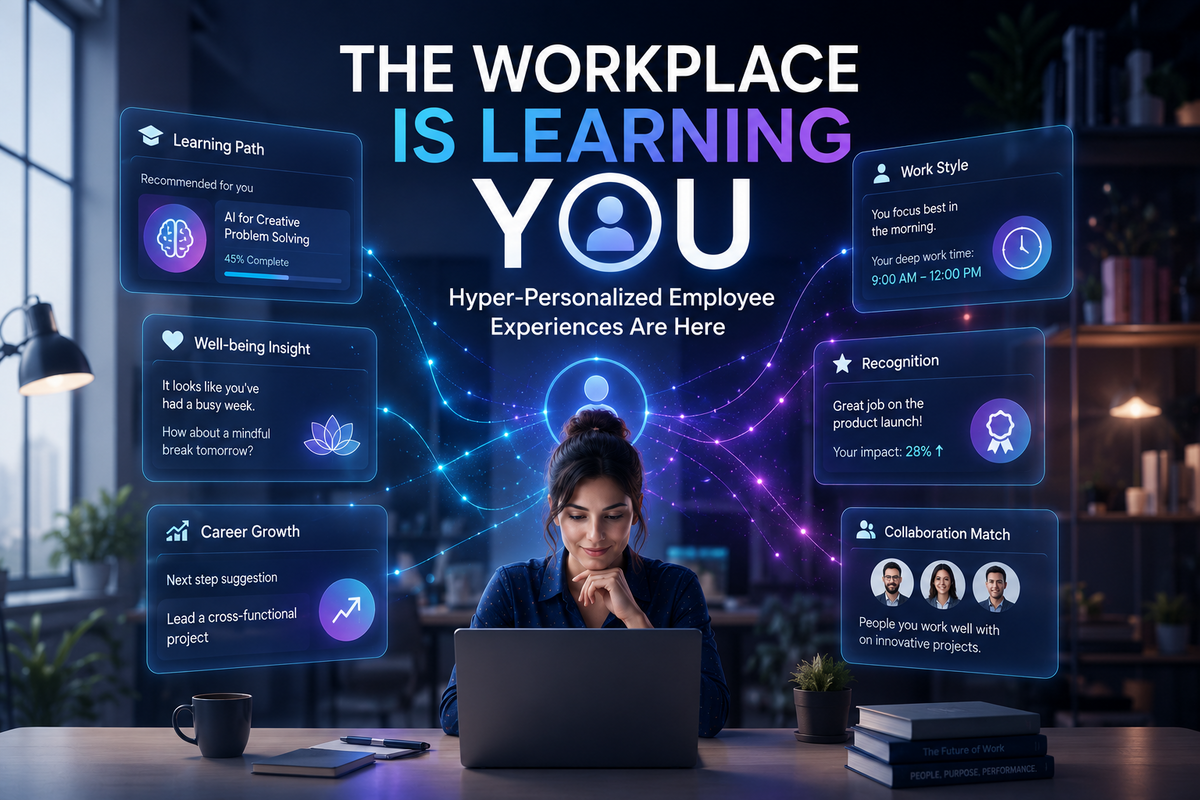
For decades, organizations have worked to improve employee experience through standardized programs. Every employee received the same onboarding journey, identical learning modules, similar engagement surveys, and uniform wellness initiatives. While these efforts created consistency, they rarely reflected the reality that every employee works differently, learns differently, and is motivated by different experiences.
That model is beginning to change.
Powered by artificial intelligence, workforce intelligence platforms, and real-time behavioral analytics, today's workplace is becoming increasingly adaptive. Instead of expecting employees to fit predefined processes, organizations are building environments that continuously adjust to individual work styles, preferences, and needs. The workplace itself is becoming intelligent enough to learn from employee interactions and deliver experiences that feel increasingly personal.
For B2B decision-makers, this evolution represents more than another HR technology or workforce trend. It reflects a strategic shift toward treating employee experience as an ongoing intelligence system rather than a collection of isolated HR initiatives. As organizations compete for talent while navigating hybrid work, skills shortages, and rapid AI adoption, hyper-personalization is emerging as a critical differentiator.
Employee Experience Is Becoming Adaptive Instead of Standardized
The rise of AI across enterprise software is accelerating a new generation of employee experiences. Modern HR platforms are moving beyond static workflows by continuously analyzing workplace interactions, collaboration patterns, learning behavior, productivity signals, and employee preferences to recommend personalized actions.
Instead of assigning identical development plans to every employee, organizations can now recommend learning opportunities based on individual career aspirations, existing skills, project involvement, and emerging business priorities. Employees receive content that is relevant to their goals rather than generic training designed for everyone.
Recent developments across the HR technology landscape demonstrate how quickly this transformation is taking shape. Leading enterprise software providers are embedding generative AI, intelligent assistants, workforce analytics, and predictive recommendations into everyday HR workflows. AI-powered copilots are helping employees locate internal knowledge faster, complete administrative tasks more efficiently, and receive personalized guidance throughout the workday.
This shift is also redefining employee engagement. Annual engagement surveys are increasingly being supplemented by continuous listening technologies that analyze employee feedback, collaboration trends, and workplace behaviors throughout the year. Rather than reacting to declining engagement after it has already occurred, organizations are beginning to identify potential issues much earlier.
Hybrid work has further accelerated this transition. Distributed teams generate enormous volumes of digital interaction data, allowing organizations to better understand communication patterns, collaboration habits, workload distribution, and employee well-being. When used responsibly and transparently, these insights enable organizations to create experiences that are both more responsive and more meaningful.
AI Is Turning HR Into an Experience Intelligence Function
Artificial intelligence is fundamentally changing the role of HR. Historically, many HR systems focused on administration, compliance, and operational efficiency. Today, intelligent platforms are helping HR leaders make more informed decisions by identifying patterns that would have been difficult to detect manually.
Predictive analytics can now highlight employees who may benefit from additional learning opportunities, identify teams experiencing collaboration challenges, and recommend career pathways based on evolving organizational needs. Rather than relying solely on periodic reviews, organizations can make workforce decisions using continuous intelligence.
Another important trend is the growing emphasis on skills-based workforce strategies. Instead of managing employees exclusively through job titles, companies are increasingly mapping skills across the organization. AI can recommend internal mobility opportunities, identify adjacent skill sets, and connect employees with projects that match both business priorities and personal career ambitions.
Generative AI is also changing how employees interact with workplace systems. Intelligent assistants can answer HR questions instantly, guide employees through internal policies, simplify benefits navigation, recommend learning resources, and automate routine administrative processes. These capabilities reduce friction while allowing HR professionals to focus on higher-value strategic initiatives.
At the same time, personalization must remain balanced with responsible governance. As organizations collect richer workplace data, privacy, transparency, ethical AI, and employee trust become increasingly important. Employees expect personalized experiences, but they also expect organizations to explain how data is collected, protected, and used. Building that trust will be essential as AI becomes more deeply embedded across enterprise HR ecosystems.
The Future Workplace Will Continuously Evolve With Every Employee
The next generation of employee experience will not rely on annual redesigns or occasional workplace initiatives. Instead, it will evolve continuously through intelligent systems capable of learning from everyday interactions while adapting to changing employee needs.
Future workplaces may automatically personalize onboarding experiences, recommend mentors based on career objectives, adjust learning pathways as skills evolve, suggest collaboration opportunities across departments, and proactively identify employees who may require additional support before challenges become visible.
This evolution also aligns with broader enterprise priorities. Business leaders increasingly recognize that employee experience directly influences productivity, innovation, retention, customer satisfaction, and organizational resilience. Personalized workplaces are therefore becoming strategic investments rather than employee engagement programs alone.
Organizations are also moving toward more connected technology ecosystems where HR platforms integrate seamlessly with collaboration software, productivity applications, workforce planning systems, learning platforms, and business intelligence tools. These connected environments enable a more complete understanding of how employees work while creating experiences that feel consistent across the entire digital workplace.
Ultimately, the workplace is no longer simply a location or a collection of software applications. It is becoming an intelligent environment that learns, adapts, and improves alongside the people who use it.
For B2B leaders, the opportunity extends beyond adopting new technology. It involves reimagining how organizations support people throughout every stage of the employee journey. Those that successfully combine artificial intelligence with thoughtful leadership, ethical governance, and human-centered design will be best positioned to create workplaces that are not only more productive, but also more engaging, adaptable, and resilient in an increasingly AI-driven future.