
Agentic Agile SDLC Architecture
Published on 21 Apr 2026
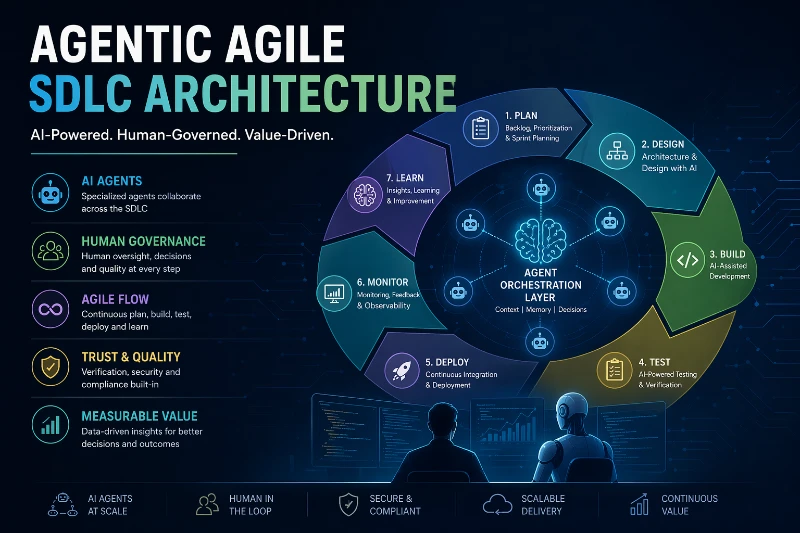
Software teams are no longer choosing whether to adopt AI, they are choosing how. The Agentic Agile SDLC Architecture offers a structured, governance-first answer to that question.
Authored by Saif ur Rehman, this whitepaper introduces a seven-layer framework that integrates specialized AI agents, covering requirements, architecture, coding, testing, documentation, DevOps, and verification—directly into a two-week Scrum sprint cycle. The result is a software factory where AI handles the repetitive, high-volume workload while human engineers focus on strategy, quality judgment, and critical decision-making.
The framework is grounded in real sprint data. A case study involving a JWT authentication module demonstrates 2.4× delivery velocity, a 72% AI contribution ratio, 94 automatically generated test cases, and zero post-release defects—at a total AI compute cost of just $180 per sprint.
Beyond theory, the whitepaper includes three annotated Kanban board examples that illustrate exactly how AI and human task ownership are split across sprint columns—from Backlog through In Progress, Review, Blocked, and Done. A dedicated agent orchestration layer governs task routing, confidence scoring, retry logic, and mandatory human-in-the-loop approval gates.
For teams concerned about risk and compliance, the whitepaper provides a comprehensive AI governance and guardrails framework covering data privacy, security scanning, bias auditing, audit traceability, and configurable approval thresholds.
A practical five-phase implementation roadmap guides organizations from initial pilot to full-scale adoption across 12 months. Whether you lead an engineering team, own a product, or drive a digital transformation strategy, this whitepaper provides the architectural clarity needed to harness AI in software delivery—responsibly, measurably, and at scale.