

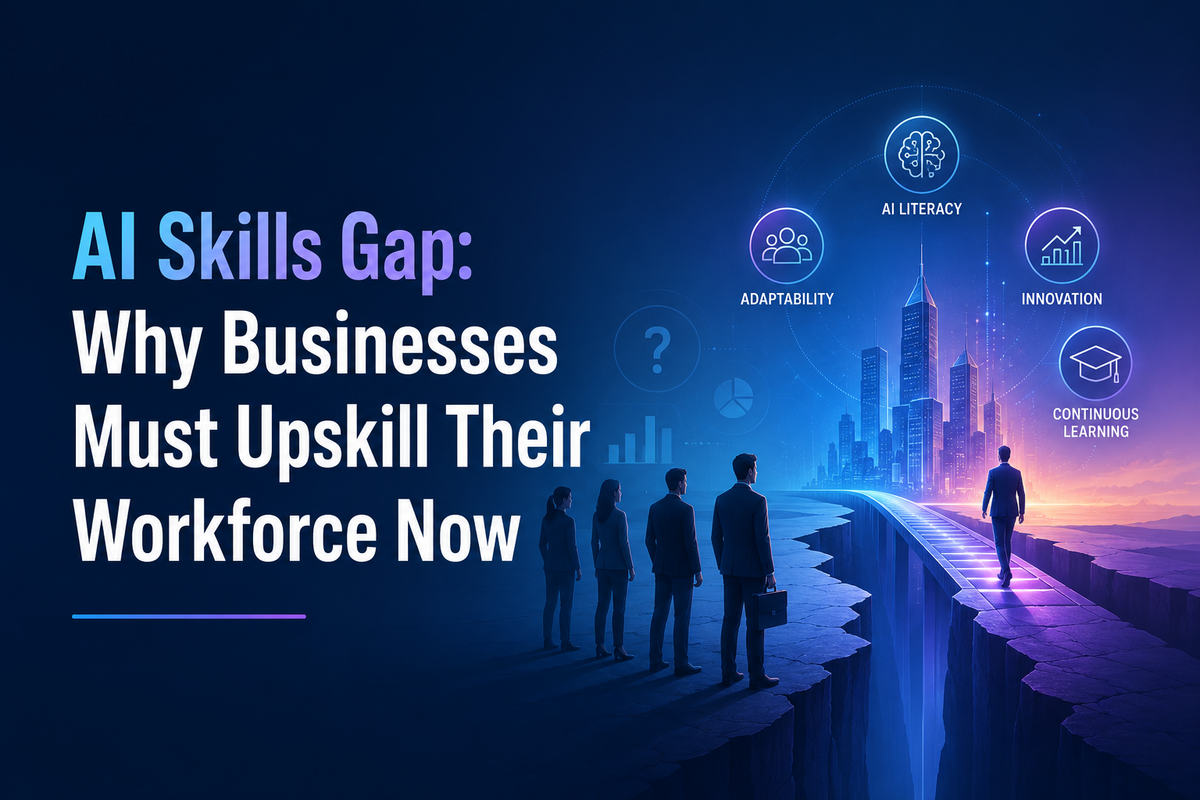
Artificial intelligence has become the centerpiece of enterprise transformation. Organizations are investing billions in AI platforms, automation, cybersecurity, and intelligent analytics. Yet, despite record-breaking technology spending, one obstacle continues to slow innovation: the shortage of AI-ready talent.
The challenge is no longer buying the right technology. It is ensuring employees know how to use it effectively. As businesses rush to integrate generative AI into everyday operations, workforce readiness has emerged as one of the biggest competitive advantages—and risks—of 2026.
For organizations planning their next digital transformation initiative, understanding the AI skills gap is becoming just as important as selecting the right software.
AI Adoption Is Moving Faster Than Employee Readiness
Generative AI tools are now embedded into customer service platforms, software development environments, marketing automation, finance operations, and healthcare systems. Employees are expected to collaborate with AI rather than simply use traditional business software.
However, many organizations are discovering that technology implementation alone doesn't create productivity gains. Without proper training, governance, and change management, AI investments often fail to deliver measurable business outcomes.
Industry analysts increasingly point to workforce capability as one of the defining factors separating successful AI initiatives from stalled digital transformation projects.
The New Enterprise Skill Set
The modern workplace requires a different combination of technical and business capabilities than it did just a few years ago.
Instead of focusing solely on programming expertise, organizations are prioritizing practical AI competencies such as:
- Prompt engineering and AI-assisted workflows
- Data literacy and analytical thinking
- Responsible AI usage and governance
- Automation strategy
- Critical evaluation of AI-generated content
- Cybersecurity awareness in AI-powered environments
These skills are becoming valuable across departments—not just within IT teams. Marketing professionals use AI for campaign optimization, finance teams automate reporting, HR departments streamline recruitment, and legal teams accelerate document analysis.
The result is a growing demand for continuous learning rather than one-time technical training.
Why AI Training Is Becoming a Business Strategy
Many organizations initially viewed AI education as an optional employee benefit. That perspective is rapidly changing.
Executives increasingly recognize that AI literacy directly impacts productivity, innovation, customer experience, and operational efficiency.
Employees who understand how to collaborate with AI systems can often complete repetitive tasks faster, generate higher-quality insights, and dedicate more time to strategic decision-making.
Conversely, poorly trained teams may misuse AI tools, introduce security risks, or create inaccurate outputs that require significant manual correction.
In other words, AI adoption without workforce enablement can become an expensive experiment rather than a competitive advantage.
Leadership Faces a New Responsibility
The AI revolution is reshaping leadership expectations.
Executives are no longer expected to understand only technology budgets and software procurement. They must also establish governance frameworks, define responsible AI policies, and create learning cultures that encourage experimentation while minimizing risk.
Organizations that provide structured AI education are generally better positioned to scale innovation across departments because employees gain confidence in using new technologies responsibly.
This shift is making learning and development programs an essential part of enterprise AI strategies rather than an afterthought.
Cybersecurity and AI Are Becoming Interconnected
Another growing concern involves cybersecurity.
As employees increasingly interact with AI platforms, organizations face new challenges involving sensitive data, privacy regulations, intellectual property protection, and model security.
Training employees to recognize secure AI practices has become just as important as teaching them how to write effective prompts.
Businesses are expanding security awareness programs to include topics such as data governance, AI compliance, secure automation, and responsible information sharing.
This integrated approach helps reduce operational risks while supporting broader digital transformation initiatives.
The Rise of AI Learning Ecosystems
Traditional classroom training is giving way to continuous learning ecosystems powered by AI itself.
Organizations are deploying adaptive learning platforms, virtual AI coaches, personalized learning paths, and interactive simulations that evolve alongside changing technologies.
Rather than completing a single certification every few years, employees now engage in ongoing skill development aligned with new AI capabilities and business priorities.
This model enables organizations to respond more quickly as AI technologies continue to evolve.
Looking Ahead
The conversation around artificial intelligence is shifting from "Which AI platform should we buy?" to "How do we prepare our people to succeed with AI?"
Technology will undoubtedly continue advancing, but organizations that combine innovation with workforce development are more likely to realize long-term value from their investments.
As AI becomes embedded in nearly every business function, closing the skills gap will require collaboration between technology leaders, HR teams, educators, and employees themselves.
The companies that invest in both technology and talent today will be better equipped to navigate tomorrow's increasingly AI-driven economy.
For business leaders, the message is clear: the future of AI is not just about smarter machines—it is about building smarter organizations.