

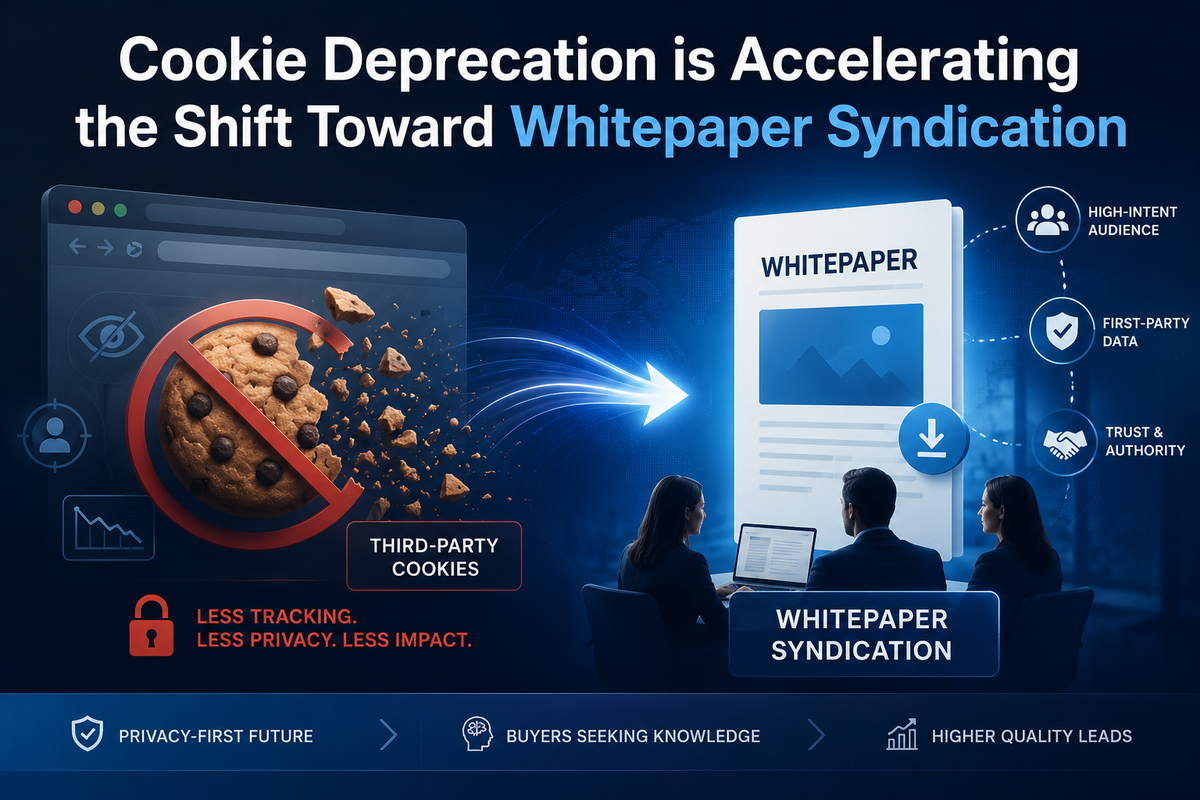
For years, digital advertising depended on third-party cookies to understand audiences, personalize campaigns, and measure performance. That model is rapidly disappearing. Privacy regulations have tightened, browsers continue restricting cross-site tracking, and buyers have become far more conscious of how their data is collected and used. Although the pace of cookie deprecation has evolved over the past year, the direction of the industry remains unchanged: businesses must rely less on third-party tracking and more on trusted, permission-based engagement.
This shift is creating a significant opportunity for B2B marketers. Rather than chasing anonymous website visitors through increasingly limited tracking methods, organizations are investing in strategies that generate meaningful interactions with prospects who actively seek valuable information. Whitepaper syndication has emerged as one of the most effective approaches because it combines educational content, first-party data collection, and high-intent audience engagement into a single demand generation strategy.
As enterprise buying journeys become longer and more research-driven, the value of delivering relevant insights through trusted content is growing faster than ever.
Privacy-First Marketing Is Redefining Lead Generation
The marketing industry is entering a privacy-first era. Recent developments across browser technologies, data protection regulations, and enterprise governance have reinforced the importance of collecting customer data transparently and responsibly. Buyers now expect organizations to explain why information is being collected and how it will be used, while regulators continue to emphasize user consent and data accountability.
At the same time, artificial intelligence is changing how enterprise buyers discover information. AI-powered search experiences, intelligent assistants, and conversational search platforms increasingly summarize content before users even visit a website. Instead of relying solely on advertisements or search rankings, businesses must ensure their expertise appears wherever buyers conduct research.
This changing landscape makes educational assets more valuable than promotional campaigns. Whitepapers provide detailed insights into emerging technologies, business challenges, regulatory changes, and industry best practices. When distributed through reputable syndication platforms, these resources reach professionals who are actively researching solutions rather than casually browsing online.
Unlike traditional advertising campaigns that often depend on behavioral tracking, whitepaper syndication generates engagement through relevance and expertise. Decision-makers willingly exchange their information because they receive valuable knowledge in return. That creates stronger first-party relationships while aligning with modern privacy expectations.
The shift is especially important as enterprise purchasing decisions involve multiple stakeholders across departments. A single whitepaper can educate technical teams, financial decision-makers, operations leaders, and executive sponsors simultaneously, making it an effective asset throughout extended buying cycles.
First-Party Data Is Becoming the Foundation of B2B Growth
As third-party data becomes less reliable, first-party data has become one of the most valuable assets in modern marketing. Every interaction that occurs through permission-based engagement creates a stronger understanding of buyer interests without depending on external tracking technologies.
Whitepaper syndication naturally supports this evolution. Instead of collecting anonymous website visits, organizations receive meaningful engagement from professionals who voluntarily demonstrate interest in specific topics. These interactions often reveal far more about purchase intent than traditional advertising metrics ever could.
The growing adoption of AI within marketing platforms further increases the value of first-party data. Machine learning models now use engagement signals, content preferences, behavioral patterns, and historical interactions to identify buying intent, prioritize leads, and personalize future communications. The higher the quality of first-party information, the more effective these AI-driven systems become.
Recent industry discussions around AI-powered demand generation also highlight another important trend. Marketing success is gradually shifting away from maximizing lead volume toward improving lead quality. Organizations are focusing on attracting decision-makers with genuine business needs rather than filling databases with low-intent contacts.
Whitepaper syndication aligns naturally with this objective because individuals downloading research-driven content are often evaluating challenges, comparing solutions, or preparing future purchasing decisions. This allows marketing and sales teams to engage prospects with greater context and relevance.
Whitepaper Syndication Is Becoming a Strategic Trust Channel
Trust has become one of the defining factors in enterprise marketing. Buyers are exposed to an overwhelming amount of AI-generated content, automated outreach, and promotional messaging every day. As a result, they increasingly seek information backed by credible research, practical expertise, and independent analysis.
Whitepapers remain one of the few content formats capable of delivering that depth. Rather than offering quick answers, they provide comprehensive perspectives that help organizations understand complex technologies, evaluate market trends, and make informed business decisions. When syndicated through trusted industry publications and professional networks, their credibility extends even further.
Another emerging trend is the growing influence of AI-generated summaries. Modern AI search experiences increasingly analyze long-form content and present concise overviews to users before they access the original source. Well-structured whitepapers with authoritative insights are therefore becoming more visible not only to human readers but also to AI systems that determine which information deserves broader exposure.
This means whitepaper syndication is no longer only a lead generation tactic. It is becoming an important visibility strategy that strengthens brand authority across both traditional search and AI-powered discovery channels.
As privacy regulations continue evolving and organizations reduce their dependence on third-party cookies, B2B marketing will increasingly revolve around trust, expertise, and first-party relationships. Whitepaper syndication sits at the intersection of all three. It enables organizations to educate buyers, collect permission-based insights, and establish credibility in an environment where meaningful engagement matters far more than anonymous tracking.
The future of demand generation will belong to organizations that create value before asking for attention. In a privacy-first digital economy, informative content distributed to the right audience is becoming far more powerful than tracking users across the web. Whitepaper syndication is not simply adapting to the post-cookie era, it is helping define what effective B2B marketing looks like in it.