

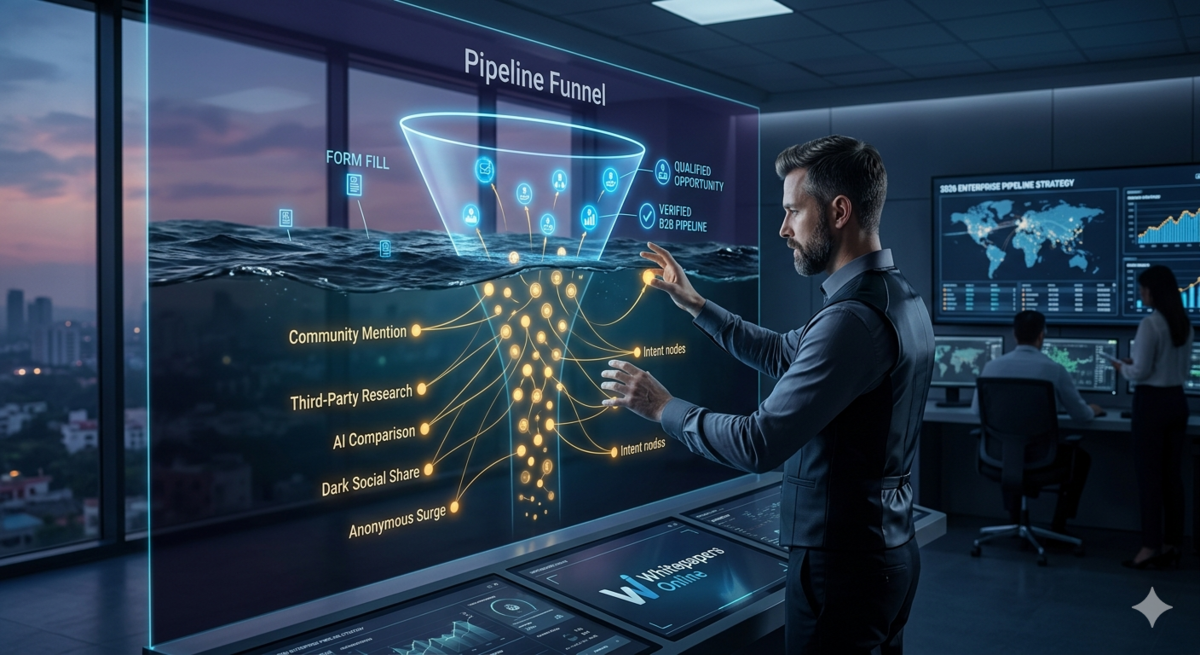
In the old world of demand generation, a prospect was a lead only when they raised their hand. They filled out a form, became an MQL (Marketing Qualified Lead), and were passed to sales. But in 2026, that hand-off is happening far too late.
Welcome to the era of the Silent Funnel. Today’s enterprise buyer completes nearly 75% of their journey in total anonymity. They are researching in private Slack communities, listening to niche podcasts, and using AI agents to compare features—all without ever hitting your website. If your B2B Pipeline relies solely on form fills, you are effectively blind to 3/4 of your potential revenue.
To win in 2026, you must stop waiting for the lead and start engineering the B2B Pipeline for the "ghost" buyer.
1. The Anatomy of a Silent Buyer
Why has the B2B Pipeline gone quiet? It’s not that buyers aren't interested; it's that they are highly protective of their time.
-
The AI Shield: Buyers use LLMs to summarize your whitepapers so they don't have to read them.
-
Dark Social: Recommendations happen in closed groups (Discord, WhatsApp, Substack) where traditional tracking pixels cannot follow.
-
The Trust Gap: Buyers avoid "Contact Sales" buttons until they have already made a 90% decision to buy.
If you don't have a strategy to influence these silent stages, your B2B Pipeline will consist only of "bottom-of-the-barrel" price shoppers rather than strategic partners.
2. Identifying "Digital Exhaust"
Just because a buyer is silent doesn't mean they are invisible. Every silent researcher leaves behind Digital Exhaust—non-linear signals that, when aggregated, show a clear intent to purchase.
To feed your B2B Pipeline, you must move beyond simple "clicks" and start tracking:
-
Topic-Level Intent: Are multiple people from the same target account suddenly researching "Sovereign Cloud Compliance" across third-party news sites like iTMunch?
-
Account-Level Surges: An individual might be anonymous, but their corporate IP range is not. Identifying an account-wide surge in interest is the 2026 equivalent of a hot lead.
3. Transitioning from MQLs to "Signal-Based" Revenue
The MQL is a vanity metric in 2026. A download is no longer a signal of intent; it’s often just a signal of curiosity (or an AI bot scraping your site).
The modern B2B Pipeline is built on Signal-Layered Qualification. Instead of a single form fill, a prospect enters the pipeline when they hit a threshold of combined signals:
-
They viewed a technical comparison on a third-party site.
-
They used an interactive ROI calculator.
-
Three different stakeholders from their company visited your pricing page.
When these signals align, the B2B Pipeline triggers an automated, low-friction "nudge"—perhaps an invitation to a private peer-roundtable—rather than an aggressive sales call.
4. How iTMunch Illuminates the Dark Funnel
This is where third-party platforms become your greatest asset. Because iTMunch acts as a neutral authority, buyers are more likely to engage with our content long before they visit a vendor’s site.
By syndicating through iTMunch, you aren't just getting "leads"; you are getting Visibility into the Silent Funnel. We provide the intent data that shows which accounts are warming up, allowing you to prioritize your B2B Pipeline based on real-world movement, not just wishful thinking.
The Final Byte
The "Silent Funnel" isn't a threat; it’s an opportunity for brands that are brave enough to ungate their best insights and trust their data. When you provide value without friction, you earn the right to be the first vendor the silent buyer calls when they finally decide to speak.
Is your pipeline running on 2022 metrics? [Talk to iTMunch today] about our 2026 Intent-Capture frameworks and start seeing the 75% of the B2B Pipeline you’ve been missing.