

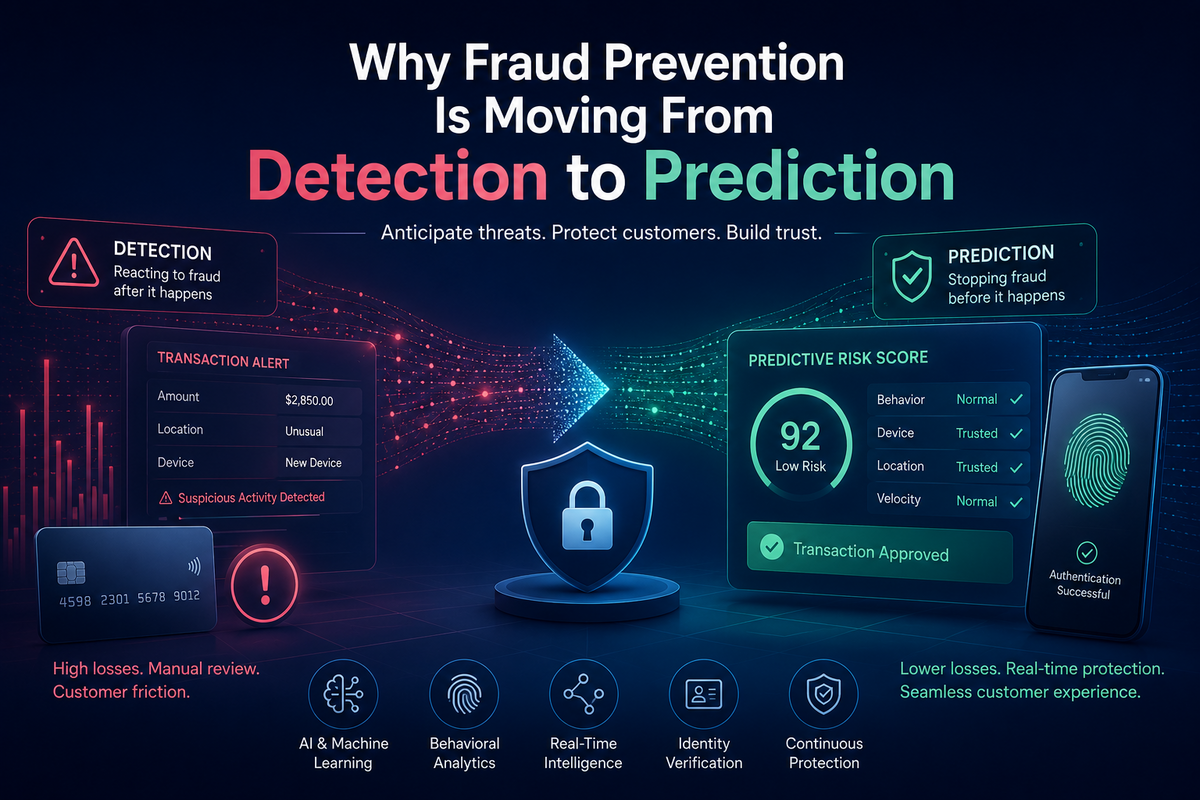
For years, fraud prevention followed a familiar pattern. A suspicious transaction occurred, security systems flagged it, investigators reviewed the activity, and organizations responded after the threat had already emerged. While this reactive approach has protected financial institutions for decades, it is becoming increasingly difficult to keep pace with today's fraud landscape.
Artificial intelligence is changing both sides of the equation. Financial institutions are using AI to detect suspicious behavior faster than ever before, while cybercriminals are leveraging the same technology to automate phishing campaigns, create convincing deepfakes, imitate customer communications, and bypass traditional security controls. Fraud is no longer simply becoming more frequent, it is becoming more intelligent.
This shift is prompting banks, payment providers, and fintech companies to rethink how they approach security. Instead of focusing only on detecting fraud after suspicious activity appears, many organizations are investing in systems that predict risk before financial losses occur. Prediction is emerging as the next frontier of fraud prevention, giving organizations the ability to anticipate threats rather than simply respond to them.
Fraud Is Becoming Faster Than Traditional Detection
The digital transformation of financial services has dramatically expanded convenience for customers, but it has also increased the number of opportunities available to fraudsters. Instant payments, digital wallets, embedded finance, open banking ecosystems, and AI-powered customer interactions have introduced new attack surfaces that require constant monitoring.
Recent industry trends reflect this growing challenge. Financial institutions across the globe are reporting an increase in AI-assisted fraud attempts, particularly those involving synthetic identities, account takeovers, and highly personalized social engineering attacks. Deepfake voice technology has also become a growing concern, with fraudsters using realistic audio to impersonate executives, employees, and even customers during payment authorization processes.
Traditional rule-based systems often struggle to identify these sophisticated attacks because they rely heavily on predefined thresholds. A transaction might only be flagged after exceeding certain limits or matching historical fraud patterns. Modern attackers understand these rules and continuously adapt their techniques to avoid triggering them.
This is where predictive intelligence begins to change the conversation.
Rather than asking whether a transaction looks suspicious, predictive fraud models analyze thousands of behavioral signals simultaneously. Login behavior, device fingerprints, transaction history, geographic patterns, typing speed, network relationships, and customer activity can all contribute to a dynamic risk profile that evolves in real time.
This allows organizations to identify subtle warning signs before fraudulent transactions are completed, reducing both financial losses and customer friction.
AI Is Making Prediction a Business Strategy
Prediction is no longer limited to fraud analysts. It is becoming a strategic capability that influences customer experience, operational efficiency, and business resilience.
Modern AI platforms continuously learn from new fraud patterns instead of relying solely on historical rules. As criminals develop new techniques, machine learning models can recognize emerging anomalies much faster than traditional systems.
At the same time, financial institutions are increasingly integrating predictive insights across multiple systems instead of treating fraud as an isolated function. A modern fraud detection software platform can combine transaction monitoring with identity verification, behavioral analytics, authentication signals, and risk scoring to create a more complete picture of potential threats.
This integrated approach is becoming increasingly important as financial ecosystems grow more connected. Embedded finance platforms, Banking-as-a-Service providers, digital payment networks, and fintech partnerships all introduce additional data sources that can improve predictive accuracy when analyzed together.
Recent regulatory developments are also encouraging stronger operational resilience and proactive risk management. Around the world, financial regulators continue emphasizing governance, AI oversight, cybersecurity readiness, and fraud prevention frameworks. Organizations are recognizing that predictive security is no longer simply a technology investment, it is becoming an essential component of regulatory preparedness and customer trust.
The business impact extends beyond security teams. Predictive fraud prevention can reduce false positives, accelerate legitimate transactions, improve customer satisfaction, and minimize unnecessary payment declines that often frustrate users.
For decision-makers, that translates into lower operational costs while protecting both revenue and brand reputation.
The Future of Fraud Prevention Starts Before the Transaction
Perhaps the biggest change in financial security is where fraud prevention now begins.
Instead of evaluating only completed transactions, organizations are monitoring digital behavior throughout the customer journey. Risk assessment increasingly starts during account creation, login authentication, identity verification, payment initiation, and even browsing behavior before sensitive actions occur.
This proactive model aligns with broader trends shaping the fintech industry. AI-powered decision-making, real-time analytics, behavioral biometrics, continuous authentication, and deepfake detection are helping organizations build security directly into the customer experience instead of adding friction after suspicious activity appears.
The objective is not to create more security barriers. It is to make security intelligent enough that legitimate customers rarely notice it while high-risk behavior is identified early.
As financial services continue evolving toward real-time experiences, reactive fraud prevention will become increasingly difficult to sustain. Instant payments leave little time for manual review, while AI-generated attacks evolve faster than static security rules can adapt.
Organizations that embrace predictive fraud strategies today will be better positioned to navigate tomorrow's risks. They will move beyond simply detecting attacks toward anticipating them, protecting customers without compromising speed or convenience.
The future of fraud prevention is not defined by how quickly organizations respond after fraud occurs. It will be defined by how effectively they predict threats before criminals have the opportunity to succeed.