

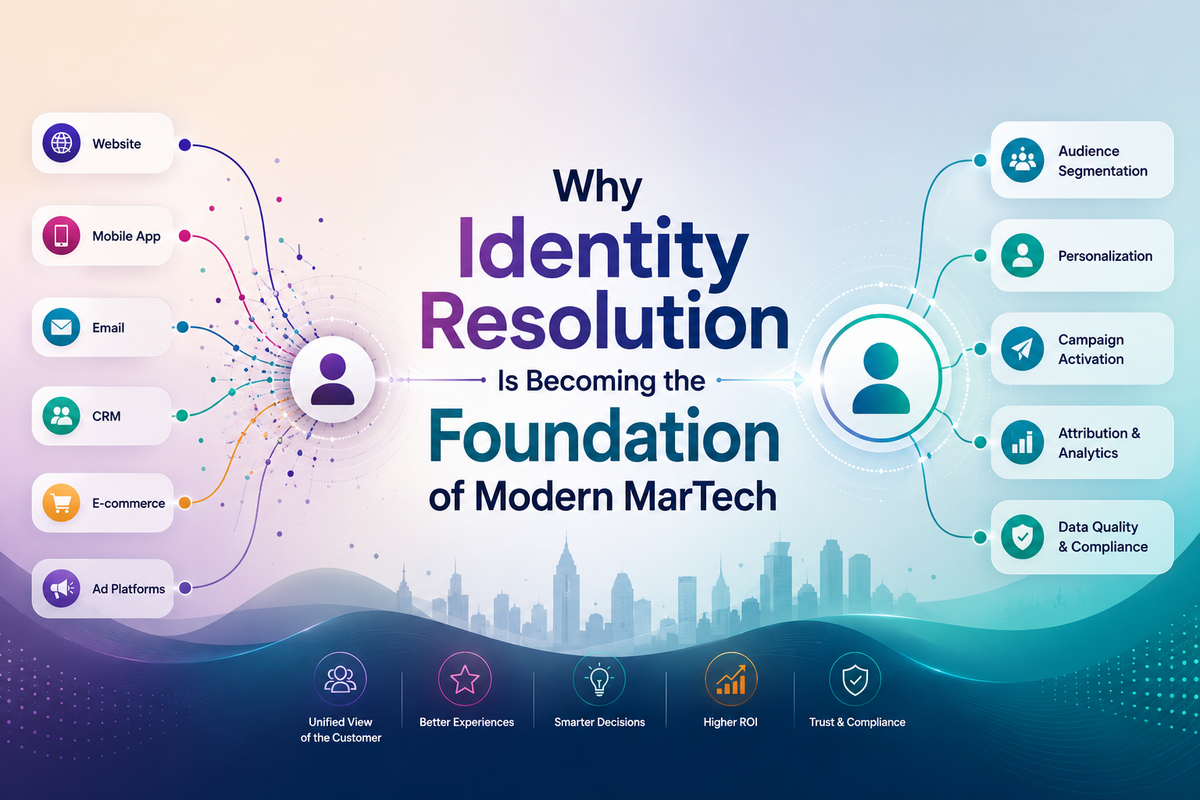
Modern marketing is experiencing a fundamental shift. For years, organizations invested heavily in customer relationship management platforms, marketing automation tools, data management platforms, customer data platforms, and AI-powered analytics. Yet despite expanding technology stacks, many B2B organizations continue to struggle with a surprisingly basic problem: they still cannot confidently identify the same customer across multiple channels, devices, and interactions.
This challenge has become even more urgent as privacy regulations evolve, third-party cookies continue disappearing, AI-powered marketing becomes more sophisticated, and buying journeys stretch across dozens of digital touchpoints. Recent industry conversations around first-party data strategies, retail media growth, AI-driven personalization, and responsible data governance all point toward one conclusion. Identity resolution is no longer just another marketing capability. It is becoming the foundation that determines whether every other MarTech investment succeeds.
Why Modern Marketing Can No Longer Rely on Fragmented Customer Data
Today's enterprise buyer rarely follows a predictable journey. A prospect may discover a company through an AI-generated search response, download a research report from a laptop, attend a webinar using a corporate email address, interact with sales through LinkedIn, revisit the website from a mobile device, and later engage with customer success after becoming a client. Every interaction generates valuable data, but much of it exists in separate systems that often fail to recognize it belongs to the same individual.
As organizations adopt more AI-powered marketing tools, disconnected customer identities create even greater complexity. Predictive models, audience segmentation, lead scoring, and campaign personalization all depend on accurate customer profiles. When data remains fragmented, AI simply processes incomplete or inconsistent information, producing recommendations that appear intelligent but often miss the broader customer context.
This challenge has become increasingly visible as enterprises accelerate investments in first-party data strategies. The industry's focus is gradually shifting away from collecting more information toward improving the quality, consistency, and usability of existing customer data. Instead of asking how much data they possess, marketing leaders are asking whether their systems truly understand who each customer is.
Identity resolution answers that question by connecting interactions across websites, CRM platforms, marketing automation systems, advertising platforms, customer support applications, and offline engagements into unified customer profiles. Rather than viewing isolated activities, organizations gain a continuous understanding of customer relationships that supports better decision-making across the business.
AI Is Raising the Stakes for Identity Resolution
Artificial intelligence has rapidly become the driving force behind modern MarTech. AI now influences campaign optimization, audience creation, content recommendations, forecasting, conversational marketing, and customer journey orchestration. However, AI is only as effective as the information it receives.
Industry discussions throughout 2026 increasingly emphasize responsible AI deployment, data governance, and trustworthy automation. Enterprises are recognizing that sophisticated AI models cannot compensate for fragmented customer identities. If multiple records represent the same buyer differently across systems, AI-generated insights become inconsistent, personalization loses relevance, and campaign performance suffers.
This reality explains why identity resolution is becoming closely connected with AI governance initiatives. Organizations are placing greater emphasis on creating trusted customer records before expanding AI capabilities. Instead of continuously adding new automation layers, forward-looking enterprises are improving the quality of the data that powers every AI decision.
The growing adoption of composable MarTech architectures also reinforces this trend. Rather than relying on a single platform to manage every marketing function, enterprises increasingly integrate specialized technologies across advertising, analytics, customer engagement, whitepaper syndication, content management, and revenue operations. Identity resolution acts as the connective layer that enables these platforms to work together, ensuring prospect and customer data remains consistent across every touchpoint. This is especially valuable for organizations running whitepaper syndication campaigns, where lead data from multiple publishing and distribution channels must be accurately matched to existing customer profiles instead of creating duplicate records or conflicting business insights.
For B2B organizations managing long buying cycles and multiple decision-makers, this unified perspective becomes especially valuable. Marketing teams can better understand account engagement, sales teams receive richer customer context, and executives gain more reliable performance reporting because every interaction contributes to a consistent customer narrative.
Identity Resolution Is Becoming a Business Strategy, Not Just a Marketing Capability
Perhaps the biggest change occurring across enterprise MarTech is that identity resolution is no longer viewed as solely a technical implementation project. It is increasingly becoming a strategic business capability that influences customer experience, compliance, revenue growth, and operational efficiency simultaneously.
As global privacy regulations continue evolving, organizations are under greater pressure to manage customer consent, maintain accurate records, and ensure responsible data usage across every marketing channel. Identity resolution helps create a clearer understanding of customer preferences while supporting stronger governance and regulatory compliance.
At the same time, executive leadership expects marketing to demonstrate measurable business outcomes rather than isolated campaign metrics. Unified customer identities improve attribution models, strengthen forecasting accuracy, enhance account-based marketing strategies, and create more meaningful engagement across the entire customer lifecycle.
Another emerging trend is the convergence of identity resolution with customer data platforms, AI governance, and revenue intelligence. Rather than operating independently, these technologies increasingly work together to deliver a consistent view of customer relationships across marketing, sales, customer success, and service teams. This broader integration transforms customer data into an enterprise-wide strategic asset rather than a collection of disconnected marketing records.
Organizations that establish strong identity resolution capabilities today will likely be better positioned to adopt future AI innovations without sacrificing trust, compliance, or customer experience. As new marketing channels, intelligent agents, and digital engagement models continue emerging, the ability to accurately recognize customers across every interaction will become even more valuable.
The future of MarTech will not be defined solely by the sophistication of AI or the number of technologies within the stack. It will be determined by how effectively those technologies understand the people they are designed to serve. Identity resolution provides that understanding, making it one of the most important foundations for modern B2B marketing in the years ahead.