

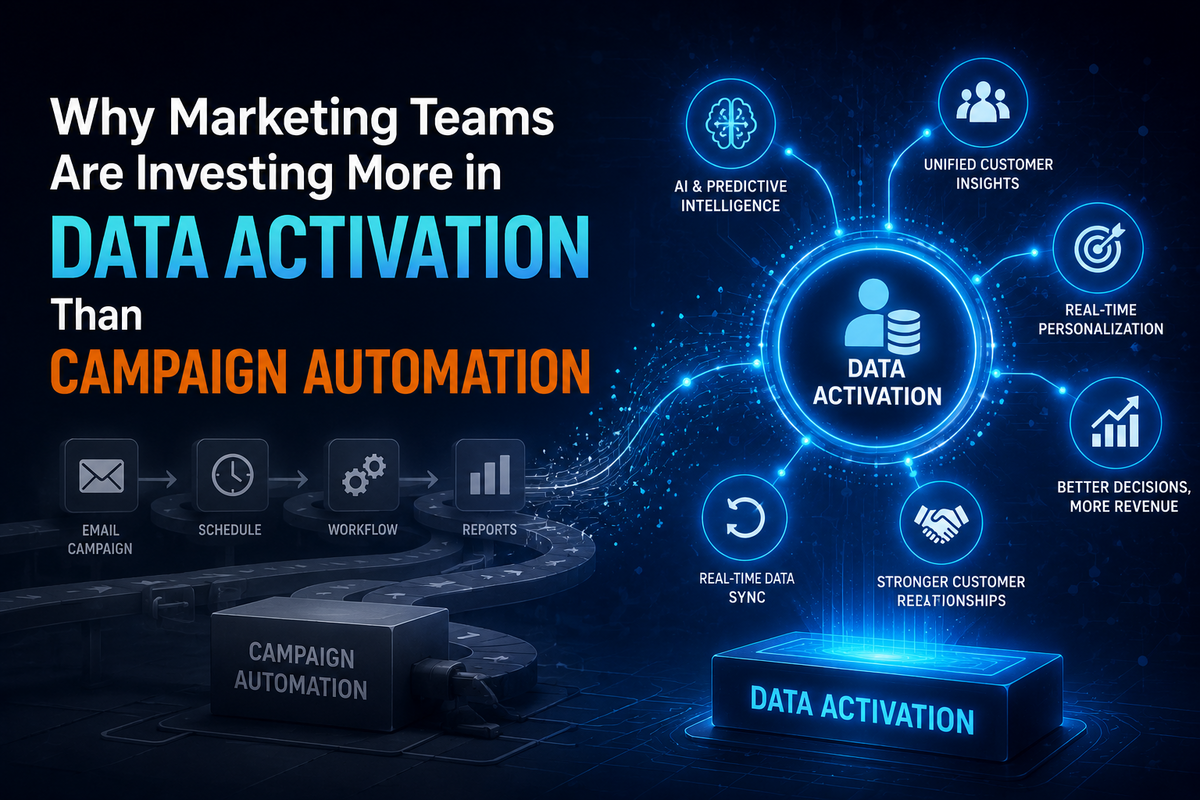
For years, campaign automation dominated conversations around marketing technology. Businesses invested heavily in tools that could automate email sequences, schedule social posts, launch personalized campaigns, and optimize customer journeys. Automation promised efficiency, scalability, and improved customer engagement and it delivered meaningful results.
However, a noticeable shift is taking place across enterprise marketing teams in 2026. The competitive advantage is no longer defined by how many campaigns an organization can automate. Instead, it depends on how effectively marketing teams can activate the data they already possess. As AI transforms customer interactions and buying journeys become increasingly fragmented, organizations are realizing that disconnected data is a far greater obstacle than manual workflows.
Today's leading B2B marketers are placing greater emphasis on data activation because relevant, real-time insights create better customer experiences than automation alone. The future of marketing belongs to organizations capable of transforming data into intelligent action.
Data Without Activation Has Limited Business Value
Most enterprises have accumulated enormous volumes of customer information through CRM platforms, websites, marketing automation systems, analytics tools, webinars, customer support channels, and third-party intent data providers. Yet despite this abundance of information, many organizations continue to struggle with delivering timely, personalized engagement.
The challenge is not collecting more data, it is making existing data usable.
Data activation bridges the gap between information and execution. Rather than allowing customer insights to remain isolated inside individual platforms, activated data flows across the entire marketing ecosystem, enabling teams to respond to customer behavior almost instantly.
Imagine a prospect who downloads a technical white paper, visits pricing pages multiple times, attends a webinar, and later searches for solution comparisons using an AI-powered search assistant. These interactions become significantly more valuable when they are connected into a unified customer profile. Marketing can then deliver relevant messaging, sales teams receive richer context, and customer success teams gain visibility into buyer intent before conversations even begin.
This growing focus reflects broader industry developments. AI-powered search experiences are changing how enterprise buyers research vendors, while privacy regulations continue encouraging organizations to maximize first-party data instead of relying heavily on third-party cookies. Businesses are responding by investing in technologies that improve customer understanding rather than simply increasing campaign volume.
As customer journeys become less predictable, activated data provides the context necessary for more intelligent decision-making.
AI Is Accelerating the Need for Real-Time Marketing Intelligence
Generative AI has significantly altered the pace of modern marketing. Buyers no longer rely solely on traditional search engines or email campaigns to discover information. They explore AI assistants, industry communities, review platforms, webinars, analyst reports, and professional networks throughout their purchasing process.
This fragmented discovery process creates dozens of valuable customer signals that cannot be managed through campaign automation alone.
Marketing leaders are increasingly adopting customer data platforms, identity resolution technologies, predictive analytics, and AI-powered intelligence layers that continuously interpret behavioral data. Rather than waiting for scheduled campaigns to engage prospects, these systems identify intent signals as they emerge and recommend the next best action.
Recent developments across the MarTech industry demonstrate this transition. Vendors are embedding AI copilots into marketing platforms, customer data platforms are expanding real-time activation capabilities, and major cloud providers continue investing in unified data architectures that eliminate departmental silos. Industry analysts also predict continued growth in AI-enabled customer intelligence as organizations prioritize personalization while maintaining stronger governance over customer data.
The result is a marketing function that reacts dynamically instead of relying exclusively on predefined automation rules.
This evolution is especially important for B2B organizations, where buying committees involve multiple stakeholders across lengthy sales cycles. Data activation helps connect interactions from every decision-maker, giving marketers a more complete understanding of account engagement and improving collaboration between marketing and sales.
Rather than automating every task, organizations are automating smarter decisions.
Data Activation Is Becoming the Foundation of Modern MarTech
The next generation of marketing technology will not be defined by the number of applications organizations own. It will be defined by how effectively those applications share intelligence.
Modern MarTech strategies increasingly revolve around interoperability, real-time synchronization, AI-driven recommendations, and unified customer profiles. Instead of adding another campaign tool, organizations are investing in technologies that strengthen data quality, enrich customer records, and distribute insights across every customer touchpoint.
This shift also changes how marketing success is measured. Traditional metrics like email open rates or campaign volume remain useful, but executive leadership increasingly expects marketing to demonstrate pipeline contribution, revenue influence, customer lifetime value, buying intent progression, and the impact of whitepaper lead generation on sales opportunities. These outcomes depend on activated data rather than isolated automation workflows, enabling marketing teams to connect content engagement with meaningful business results.
White paper lead generation offers a practical example of this transformation. Instead of measuring success purely through downloads, marketing teams now analyze how prospects interact with content after engagement. Activated data connects white paper consumption with website behavior, AI search referrals, webinar attendance, CRM activity, and sales conversations. These connected insights provide a much clearer picture of purchase readiness than campaign metrics alone.
As AI continues reshaping digital experiences, organizations that activate customer intelligence across every interaction will outperform those relying solely on automated campaigns. Automation remains an essential capability, but without accurate, connected, and actionable data, even the most sophisticated workflows lose effectiveness.
The future of marketing is not about sending more messages or building more automated journeys. It is about understanding customers with greater precision and responding with relevance at exactly the right moment. For B2B decision-makers, investing in data activation is no longer simply a technology upgrade, it is becoming a strategic advantage that enables better decisions, stronger customer relationships, and more sustainable business growth in an increasingly AI-driven marketplace.