
Silent System Collapse: Integration Failures in B2B and B2C Digital Commerce
Published on 14 Feb 2026
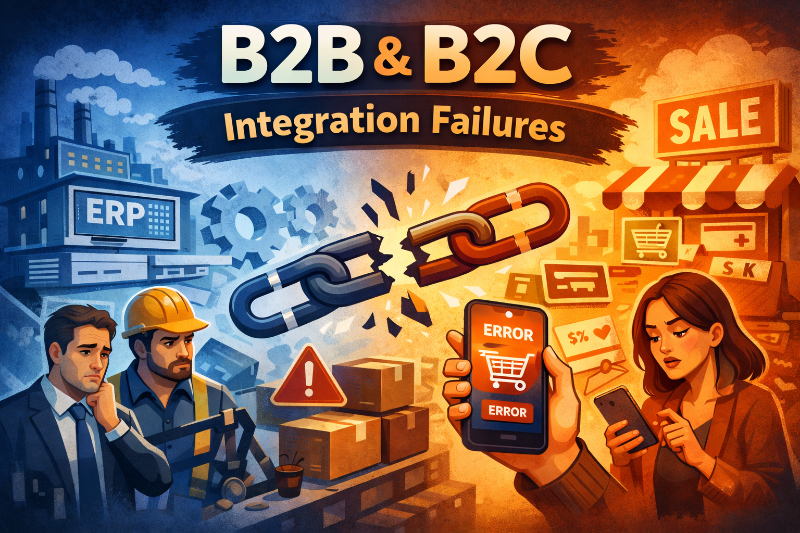
Integration failures rarely originate from a single defect; they emerge from systemic misalignment across architecture, governance, and operational processes. In both B2B and B2C environments, the surface symptoms differ, but the structural weaknesses often overlap.
B2B: Transactional Integrity Breakdown
In B2B ecosystems, enterprise platforms such as SAP and Oracle exchange high-value, contract-bound transactions across distributed systems. A frequent failure pattern occurs when batch-based synchronization collides with real-time API dependencies. For example, pricing or inventory updates processed overnight may conflict with live order placements during business hours.
Deep Root Causes:
-
Fragmented data ownership across departments
-
Poorly defined system-of-record governance
-
Tight coupling between legacy ERP logic and modern APIs
-
Lack of distributed tracing across middleware layers
The result is not immediate system collapse but silent data divergence—orders processed with outdated pricing, duplicated invoices, or delayed shipment acknowledgments. Over time, these inconsistencies compound into financial discrepancies and audit risks.
B2C: Latency Amplification and Experience Failure
In B2C models powered by platforms like Stripe and cloud services such as Amazon Web Services, integration failures propagate instantly to end users. Real-time personalization engines, payment confirmations, and inventory services must synchronize within milliseconds.
Deep Root Causes:
-
Event ordering inconsistencies in microservices
-
Insufficient load and chaos testing
-
Weak resiliency patterns (no circuit breakers or retries)
-
Cache and database state misalignment
Unlike B2B environments, B2C failures escalate publicly—resulting in overselling, checkout failures, and brand erosion. Ultimately, integration fragility stems from architectural complexity without governance discipline. Sustainable resilience requires strict API contracts, event-driven consistency models, and continuous observability across the integration landscape.
- #金融科技
- #人力资源科技
- #法律科技
- #营销科技
- #技术