

There was a time when B2B marketers celebrated high download numbers as the ultimate measure of a successful white paper. Thousands of downloads meant strong engagement, healthy lead generation, and a campaign worth repeating. But today's enterprise buying environment tells a different story.
Modern B2B purchases are rarely influenced by a single individual. Research from leading analyst firms continues to show that enterprise technology decisions often involve multiple stakeholders spanning IT, procurement, finance, operations, security, and executive leadership. At the same time, buyers are conducting more independent research through AI-powered search platforms, professional communities, analyst reports, and trusted industry publications before they ever speak with a vendor.
This shift has fundamentally changed what makes a white paper successful.
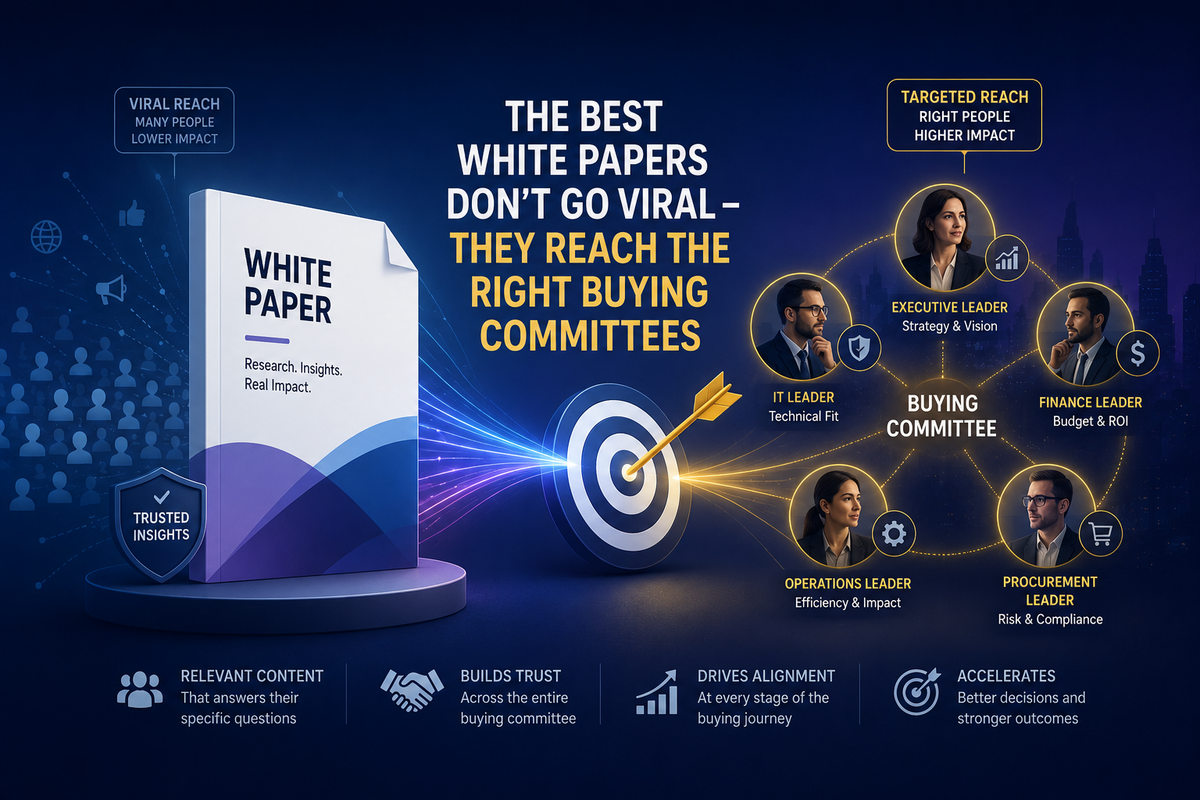
The most effective whitepapers are no longer those that achieve widespread visibility across the internet. They are the ones that consistently reach the specific people responsible for evaluating, influencing, and approving purchasing decisions. For B2B organizations, relevance has become significantly more valuable than reach.
Enterprise Buying Has Become a Committee Decision
The traditional marketing funnel assumed that a prospect downloaded a whitepaper, engaged with sales, and eventually became a customer. Today's buying journey is considerably more complex.
A technology evaluation may begin with an operations manager identifying a business challenge. An IT leader validates technical feasibility, procurement reviews commercial terms, finance assesses budget implications, while executives evaluate long-term strategic value. Each stakeholder enters the conversation with different priorities, different concerns, and different expectations from the content they consume.
This is one reason why generic thought leadership often struggles to influence enterprise purchases. While a broad industry report may generate significant download numbers, it may fail to answer the specific questions individual buying committee members are asking during their evaluation process.
The most successful whitepapers recognize this reality. Rather than attempting to appeal to everyone, they address a clearly defined business problem, present credible evidence, and deliver practical insights that multiple decision makers can confidently share within their organizations.
Another major development is the growing influence of AI-powered discovery. Buyers increasingly use platforms like ChatGPT, Gemini, Microsoft Copilot, and Perplexity to compare vendors, summarize complex topics, and identify potential solutions before visiting company websites. This means your white paper is no longer competing only against other downloadable assets, it is competing against countless digital sources that AI systems reference when answering enterprise questions.
As a result, organizations are placing greater emphasis on producing authoritative content supported by original insights, customer experiences, and industry expertise rather than simply increasing publishing volume.
Distribution Determines Whether Great Content Gets Read
Creating a valuable white paper is only half the challenge. Ensuring it reaches the right audience has become equally important.
Many organizations invest months researching, writing, and designing high-quality assets, only to promote them through a limited set of owned channels. Even exceptional content can remain invisible if it fails to appear where enterprise buyers are actively researching. This is why a well-planned media buying strategy, combined with targeted content distribution, has become increasingly important for ensuring high-value assets reach the right audiences across trusted digital platforms.
This is why whitepaper syndication continues to play an important role within modern B2B demand generation strategies. Rather than relying exclusively on website traffic or organic search, syndication extends authoritative content across trusted industry publications and professional networks where relevant decision makers are already consuming information. When combined with account-based marketing, targeted advertising, partner ecosystems, and email nurturing, it increases the likelihood that multiple members of a buying committee encounter the same research throughout their evaluation journey.
Recent shifts in search behavior reinforce the importance of this approach. As AI-generated answers and zero-click search experiences reduce direct website visits for many informational queries, marketers are recognizing that visibility across credible third-party platforms contributes to both buyer trust and AI discoverability. Content that consistently appears within respected industry ecosystems has a stronger chance of influencing both human decision makers and AI-generated recommendations.
The objective is no longer to maximize downloads. It is to maximize meaningful exposure among the accounts that are most likely to purchase.
Influence Is Becoming More Valuable Than Volume
One of the biggest misconceptions in B2B marketing is that campaign success can be measured primarily through lead volume.
In reality, one white paper downloaded by six stakeholders within a target enterprise account may create far greater business impact than hundreds of downloads from organizations with no purchasing intent.
Forward-thinking marketing leaders are therefore shifting their focus toward engagement quality rather than campaign scale. They are evaluating how content influences target accounts, how frequently it is shared internally, whether it accelerates sales conversations, and how effectively it supports buying committee alignment throughout long and complex sales cycles.
This mindset also encourages marketers to create content that remains valuable beyond its initial launch. A well-researched white paper can become the foundation for executive articles, webinars, analyst conversations, social content, sales enablement materials, customer education, and AI-friendly knowledge assets. This approach also strengthens whitepaper lead generation by extending the value of a single asset across multiple buyer touchpoints instead of relying solely on downloads. Instead of treating a white paper as a single campaign deliverable, successful organizations view it as a long-term strategic resource that builds authority across multiple channels.
The future of B2B lead generation will not belong to the brands generating the highest number of downloads. It will belong to those consistently earning the attention and trust of the right decision makers at the right time.
Virality may create awareness, but enterprise purchases are rarely driven by popularity alone. They are driven by credibility, relevance, and confidence across an entire buying committee.
The best white papers understand that distinction. They are not written to impress the internet. They are created to help the people who ultimately influence purchasing decisions make better, more informed choices. In today's AI-driven and committee-led buying landscape, that is what transforms content into meaningful business growth.