

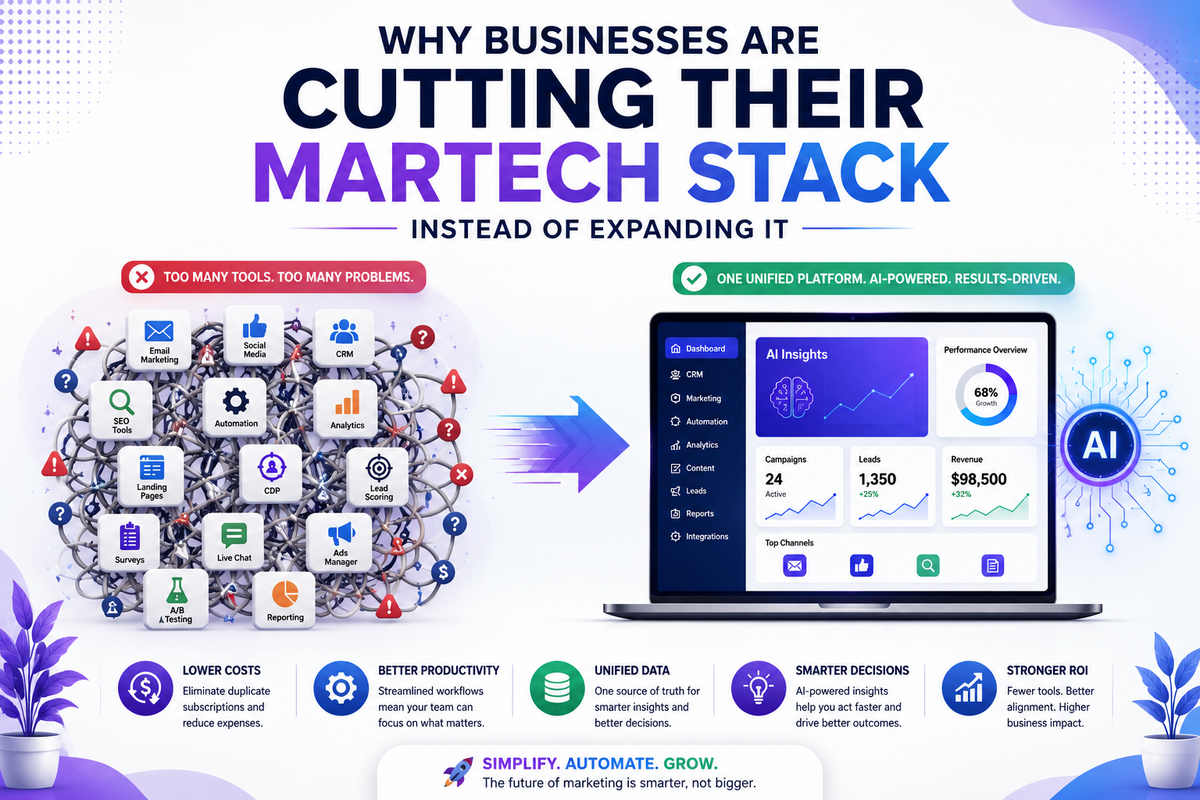
For nearly two decades, the marketing technology (MarTech) industry has operated on one simple belief: the more tools a business has, the better its marketing performance will be. Organizations invested heavily in customer relationship management (CRM) platforms, email marketing software, analytics dashboards, social media management tools, SEO suites, customer data platforms (CDPs), workflow automation software, and countless niche applications to optimize every stage of the customer journey.
But in 2026, that philosophy is rapidly changing.
Instead of expanding their technology stack, businesses are actively reducing it. Marketing leaders are auditing their software portfolios, eliminating redundant applications, and replacing fragmented systems with unified platforms that deliver more functionality from a single interface.
This shift isn't a sign that innovation has slowed—it's evidence that businesses are becoming more strategic about how they use technology. In an era where AI can automate multiple marketing functions simultaneously, simplicity is becoming one of the biggest competitive advantages.
The Problem with Expanding MarTech Stacks
Over the past decade, businesses adopted specialized software to solve specific marketing challenges. One platform managed email campaigns, another handled social media scheduling, another tracked website analytics, while separate tools focused on lead scoring, customer segmentation, automation, reporting, and advertising.
Individually, each application offered clear value. Together, however, they created an increasingly complex ecosystem that became difficult to manage. Marketing teams now spend valuable hours switching between platforms, troubleshooting integrations, synchronizing customer data, and maintaining disconnected workflows. Instead of improving productivity, oversized MarTech stacks often introduce unnecessary friction into daily operations.
Another growing concern is data fragmentation. Customer information scattered across multiple platforms makes it difficult to create a unified view of each customer, resulting in inconsistent messaging, inaccurate reporting, and missed opportunities for personalization. As businesses place greater emphasis on customer experience, disconnected data has become a liability rather than an inconvenience.
AI Is Accelerating Platform Consolidation
Artificial intelligence has become one of the biggest catalysts behind MarTech consolidation. Today's AI-powered platforms are capable of handling tasks that previously required multiple independent tools.
Content creation, campaign management, customer segmentation, lead scoring, workflow automation, predictive analytics, reporting, and personalization can now exist within a single platform. Rather than managing a collection of disconnected applications, businesses are choosing integrated ecosystems where AI works across every function using centralized customer data.
This approach not only reduces manual work but also improves decision-making. When AI has access to unified datasets instead of isolated information spread across several platforms, it can generate more accurate insights, automate workflows more effectively, and help marketing teams deliver more relevant customer experiences.
Rising Software Costs Are Driving Smarter Decisions
The economic landscape has also encouraged organizations to rethink their software investments. As budgets become more closely scrutinized, companies are questioning whether every subscription truly delivers measurable business value.
Many businesses have discovered overlapping functionality across multiple tools. Different departments often subscribe to similar platforms without realizing another team already uses software capable of performing the same tasks. These duplicate investments increase operational costs without improving results.
Rather than measuring success by the size of their software portfolio, marketing leaders are now evaluating whether each platform directly contributes to revenue growth, customer engagement, or operational efficiency. Eliminating unnecessary subscriptions has become one of the fastest ways to reduce expenses while simplifying everyday workflows.
Integration Complexity Is Becoming a Business Risk
Every additional marketing application introduces another integration that must be maintained.
APIs evolve, third-party connectors occasionally fail, and data synchronization issues become increasingly common as software ecosystems grow larger. Security reviews become more demanding, compliance requirements become harder to manage, and IT teams spend more time maintaining infrastructure instead of driving innovation.
Businesses are beginning to recognize that every new tool adds technical debt alongside new functionality. Reducing the number of integrations creates more stable systems, improves data accuracy, minimizes security risks, and lowers long-term maintenance costs. A streamlined technology environment is often more resilient than one built from dozens of interconnected applications.
Productivity Improves When Teams Use Fewer Platforms
One of the most overlooked benefits of MarTech consolidation is its impact on employee productivity.
When marketers no longer need to navigate multiple dashboards throughout the day, campaign execution becomes significantly faster. Training new employees requires less time, collaboration improves across departments, and teams spend more energy developing creative strategies instead of managing software.
Instead of remembering where specific reports, customer records, or automation workflows are located, employees can focus on delivering better marketing experiences. For lean marketing teams expected to accomplish more with fewer resources, simplifying the technology stack has become a practical way to increase efficiency without increasing headcount.
Vendors Are Responding with All-in-One Solutions
Software vendors have noticed this shift in buyer behavior and are adapting accordingly.
Rather than positioning themselves as single-purpose applications, many providers are expanding into comprehensive marketing ecosystems. Through AI capabilities, strategic acquisitions, and native integrations, software companies are combining CRM functionality, automation, analytics, content generation, lead management, reporting, and customer communication into unified platforms.
Businesses increasingly favor these all-in-one solutions because they reduce implementation time, simplify user adoption, and eliminate the operational challenges associated with managing dozens of disconnected applications. As AI continues to mature, integrated platforms are likely to become the new industry standard.
What Businesses Should Evaluate Before Cutting Tools
Reducing a MarTech stack isn't simply about eliminating software—it's about creating a smarter, more connected marketing ecosystem. Before removing any platform, businesses should carefully assess the value it brings to day-to-day operations. Some applications may appear redundant but still support critical workflows or unique business processes that aren't immediately obvious.
A good starting point is identifying overlapping functionality. If multiple tools perform similar tasks, consolidating them into a single platform can significantly reduce costs while simplifying operations. Marketing leaders should also analyze adoption rates across teams. A platform packed with features has little value if only a small percentage of employees actually use it. Modern AI-powered solutions are increasingly capable of replacing several standalone applications, making consolidation both practical and cost-effective.
Organizations should also evaluate how well each platform integrates with their core business systems. Software that seamlessly connects sales, marketing, and customer success teams creates a more complete customer journey while reducing manual work. The goal isn't simply to own fewer tools—it's to build a technology ecosystem where every platform has a clear purpose and contributes measurable business value.
Conclusion
The era of collecting marketing tools like trophies is coming to an end. Today's fastest-growing businesses aren't winning because they own the largest MarTech stack—they're winning because they've built the smartest one. By replacing fragmented software with integrated, AI-powered platforms, organizations are creating faster workflows, reducing operational costs, improving collaboration, and giving their teams more time to focus on building meaningful customer relationships.
As artificial intelligence continues to reshape the marketing landscape, the conversation is shifting from "What new tool should we buy?" to "What can we simplify?" Businesses that embrace this mindset won't just save money—they'll be better positioned to adapt, innovate, and compete in an increasingly AI-driven world.
If you want to stay ahead of these industry shifts, ITMunch is a great place to start. From breaking technology news and emerging AI trends to in-depth analysis of MarTech, cybersecurity, enterprise software, and digital transformation, ITMunch delivers the insights businesses need to make smarter technology decisions. Whether you're a marketing leader, IT professional, or business decision-maker, you'll find practical perspectives on the innovations shaping tomorrow's workplace.