

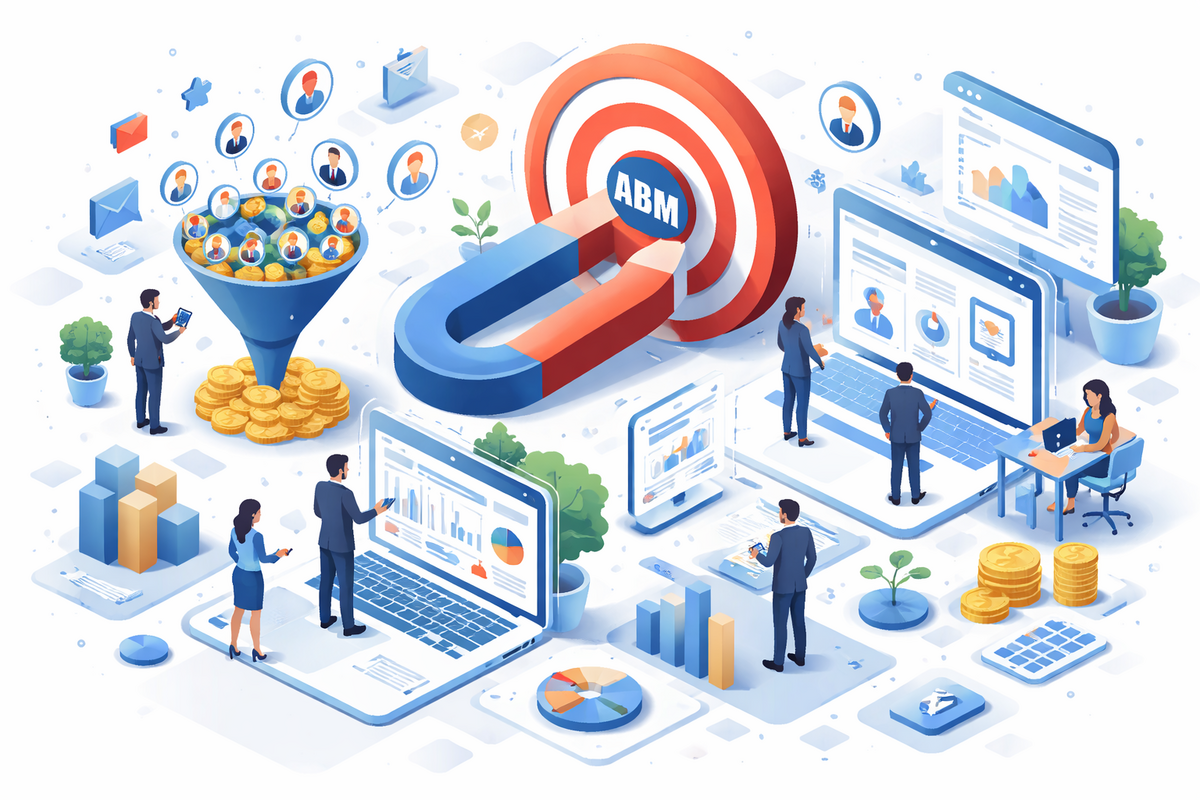
Account-Based Marketing is a B2B marketing strategy that treats individual organizations as distinct markets.
Rather than marketing to thousands of unknown prospects, companies identify key accounts that align closely with their business objectives and tailor marketing efforts specifically for those organizations.
This approach typically involves close collaboration between marketing and sales teams to ensure that outreach efforts are highly relevant and personalized.
ABM campaigns often include customized messaging, targeted advertising, and personalized content designed for decision-makers within specific companies.
Why ABM Is Effective for B2B Companies
ABM is particularly effective in B2B industries where purchasing decisions involve multiple stakeholders and long sales cycles.
By focusing on a smaller number of high-value accounts, businesses can invest more effort into understanding each organization’s challenges, goals, and priorities.
Some of the key benefits of account-based marketing include:
-
higher conversion rates
-
improved alignment between sales and marketing teams
-
more personalized customer experiences
-
stronger relationships with target accounts
-
better return on marketing investment
Because ABM focuses on quality rather than quantity, companies often achieve better results compared to traditional lead generation approaches.
The Role of Personalization in ABM
Personalization is one of the most important aspects of a successful ABM strategy.
Instead of sending generic marketing messages, businesses develop content and campaigns tailored to the specific needs of their target accounts.
Examples of personalized ABM tactics include:
-
customized email campaigns for key decision-makers
-
industry-specific whitepapers and research reports
-
personalized landing pages
-
targeted digital advertising campaigns
-
invitations to exclusive webinars or events
These tailored interactions make potential clients feel understood and valued, increasing the likelihood of meaningful engagement.
Using Data to Identify Target Accounts
A successful ABM strategy begins with identifying the right organizations to target.
Businesses typically analyze several factors when selecting accounts, such as:
-
company size and revenue
-
industry sector
-
geographic location
-
technology stack
-
purchasing behavior and intent signals
By analyzing these factors, marketing teams can create a list of accounts that are most likely to benefit from their solutions.
This data-driven approach ensures that marketing efforts focus on prospects with the highest potential value.
Aligning Sales and Marketing Teams
One of the biggest advantages of ABM is its ability to bring sales and marketing teams together.
In traditional marketing models, sales and marketing departments often operate separately, which can lead to misaligned goals and inefficient processes.
ABM encourages collaboration between these teams by focusing on shared objectives.
Marketing teams create targeted campaigns designed to engage key accounts, while sales teams build relationships and guide prospects through the decision-making process.
This alignment helps create a more cohesive and effective approach to customer acquisition.
Measuring the Success of ABM Campaigns
Unlike traditional marketing strategies that focus heavily on lead volume, ABM success is measured through different performance indicators.
Key metrics often include:
-
engagement levels within target accounts
-
meetings and conversations with decision-makers
-
deal progression within the sales pipeline
-
revenue generated from targeted accounts
By focusing on these metrics, businesses can better evaluate the impact of their marketing efforts on revenue growth.
The Future of Account-Based Marketing
As B2B markets become increasingly competitive, companies must find smarter ways to connect with decision-makers.
Advancements in data analytics, artificial intelligence, and marketing automation are making it easier for businesses to identify high-value accounts and deliver highly personalized experiences.
These technologies will continue to enhance ABM strategies by enabling more precise targeting and deeper insights into customer behavior.
For organizations looking to improve lead quality and build stronger client relationships, Account-Based Marketing offers a powerful and strategic approach to modern B2B growth.