

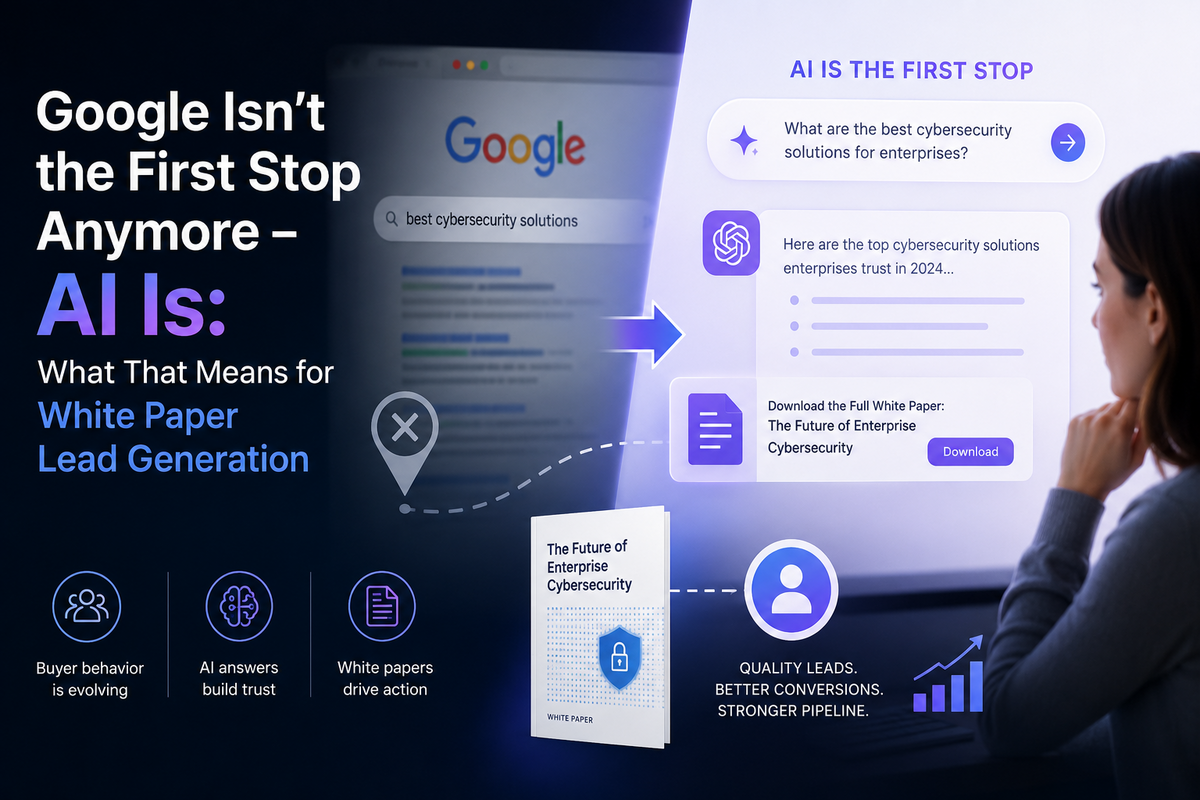
For years, the B2B buying journey followed a familiar path. A prospect identified a challenge, searched Google, compared vendors, downloaded a white paper, and eventually engaged with sales. Search engines acted as the gateway to discovery, and marketers optimized every piece of content to win visibility on search results pages.
That journey is changing.
Today, an increasing number of B2B buyers begin their research by asking AI-powered assistants instead of traditional search engines. Whether it's ChatGPT, Microsoft Copilot, Google's AI Overviews, Perplexity AI, or enterprise AI assistants embedded within workplace applications, decision-makers are turning to conversational AI to summarize complex topics, compare technologies, and recommend resources before they ever click a website.
This shift is creating a new challenge and a new opportunity for B2B marketers. If AI is becoming the first touchpoint in the buying journey, where does that leave one of the most trusted assets in enterprise marketing: the white paper?
The answer is surprisingly optimistic. White papers are becoming even more valuable, but only if marketers rethink how they create, distribute, and position them in an AI-first world.
AI Is Becoming the New Research Assistant for Enterprise Buyers
Enterprise buying has always been research-intensive. Purchasing decisions involve multiple stakeholders, longer evaluation cycles, and significant financial commitments. Instead of browsing dozens of websites, today's buyers increasingly expect AI to accelerate the research process by synthesizing information, explaining technical concepts, and surfacing credible sources within seconds.
The widespread rollout of Google's AI Overviews has fundamentally changed how users interact with search results. Rather than scrolling through a list of links, users are increasingly consuming AI-generated summaries that answer their questions directly. At the same time, tools like ChatGPT and Perplexity have become trusted companions for professionals seeking quick yet comprehensive insights into emerging technologies, market trends, and vendor landscapes.
For B2B marketers, this means visibility is no longer measured solely by search rankings. The real question is whether your expertise is influencing the answers AI provides.
Whitepapers play an important role here because they offer something AI systems consistently value: depth. Unlike short-form blog posts or promotional landing pages, well-researched white papers provide structured analysis, industry data, expert perspectives, and practical frameworks that help AI models identify authoritative information. In many cases, AI-generated responses reference concepts originally developed in long-form thought leadership, even if users never visit the source directly.
Rather than replacing white papers, AI is increasing the importance of producing content that demonstrates genuine expertise and provides unique value beyond what generic online articles can offer.
Visibility Now Depends on Distribution, Not Just Discovery
Creating an exceptional white paper is only part of the equation. If it remains buried within a company's resource center, its influence is limited regardless of its quality.
The growing role of AI has elevated the importance of content distribution. White papers that appear across trusted industry publications, analyst platforms, technology communities, and reputable syndication networks have a greater chance of being discovered, referenced, and recommended during AI-assisted research.
This represents a subtle but significant shift in content strategy. Traditional SEO focused on attracting visitors through keywords and backlinks. AI-first discovery rewards credibility, topical authority, contextual relevance, and broad digital presence.
For enterprise marketers, this means every white paper should be viewed as a strategic knowledge asset rather than a gated download. The objective is no longer simply generating traffic but ensuring your organization's expertise becomes part of the broader conversations shaping buyer decisions.
This also aligns with another emerging trend in B2B marketing: measuring influence beyond clicks. As AI-generated answers reduce website visits, marketers are increasingly evaluating content based on brand visibility, engagement quality, pipeline contribution, and buying intent instead of pageviews alone. A whitepaper that informs an AI-generated recommendation may create meaningful business impact, even if the reader never lands directly on your website.
Whitepaper Lead Generation Needs a New Mindset
The evolution of AI search doesn't diminish the value of lead generation, it changes how trust is established before a prospect converts.
By the time many buyers download a white paper today, they have often completed a substantial portion of their research using AI tools. They arrive with more informed questions, clearer expectations, and a stronger understanding of available solutions. The white paper is no longer introducing the conversation; it is validating expertise and helping buying committees make confident decisions.
This shift encourages marketers to produce content that goes beyond product education. The most effective white papers now explore market trends, emerging technologies, implementation strategies, regulatory considerations, and original research. They answer complex questions that AI alone cannot fully address because they incorporate proprietary insights, real-world experience, and industry-specific perspectives.
Another important consideration is content originality. As generative AI makes it easier to produce large volumes of generic content, originality has become a competitive advantage. Enterprise buyers and increasingly AI systems are more likely to recognize and value content supported by unique data, customer experiences, expert interviews, and practical frameworks that cannot be replicated through automated writing alone.
The organizations that succeed in this environment will not necessarily publish more content. They will publish more meaningful content and ensure it reaches audiences wherever research begins.
The Future Belongs to Brands That Teach, Not Just Rank
Search engines are no longer the sole gateway to enterprise discovery. AI is rapidly becoming the first conversation many buyers have before engaging with vendors, consuming thought leadership, or downloading resources.
For B2B decision-makers, this represents a broader transformation in how knowledge is discovered and trusted. Visibility is shifting from ranking pages to becoming a recognized source of expertise across the digital ecosystem. Whitepapers remain one of the strongest vehicles for building that authority because they provide the depth, evidence, and strategic thinking that both human buyers and AI systems increasingly seek.
The future of whitepaper lead generation will belong to organizations that stop viewing these assets as isolated lead magnets and start treating them as enduring sources of knowledge. In an AI-first buying journey, the brands that consistently educate, inform, and contribute meaningful insights will shape conversations long before the first sales call ever happens.