

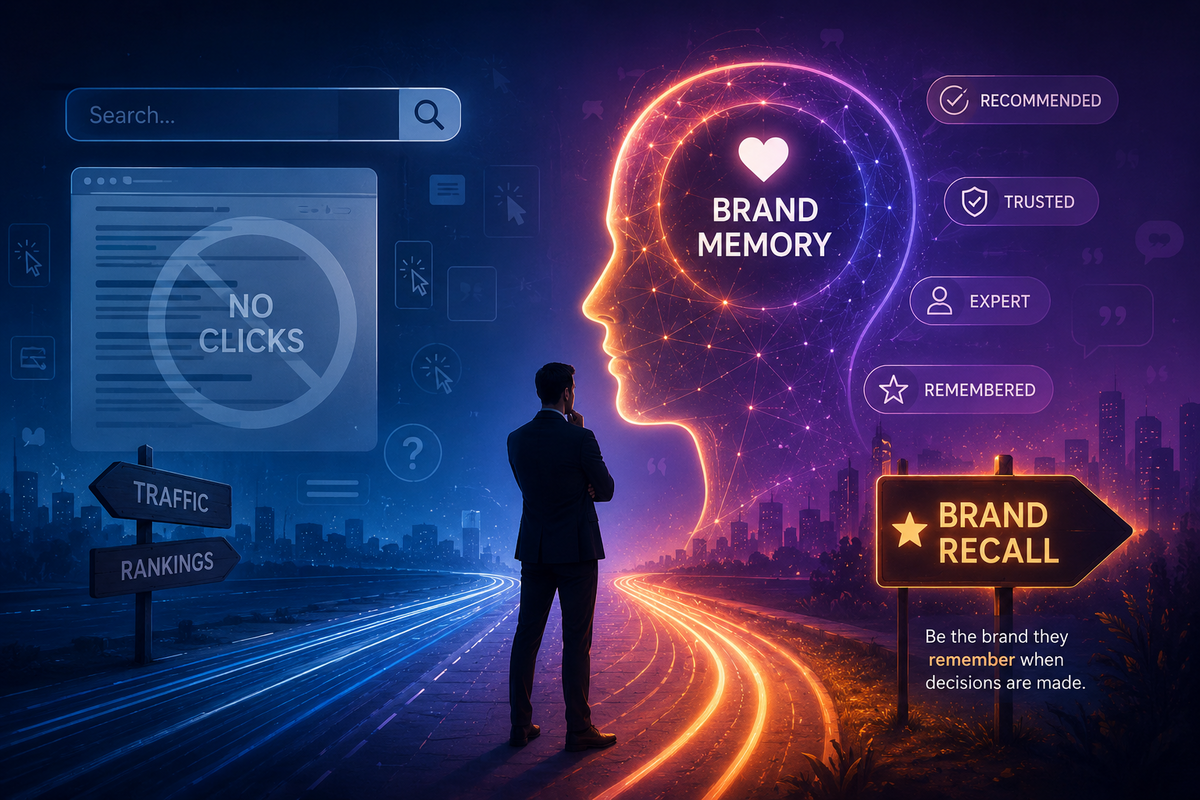
For years, B2B marketing operated on a familiar equation: rank higher, earn the click, capture the lead. Search engines were the gateway to discovery, and success was measured by traffic. Every content strategy, SEO roadmap, and demand generation campaign revolved around attracting visitors to a website.
That equation is changing faster than many organizations expected.
Today, enterprise buyers increasingly begin their research inside AI-powered platforms such as ChatGPT, Gemini, Microsoft Copilot, and Perplexity. Instead of receiving a page of blue links, they receive direct answers, summarized recommendations, and curated comparisons. In many cases, the buying journey progresses significantly before a prospect ever visits a company website. Recent industry reports also indicate that zero-click searches continue to rise as AI-generated responses answer user queries without requiring a website visit, fundamentally reshaping digital discovery.
For B2B decision makers, this represents more than another search algorithm update. It signals a shift from competing for attention to competing for memory. Brands that are consistently recognized, trusted, and referenced across multiple digital ecosystems will outperform those that rely solely on organic traffic.
Visibility Is No Longer the Same as Discoverability
Traditional search rewarded websites that successfully answered a query while encouraging users to click through for additional information. Modern AI search behaves differently. Large language models synthesize information from multiple trusted sources before presenting a concise recommendation, often eliminating the need for users to explore numerous websites.
This means buyers may shortlist vendors without ever browsing their homepages.
Instead of asking, "Which company ranks first?" enterprise buyers are increasingly asking AI, "Which platforms are best for customer data management?" or "Which marketing automation solution is ideal for enterprise organizations?" The AI responds with a handful of brands, supported by context rather than rankings.
Being part of that conversation is becoming more valuable than simply appearing on the first page of search results.
This evolution also changes what marketers should optimize for. Website traffic remains important, but brand familiarity, topical authority, trusted third-party mentions, structured content, and consistent expertise are becoming equally critical signals that influence whether AI systems recognize and recommend a business. Tactics such as whitepaper syndication can also contribute by extending the reach of authoritative content across trusted industry publications, helping brands build credibility and visibility beyond their own websites. Industry observers increasingly describe this as moving beyond SEO toward AI-first discoverability and Generative Engine Optimization (GEO).
The New Competitive Advantage Is Brand Recall
B2B purchases have always involved trust, but AI has accelerated how that trust is formed.
When buyers repeatedly encounter the same organization across analyst reports, industry publications, podcasts, webinars, executive interviews, customer success stories, research reports, and authoritative articles, the brand becomes familiar before a sales conversation ever begins.
That familiarity matters because AI systems often prioritize credible, well-established sources when generating responses. A company that consistently publishes original research, contributes expert opinions, and demonstrates thought leadership creates a stronger digital footprint than one producing high volumes of generic marketing content.
This explains why many leading enterprises are shifting investment toward content quality rather than content quantity. Original insights, proprietary research, customer success narratives, executive perspectives, and educational resources create information that both people and AI systems can reference with confidence.
Brand memory is no longer built through advertising alone. It is created through repeated exposure across multiple trusted environments.
The organizations gaining momentum today are also aligning their marketing, PR, SEO, product marketing, and customer advocacy teams around one objective: becoming the brand buyers remember before they begin evaluating vendors.
Winning the AI Era Means Building Recognition, Not Just Reach
The emergence of AI-assisted buying does not make search irrelevant. Instead, it changes what success looks like.
Traffic alone no longer tells the full story. A prospect may first encounter your company in an AI-generated recommendation, later hear your executives on a webinar, read an analyst report mentioning your solution, and finally search specifically for your brand. In this journey, the branded search is not the starting point, it is the outcome of earlier trust-building moments.
Forward-thinking marketing teams are therefore measuring more than rankings. They are paying closer attention to branded search growth, AI citations, share of voice across authoritative publications, direct traffic, returning visitors, and content that earns references beyond their own websites. As AI-generated discovery becomes more common, marketers are beginning to evaluate visibility inside AI responses alongside traditional SEO metrics.
This also places greater importance on content that demonstrates expertise instead of simply targeting keywords. AI systems evaluate context, authority, consistency, and credibility. Brands that invest in original thinking, expert commentary, industry research, and educational resources are better positioned to become part of AI-generated recommendations.
For B2B organizations, this is an opportunity rather than a challenge. Companies that establish trust before buyers actively enter the market will enjoy shorter sales cycles, stronger brand preference, and higher-quality buying conversations.
The future of search is not disappearing, it is becoming invisible. Buyers are still searching, but increasingly they are searching through conversations instead of result pages. That subtle difference changes everything.
In this new landscape, the brands that succeed will not necessarily be the ones generating the most clicks. They will be the ones remembered when decisions are made, recommended when AI is asked for guidance, and recognized long before a purchase begins.
Because in the age of AI-powered discovery, being found is valuable but being remembered is what truly drives growth.