

Marketing teams have never had more data. Every campaign, email, webinar, paid advertisement, social interaction, website visit, and product demonstration generates measurable signals. Yet despite this abundance of information, many B2B organizations continue asking the same question: Which marketing activities are actually driving revenue?
The problem isn't a lack of data. It's the way businesses continue measuring success.
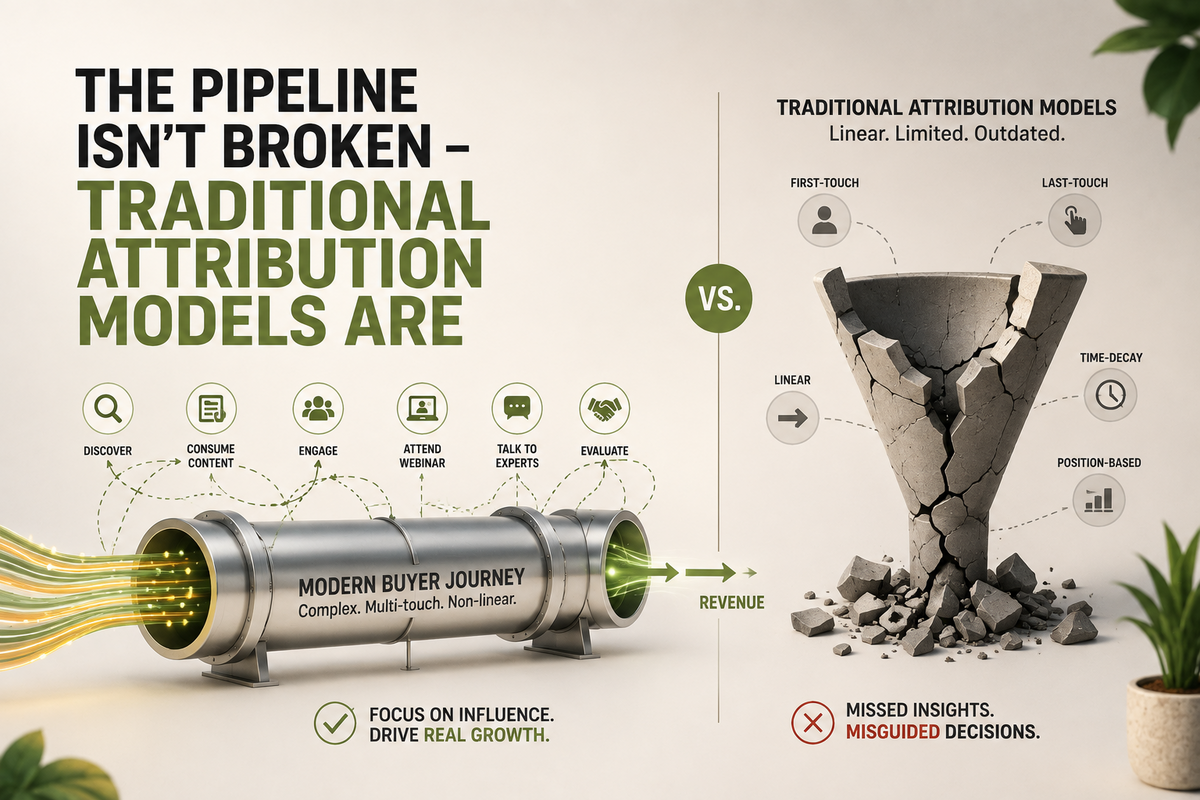
For years, traditional attribution models have attempted to assign credit to a single touchpoint or distribute it across a predefined customer journey. That approach made sense when buying journeys were relatively predictable. Today, enterprise buyers engage with brands across AI-powered search engines, digital communities, podcasts, analyst reports, webinars, review platforms, partner ecosystems, and multiple stakeholders before ever speaking to sales.
As buyer behavior becomes increasingly fragmented, traditional attribution models are struggling to capture the complete story. Forward-thinking organizations are realizing that the sales pipeline is functioning exactly as modern buyers expect—it is the measurement framework that needs to evolve.
Modern Buying Journeys Have Outgrown Traditional Attribution
The average B2B purchase today involves multiple decision-makers, longer evaluation cycles, and countless digital interactions. Prospects often spend weeks or months researching independently before submitting a contact form or requesting a product demonstration. During that time, they may discover a company through AI-powered search experiences, consume thought leadership content, compare vendors on software review platforms, attend virtual events, engage with industry communities, and revisit a website several times.
Traditional first-touch and last-touch attribution models cannot accurately represent this complexity. Even multi-touch attribution models frequently rely on predefined rules that assign percentages of credit based on assumptions rather than actual buyer influence.
Recent developments across the marketing technology landscape, including the ongoing AI Agent boom, further highlight this challenge. AI-powered search experiences are reducing direct website visits, while privacy regulations continue limiting third-party tracking capabilities. At the same time, enterprise buyers increasingly rely on trusted content, peer recommendations, and industry expertise rather than responding immediately to advertising campaigns.
As a result, many valuable marketing activities appear invisible within conventional attribution dashboards. Educational content that builds early awareness, executive thought leadership that influences buying committees, and brand visibility across AI search platforms may contribute significantly to pipeline creation without receiving measurable credit under traditional models.
This disconnect often leads organizations to reduce investment in initiatives that genuinely influence revenue simply because legacy attribution systems fail to recognize their contribution.
Revenue Intelligence Is Replacing Attribution as the Primary Decision Tool
Leading enterprises are beginning to shift their focus away from assigning credit toward understanding influence.
Rather than asking which campaign generated a lead, marketing teams are increasingly examining how every interaction contributes to revenue outcomes over time. Modern revenue intelligence platforms combine customer relationship management data, marketing automation, conversational analytics, website behavior, content engagement, and sales activity into unified intelligence models that reveal patterns traditional attribution cannot identify.
Artificial intelligence is accelerating this transformation. Instead of relying on static attribution rules, machine learning models evaluate thousands of customer interactions simultaneously, identifying which combinations of activities consistently contribute to successful opportunities. This enables marketing leaders to understand not only what happened, but also why certain buyer journeys convert more effectively than others.
The rapid growth of AI-powered marketing platforms is reinforcing this trend. Enterprise organizations are increasingly investing in predictive analytics, intent data, and buying signal analysis to uncover opportunities earlier in the customer journey. Rather than waiting until prospects complete a form, businesses can identify purchasing intent through behavioral patterns across multiple channels and tailor engagement strategies accordingly.
This evolution also encourages stronger collaboration between marketing and sales. Instead of debating lead ownership or campaign credit, both teams can work from a shared understanding of how customer engagement influences revenue progression throughout the buying cycle.
The Future of Measurement Is Built Around Buying Signals
The next generation of marketing measurement is shifting from attribution to intelligence.
Enterprise buyers no longer follow linear journeys, and measurement strategies should reflect that reality. Instead of forcing complex buying behavior into rigid attribution models, organizations are beginning to analyze continuous buying signals that emerge across the entire customer lifecycle.
These signals include content consumption patterns, repeat website engagement, executive-level interactions, product research activity, account expansion behavior, customer advocacy, and evolving purchase intent. Collectively, they provide a far richer picture of buyer readiness than a single attributed marketing touchpoint ever could.
Marketing technology platforms are evolving to support this approach by integrating customer data, predictive analytics, AI-powered insights, whitepaper syndication, and real-time decision-making into unified ecosystems. Rather than producing static attribution reports at the end of a campaign, modern Martech solutions continuously evaluate customer engagement and recommend actions that improve conversion potential.
This shift is particularly important as organizations prepare for an AI-first digital landscape. AI assistants, conversational search, and intelligent recommendation engines are changing how buyers discover information and evaluate vendors. Many influential interactions may occur outside traditional websites, making conventional attribution increasingly incomplete.
For B2B decision-makers, success will depend less on identifying a single campaign responsible for revenue and more on understanding the broader ecosystem of buyer influence. Organizations that embrace intelligent measurement will be better positioned to optimize marketing investments, strengthen collaboration across teams, and adapt to changing customer behavior with greater confidence.
The pipeline itself has not become less effective. Buyers are still researching, evaluating, comparing, and making purchasing decisions. What has changed is the path they take to reach those decisions. Traditional attribution models were built for a simpler digital environment, while today's enterprise landscape demands a more connected, data-driven, and AI-powered approach to understanding marketing performance.
As Martech continues to evolve, the organizations that thrive will be those that stop chasing perfect attribution and start building comprehensive revenue intelligence. In an era where buying journeys are dynamic, non-linear, and increasingly influenced by AI, understanding customer intent and engagement is far more valuable than assigning credit to a single click.