

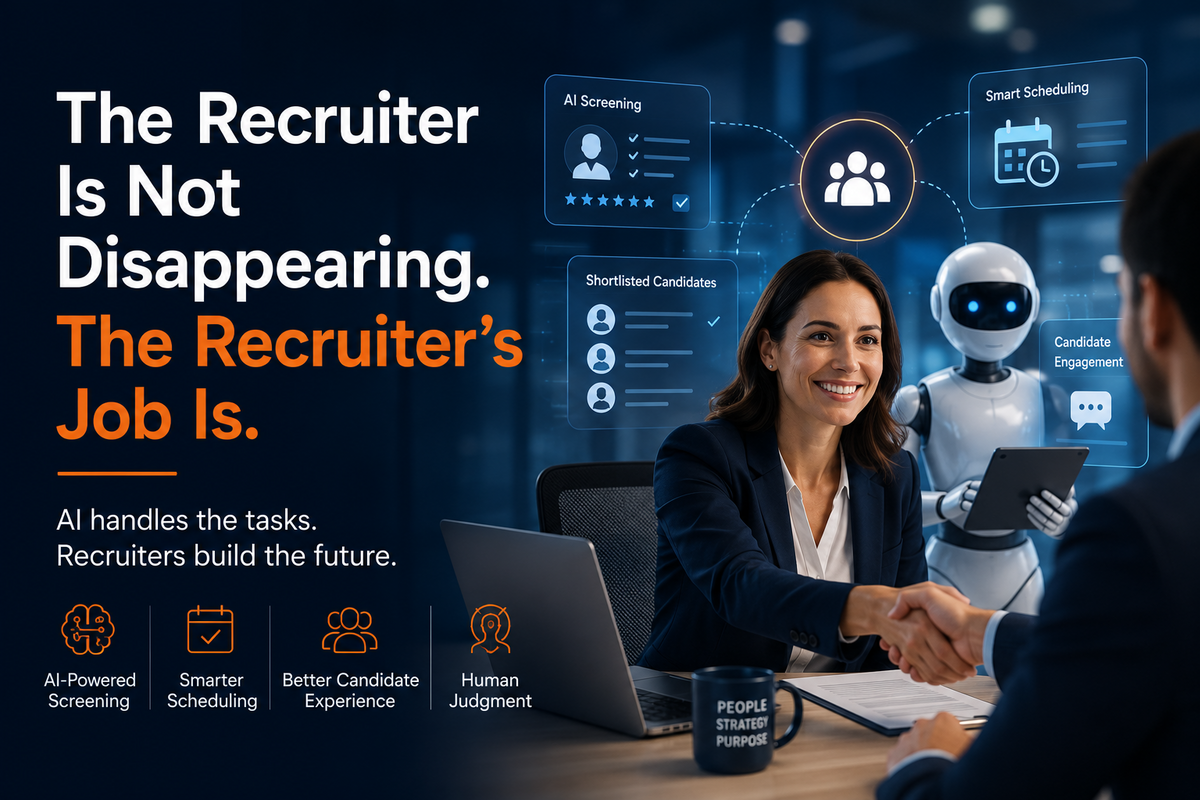
For years, every new wave of recruitment technology has arrived with the same uncomfortable question: Will technology replace recruiters?
Artificial intelligence has made the question louder.
AI can now help write job descriptions, identify candidates, match skills, answer applicant questions, schedule interviews, and support screening. Some recruitment platforms are moving even further, automating large parts of the hiring workflow from sourcing to assessment.
But the more interesting story is not that recruiters are disappearing.
It is that the traditional recruiter job is.
The recruiter who spends most of the day searching databases, coordinating calendars, forwarding resumes, writing repetitive emails, and manually filtering applications is increasingly working in an environment designed for machines.
The recruiter who understands talent strategy, evaluates potential, builds relationships, and helps companies decide who they actually need is becoming more valuable.
That distinction could define the next chapter of HRtech.
AI Is Taking the Busywork Out of Recruiting
Recruiting has historically involved an enormous amount of repetitive work.
A position opens. A job description is created. Applications arrive. Recruiters search through resumes, identify potential matches, contact candidates, coordinate interviews, collect feedback, and eventually move finalists through an offer process.
Modern HR technology is steadily compressing that workflow.
According to SHRM, AI in talent acquisition is now being used across job posting, candidate screening, skills matching, candidate engagement and interview scheduling. The technology is moving beyond isolated automation toward connected hiring workflows.
That changes the economics of recruiting.
When software can handle hundreds of routine interactions simultaneously, recruiters have less reason to spend their working hours on administration. Instead, their attention can move toward decisions that require context.
And context remains difficult to automate.
The New Recruiter Is Becoming a Talent Strategist
Imagine two recruiters.
One is measured by how many resumes they review each week.
The other is measured by whether the company consistently hires people who succeed six months later.
Those are not the same job.
AI is making the first version easier to automate and the second more important.
Recruiters increasingly need to understand business objectives, workforce planning, skill shortages, compensation expectations, employer reputation and the capabilities a company will need next—not simply the qualifications it needs today.
That shift is particularly important as organizations rethink the skills they want from employees.
Research published in 2026 based on an experiment involving 1,700 recruiters in the United States and United Kingdom found that AI skills increased candidates' chances of receiving interview invitations by roughly 8 to 15 percentage points across several occupations.
In other words, the hiring conversation itself is changing.
Recruiters aren't simply matching people to job titles anymore. They are increasingly matching capabilities to a moving target.
Resumes Are Losing Their Monopoly
The resume has been one of recruitment's most durable technologies.
But AI is challenging the idea that a document containing job titles, degrees and years of experience should determine who gets noticed.
Skills-based hiring is gaining momentum because organizations can evaluate candidates based on what they can actually do rather than relying entirely on traditional career signals.
That creates an opportunity for recruiters but also a new responsibility.
Someone still needs to determine which skills actually matter.
Someone needs to distinguish between a candidate who can describe a capability and someone who can demonstrate it.
And someone needs to understand when an unusual career path represents a risk and when it represents exactly the kind of adaptability the business needs.
AI can surface patterns.
Recruiters still have to interpret them.
The Candidate Experience Is Becoming a Human Differentiator
There is another reason recruiters are unlikely to disappear: candidates are not spreadsheets.
As automated screening and interviews become more common, concerns about transparency and human connection are growing. Research into AI-mediated hiring has found that candidates can experience uncertainty when they do not understand how automated systems evaluate them. Some report feeling detached from organizations when human interaction is largely removed from early-stage hiring.
That creates an interesting contradiction.
Companies are using technology to make hiring faster.
Candidates may increasingly value organizations that make hiring feel more human.
The recruiter could become the bridge between those two objectives.
A chatbot can tell a candidate when an interview is scheduled. A recruiter can explain why the organization is interested in their background.
Software can compare skills. A recruiter can help a candidate understand where those skills could create value.
Technology can process the transaction.
People can build the relationship.
AI Could Also Change Who Gets Hired
There is a less comfortable side to automated recruiting.
When AI becomes part of the hiring process, it does not merely accelerate existing decisions. It can influence what information gets considered important in the first place.
Recent research involving recruiting professionals found concerns that generative AI can subtly shape hiring workflows, from how jobs are defined to how candidate performance is evaluated. The researchers warned that heavy reliance on AI could also contribute to recruiter deskilling if human oversight becomes increasingly passive.
That makes the future role of recruiters more complicated.
A recruiter may no longer be expected to manually review every application. But they may be expected to understand how the technology behind those recommendations works.
The future recruiter may therefore need a hybrid skill set: part talent professional, part data interpreter, part technology user and part human decision-maker.
The Entry-Level Problem Makes the Shift Even More Important
There is another question hiding underneath AI recruitment: How does the next generation of recruiters learn the profession?
If technology automates the repetitive tasks that once gave junior recruiters experience, early-career professionals could lose some of the hands-on exposure through which recruiting skills traditionally developed.
The same issue is appearing across the broader employment market.
A recent 2026 HirePro report found that only 9% of surveyed companies considered fresh graduates job-ready on day one, while 51% said new graduates require at least a month or more of structured training.
The implication for HRtech is significant.
Companies may automate entry-level tasks, but they still need to develop people capable of handling increasingly complex decisions.
Automation may remove the ladder's first few rungs without creating a replacement path for learning.
The Future of Recruiting Is Not Human vs. Machine
That framing is already becoming outdated.
The more realistic future is human with machine.
AI will probably continue taking over the tasks recruiters dislike or simply cannot perform efficiently at scale. Candidate sourcing, scheduling, screening and administrative coordination are obvious candidates for automation.
But hiring is not only about finding candidates.
It is about understanding people, organizations and uncertainty.
The recruiter of the future may have fewer spreadsheets open and more strategic conversations on the calendar.
They may review fewer resumes but spend more time defining what a successful hire actually looks like.
They may send fewer generic emails but build stronger relationships with high-value candidates.
And they may spend less time doing recruitment and more time helping the business understand what talent it needs to win next.
That is not the disappearance of recruiting.
It is its reinvention.
The question was never whether AI would replace recruiters.
The more important question is whether recruiters will evolve fast enough to move beyond the parts of the job AI can already do.
For HRtech, that may be the real story of 2026: the recruiter isn't disappearing. The old version of the recruiter is.