

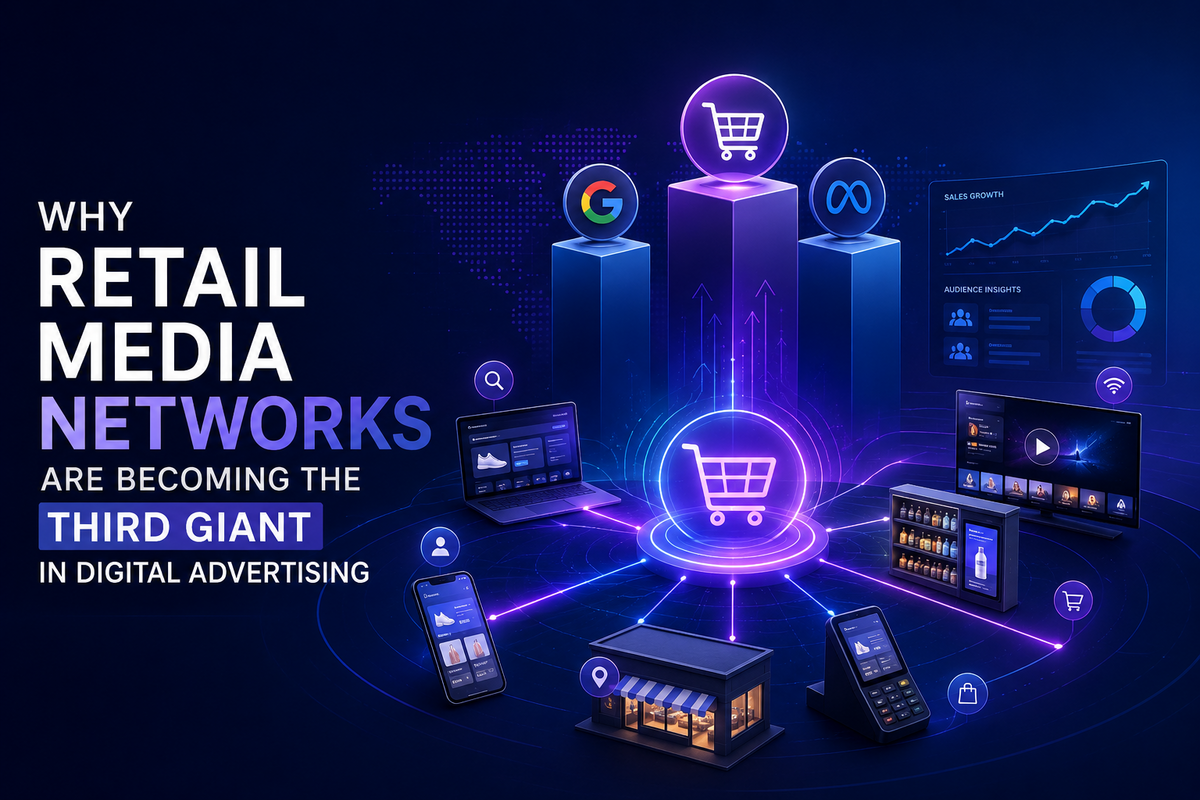
For years, digital advertising has largely revolved around two dominant ecosystems: Google and Meta. Together, they have shaped how brands reach consumers, measure campaign performance, and allocate marketing budgets. However, a significant shift is underway. Retail Media Networks (RMNs) are rapidly emerging as the third major force in digital advertising, attracting billions in investment and fundamentally changing how brands engage shoppers.
What began as a revenue opportunity for large retailers has evolved into one of the fastest-growing segments of the marketing technology landscape. Companies like Amazon, Walmart, Target, Instacart, Kroger, and even specialized retailers are expanding their advertising businesses, giving brands direct access to consumers at the exact moment purchase decisions are being made.
For enterprise marketers, this is more than another advertising channel. It represents a strategic shift toward data-rich, commerce-driven marketing that combines customer insights, measurable outcomes, and closed-loop attribution in ways traditional digital advertising cannot always deliver.
The Commerce Data Advantage Is Changing Advertising
One of the biggest challenges in digital marketing has always been understanding what happens after a customer clicks an ad. While impressions, clicks, and website visits provide useful metrics, they do not always reveal whether a campaign ultimately influenced a purchase.
Retail Media Networks change that equation by leveraging first-party commerce data collected directly from retailer ecosystems. Every search, product view, purchase, loyalty program interaction, and shopping preference becomes a valuable signal that helps brands deliver more relevant advertising experiences.
This advantage has become even more important as privacy regulations continue to evolve and third-party cookies disappear. Marketers are increasingly looking for reliable sources of first-party data that enable effective targeting while respecting consumer privacy. Retailers already possess some of the richest customer datasets available because they understand not only what consumers browse but also what they actually buy.
This combination of purchase behavior and audience intelligence allows advertisers to move beyond demographic targeting and focus on genuine buying intent. Instead of guessing who might be interested in a product, brands can engage consumers based on real shopping behaviors, improving campaign efficiency and return on investment. Unlike strategies that rely on a low quality backlink profile to generate traffic, retail media focuses on reaching audiences with proven purchase intent, resulting in more meaningful engagement and measurable business outcomes.
Industry analysts expect retail media spending to continue growing at a rapid pace throughout 2026 as more retailers invest in advertising platforms and brands diversify budgets beyond traditional search and social advertising.
Retail Media Is Becoming a Core Part of Enterprise Marketing Strategies
The rapid growth of Retail Media Networks is not simply about advertising inside retailer websites. Today's retail media ecosystems extend across connected television, mobile applications, online marketplaces, in-store digital displays, streaming platforms, and off-site advertising powered by retailer data.
This expansion allows brands to maintain consistent messaging throughout the customer journey instead of only appearing during the final purchase stage. A consumer may discover a product through connected TV, encounter personalized advertisements while browsing online, receive relevant recommendations inside a retailer's mobile app, and complete the purchase through an ecommerce marketplace all supported by the same retail data ecosystem.
Major retailers are also investing heavily in self-service advertising platforms, advanced measurement capabilities, AI-powered audience segmentation, and omnichannel campaign management. These innovations make Retail Media Networks increasingly attractive not only for consumer brands but also for B2B companies selling through distributors, marketplaces, and business procurement platforms.
Enterprise marketers are responding by restructuring media strategies around commerce intelligence rather than isolated advertising channels. Marketing teams are placing greater emphasis on measurable business outcomes, customer lifetime value, and incremental sales instead of relying solely on traditional campaign metrics such as impressions or click-through rates.
At the same time, partnerships between retailers and advertising technology providers are making Retail Media Networks easier to integrate into existing marketing technology stacks, allowing brands to manage campaigns alongside other digital channels without significantly increasing operational complexity.
Why Retail Media Networks Are Becoming the Third Digital Advertising Giant
The rise of Retail Media Networks reflects a broader transformation in digital marketing. Brands are no longer looking only for reach; they want measurable influence on purchasing decisions. Advertising platforms that combine audience intelligence with transaction data naturally provide greater confidence when evaluating marketing performance.
This explains why many organizations are shifting larger portions of their advertising budgets toward commerce media. Instead of treating retail media as an experimental channel, enterprise marketing leaders increasingly view it as a long-term investment that complements search, social media, video advertising, and content marketing.
Another factor driving adoption is the growing demand for accountability. Marketing leaders are under constant pressure to demonstrate clear business impact, particularly during periods of economic uncertainty. Retail Media Networks offer a stronger connection between advertising spend and sales outcomes, helping organizations make more informed investment decisions.
The competitive landscape is also expanding rapidly. Beyond traditional retail giants, travel companies, financial institutions, grocery chains, pharmacy networks, and delivery platforms are building their own media businesses based on customer data. This evolution suggests that commerce-driven advertising will extend well beyond retail over the next few years.
For B2B decision-makers, the lesson is becoming increasingly clear. Retail Media Networks are no longer simply another marketing trend, they represent a structural shift in how digital advertising operates. As customer expectations evolve, privacy standards tighten, and marketers demand better measurement, platforms built around first-party commerce data are positioned to play a much larger role in future marketing strategies. When combined with initiatives such as whitepaper lead generation, these data-driven advertising ecosystems enable organizations to engage high-intent buyers with relevant content and generate more qualified leads throughout the buying journey.
The digital advertising landscape has historically been defined by search and social media. Today, commerce media is establishing itself alongside these giants, giving brands a new way to connect with high-intent audiences while delivering measurable business value. Organizations that understand this shift early will be better positioned to adapt their marketing investments, strengthen customer relationships, and compete in an increasingly commerce-driven digital economy.