

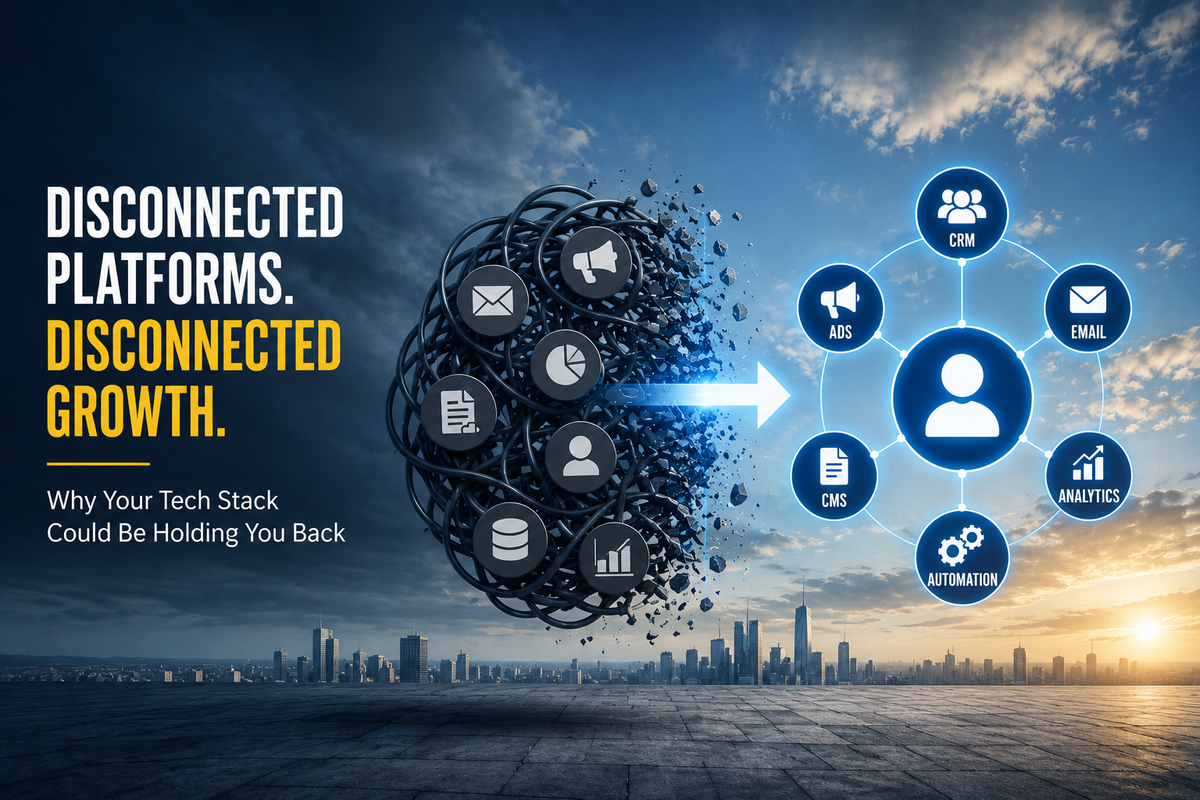
As marketing technology continues to evolve, organizations are investing in an expanding ecosystem of platforms to manage customer engagement, campaign execution, analytics, and automation. However, industry experts are warning that simply adding more technology may not translate into better business outcomes if those platforms remain disconnected.
According to recent MarTech research, enterprises now manage dozens of marketing applications across customer relationship management (CRM), email marketing, advertising, content management, analytics, and artificial intelligence. While each platform delivers value independently, many organizations continue to struggle with fragmented customer data and inconsistent reporting due to limited integration across their technology stack.
Fragmented Data Is Limiting Marketing Performance
Disconnected marketing platforms create significant operational challenges for both marketing and sales teams. Customer interactions are frequently spread across multiple systems, making it difficult to build a unified view of the customer journey.
Without connected data, organizations often experience:
- Inconsistent customer experiences across digital channels
- Limited visibility into campaign performance
- Incomplete customer insights for sales teams
- Reduced effectiveness of AI-powered personalization and automation
Industry analysts suggest that fragmented data environments can increase customer acquisition costs while reducing marketing efficiency, particularly as organizations adopt more AI-driven decision-making.
Integration Is Emerging as a Strategic Priority
Rather than expanding their MarTech stacks indefinitely, businesses are increasingly focusing on platform integration.
Connecting CRM systems, marketing automation platforms, analytics tools, websites, and advertising platforms enables organizations to establish a single source of truth for customer data. This integrated approach improves collaboration between marketing and sales while supporting more accurate reporting and better-informed strategic decisions.
Analysts also note that artificial intelligence depends heavily on high-quality, connected data. Predictive analytics, intelligent segmentation, and automated customer engagement all perform more effectively when information flows seamlessly between systems.
AI Is Accelerating the Need for Connected Ecosystems
The growing adoption of AI across marketing functions is placing additional emphasis on technology integration.
As organizations deploy AI-powered content generation, predictive analytics, customer journey orchestration, and campaign optimization tools, disconnected platforms can limit the quality of AI-generated insights. Incomplete or siloed data reduces the effectiveness of automation and personalization initiatives.
Industry observers expect organizations to prioritize interoperable MarTech ecosystems over standalone solutions as AI adoption continues to mature.
Looking Ahead
Marketing leaders are increasingly shifting their focus from acquiring new software to maximizing the value of existing technology investments through integration.
A connected marketing ecosystem enables organizations to improve customer experiences, strengthen cross-functional collaboration, enhance reporting accuracy, and support scalable AI initiatives.
As digital transformation accelerates, experts suggest that competitive advantage will depend less on the number of marketing platforms a business owns and more on how effectively those platforms work together.