

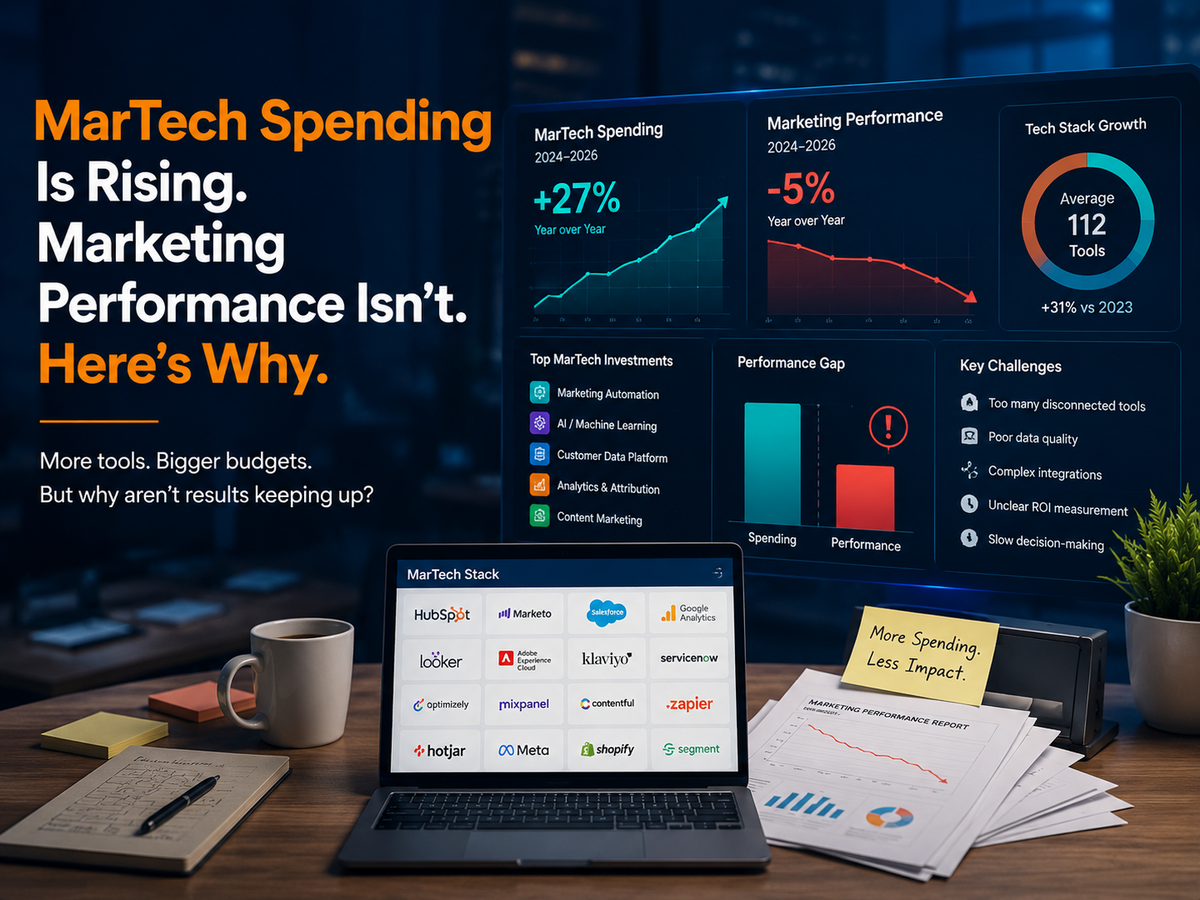
Marketing budgets are climbing. AI adoption is accelerating. Businesses are investing in more platforms than ever before. Yet despite record-breaking investments in marketing technology, many organizations are struggling to improve campaign performance, customer engagement, and return on investment.
This growing disconnect is forcing marketing leaders to ask a difficult question: If MarTech spending continues to rise, why aren't results keeping pace?
The answer isn't simply about technology. It's about how organizations use it.
Businesses Are Buying More Tools Than They Can Effectively Use
Over the past few years, organizations have rapidly expanded their MarTech ecosystems. AI-powered analytics, customer data platforms, automation software, personalization engines, conversational AI, and predictive analytics have become common additions to enterprise marketing stacks.
The expectation was clear: more technology would naturally produce better marketing outcomes.
Instead, many teams now face an entirely different challenge.
Instead of simplifying marketing operations, larger technology stacks have introduced greater complexity. Teams spend more time integrating platforms, managing data, learning new interfaces, and maintaining workflows than creating meaningful customer experiences.
In many cases, technology has become an operational burden rather than a competitive advantage.
The Problem Isn't Budget. It's Fragmentation.
Many organizations now rely on dozens of disconnected marketing applications.
Customer information often exists across multiple systems, campaign data remains isolated, and reporting dashboards rarely provide a complete picture of performance.
When marketing decisions depend on fragmented data, personalization becomes inconsistent, attribution becomes unreliable, and campaign optimization slows significantly.
Rather than making smarter decisions, marketers spend valuable time trying to reconcile conflicting insights.
This fragmentation is quietly reducing the value of every new technology investment.
AI Alone Cannot Solve Broken Processes
Artificial intelligence has become the centerpiece of modern marketing conversations.
AI can generate content, automate workflows, analyze customer behavior, optimize campaigns, and even predict purchasing intent.
However, AI cannot fix inefficient processes or poor-quality data.
Organizations that implement AI without first improving governance, integration, and strategy often discover that automation simply accelerates existing inefficiencies.
The businesses seeing measurable success are not necessarily using more AI—they are using cleaner data, clearer objectives, and better operational discipline.
Customer Expectations Have Changed Faster Than Marketing Systems
Today's customers expect personalized, consistent experiences across every digital interaction.
They move between websites, social media platforms, email campaigns, mobile applications, online marketplaces, and customer support channels without distinguishing between departments or technologies.
Unfortunately, many marketing systems still operate in isolated environments.
When disconnected platforms fail to share customer insights, brands struggle to deliver the seamless experiences consumers now expect.
This experience gap has become one of the biggest obstacles to marketing performance.
Measuring Success Has Become More Complicated
Modern marketing generates more performance metrics than ever before.
Clicks, impressions, engagement rates, customer lifetime value, conversion paths, attribution models, and predictive scores all compete for attention.
Ironically, having more data does not always produce better decisions.
Without clearly defined business objectives, marketing teams often optimize individual metrics instead of overall business growth.
The result is impressive-looking dashboards that fail to translate into stronger revenue or customer loyalty.
Organizations are beginning to recognize that actionable intelligence matters far more than endless reporting.
The Shift Toward Smarter, Smaller MarTech Stacks
An emerging trend across the industry is not adding more technology—but simplifying existing ecosystems.
Many organizations are consolidating vendors, removing redundant applications, strengthening integrations, and prioritizing platforms that work together rather than independently.
This strategy reduces operational complexity while improving visibility across the customer journey.
Instead of asking, "What new tool should we buy?", leading marketing teams are asking, "Which tools actually create measurable business value?"
That shift represents a major change in MarTech strategy.
What Marketing Leaders Should Prioritize Next
As economic pressures increase and marketing accountability grows, technology investments will face greater scrutiny.
Organizations that achieve sustainable growth will likely focus on:
- Building unified customer data foundations.
- Improving platform integration instead of expanding software portfolios.
- Measuring business outcomes rather than isolated campaign metrics.
- Using AI to enhance strategic decision-making rather than replace it.
- Simplifying marketing operations to improve speed and agility.
These priorities create stronger long-term performance than continuously adding new platforms.
Looking Ahead
MarTech remains one of the most important drivers of modern digital marketing. However, the industry is entering a more mature phase where success depends less on purchasing additional technology and more on maximizing the value of existing investments.
The organizations leading the next generation of marketing will not necessarily own the largest MarTech stacks. They will build the most connected, efficient, and customer-focused ones.
As businesses continue to evaluate future investments, one reality is becoming increasingly clear: marketing performance is no longer determined by how much technology you buy, but by how effectively every technology works together.
For organizations navigating this transition, staying informed about evolving marketing technology trends, AI innovation, and enterprise digital transformation will be critical. Whitepapers Online will continue tracking the developments shaping the future of MarTech, helping business leaders separate lasting innovation from short-lived hype.