

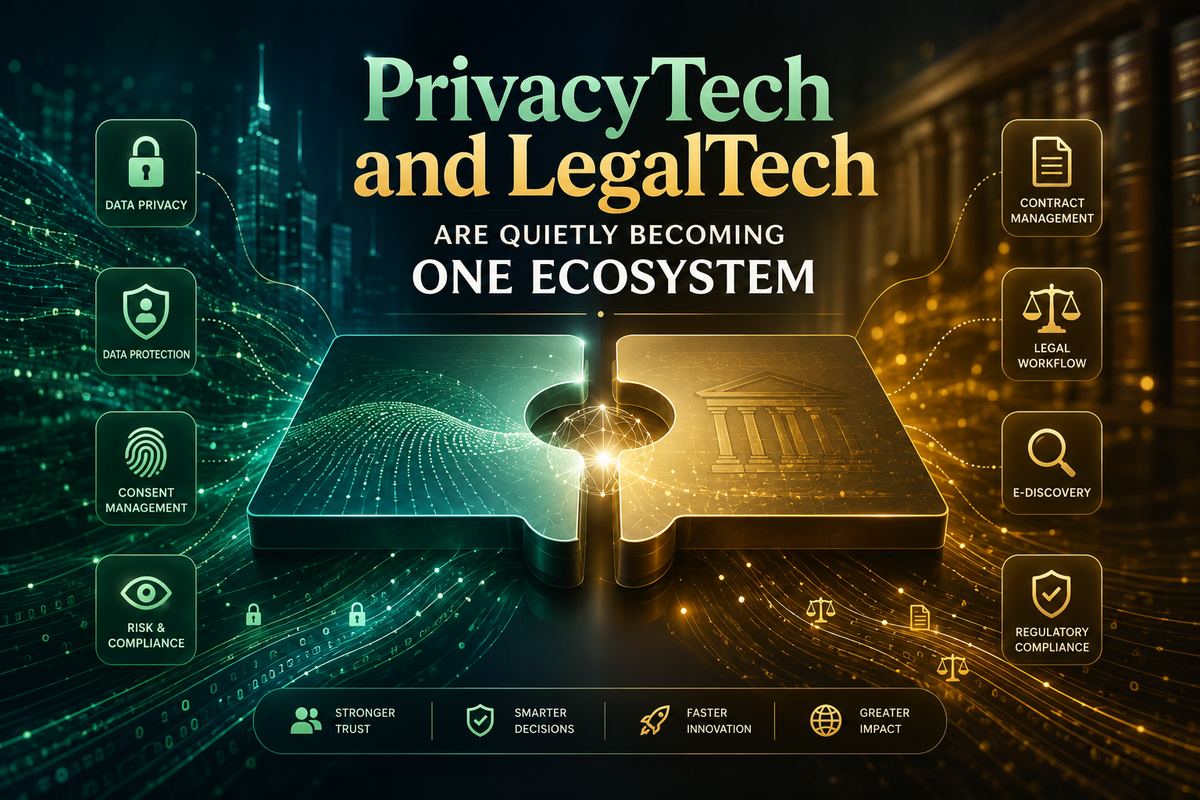
For years, organizations viewed privacy and legal compliance as two separate responsibilities. Privacy teams focused on protecting customer data, while legal departments interpreted regulations, managed contracts, and minimized organizational risk. The two functions often collaborated, but they relied on different systems, workflows, and priorities.
That separation is quickly disappearing. PrivacyTech and LegalTech are converging into a unified ecosystem as enterprises face an increasingly complex regulatory landscape, rapid AI adoption, and growing customer expectations around data transparency. Today's businesses can no longer afford disconnected compliance processes. Instead, they need integrated platforms that help legal, privacy, security, and compliance teams operate from the same source of truth.
For B2B decision-makers, this shift represents more than operational efficiency. It reflects a broader transformation in how organizations manage digital trust. Enterprises are discovering that protecting data and complying with regulations are no longer independent objectives, they are becoming inseparable business strategies.
AI Is Accelerating the Convergence of Privacy and Legal Operations
The rapid adoption of artificial intelligence has significantly increased compliance complexity. Every AI application processes information differently, creating new questions around data ownership, consent, intellectual property, transparency, and accountability. Enterprises are finding that traditional compliance models cannot keep pace with continuously evolving AI technologies.
Recent regulatory developments reinforce this reality. The implementation of the European Union's AI Act, expanding privacy legislation across multiple jurisdictions, and increasing enforcement of existing regulations such as GDPR continue to reshape enterprise governance. Organizations are responding by investing in platforms that combine privacy management, legal workflows, regulatory intelligence, and AI governance into a single operational framework.
Instead of reviewing privacy obligations after products are launched, enterprises are embedding compliance directly into software development, procurement, vendor management, and AI deployment. PrivacyTech platforms increasingly automate consent management, data mapping, and risk assessments, while LegalTech solutions integrate contract intelligence, policy management, and regulatory monitoring. Together, they create continuous visibility across the enterprise rather than isolated compliance checkpoints.
This convergence also supports faster business decisions. When legal and privacy teams work within connected systems, organizations spend less time reconciling conflicting information and more time enabling innovation with confidence.
Digital Trust Is Becoming a Competitive Advantage
Customers, partners, and regulators now evaluate organizations based on how responsibly they collect, store, and use information. Compliance is no longer simply about avoiding fines. It has become a critical component of brand reputation and long-term business growth.
Modern enterprises recognize that every digital interaction generates legal and privacy obligations. Cloud platforms, connected applications, digital identity systems, and AI-powered services continuously exchange sensitive information across multiple jurisdictions. Managing these environments requires coordinated governance rather than isolated policies.
Organizations are increasingly adopting unified PrivacyTech and LegalTech platforms that automatically classify sensitive data, monitor regulatory obligations, identify contractual risks, and generate audit-ready documentation. Instead of manually tracking regulatory changes, compliance teams receive real-time insights that enable proactive decision-making.
The rise of privacy-enhancing technologies, confidential computing, secure data collaboration, and automated regulatory reporting further illustrates this evolution. Businesses are moving beyond compliance documentation toward continuous compliance operations, where legal obligations are monitored alongside cybersecurity risks, operational performance, and business objectives.
Industry investment also reflects this momentum. Enterprise software providers continue expanding governance capabilities, while AI-powered compliance platforms are introducing intelligent policy recommendations, automated legal reviews, and predictive risk monitoring. Rather than purchasing standalone compliance tools, organizations increasingly prefer integrated ecosystems that connect legal, privacy, security, and business operations.
The Future Belongs to Connected Compliance Ecosystems
The next generation of enterprise governance will rely less on manual reviews and more on intelligent automation. Machine learning models are already helping organizations identify regulatory changes, detect policy conflicts, analyze contractual obligations, and prioritize compliance risks before they become business issues.
Looking ahead, autonomous compliance assistants are expected to support legal professionals by continuously monitoring enterprise activities, recommending policy updates, reviewing contracts, and identifying emerging regulatory risks. As organizations modernize their cloud architecture, these intelligent systems will help ensure compliance is embedded across distributed applications and data environments. Rather than replacing legal expertise, these technologies will enable professionals to focus on strategic decision-making while routine compliance activities become increasingly automated.
Cross-functional collaboration will become equally important. Legal teams will work more closely with cybersecurity leaders, privacy professionals, AI governance specialists, and technology executives to establish enterprise-wide trust frameworks. PrivacyTech and LegalTech will no longer operate as independent software categories but as interconnected capabilities supporting every digital initiative.
For B2B decision-makers, the implications are significant. Organizations that invest in unified governance platforms will be better positioned to scale AI responsibly, accelerate digital transformation, strengthen regulatory resilience, and build lasting customer trust. Those that continue relying on fragmented compliance systems may struggle to keep pace with growing regulatory expectations and increasingly sophisticated technology ecosystems.
The future of enterprise compliance is not defined by separate legal or privacy functions. It is being shaped by intelligent ecosystems where PrivacyTech and LegalTech work together to transform governance from a reactive obligation into a strategic business advantage. As digital regulations continue to evolve and AI becomes deeply embedded across industries, organizations that embrace this convergence will be better equipped to innovate with confidence while maintaining the trust that modern business increasingly depends upon.