

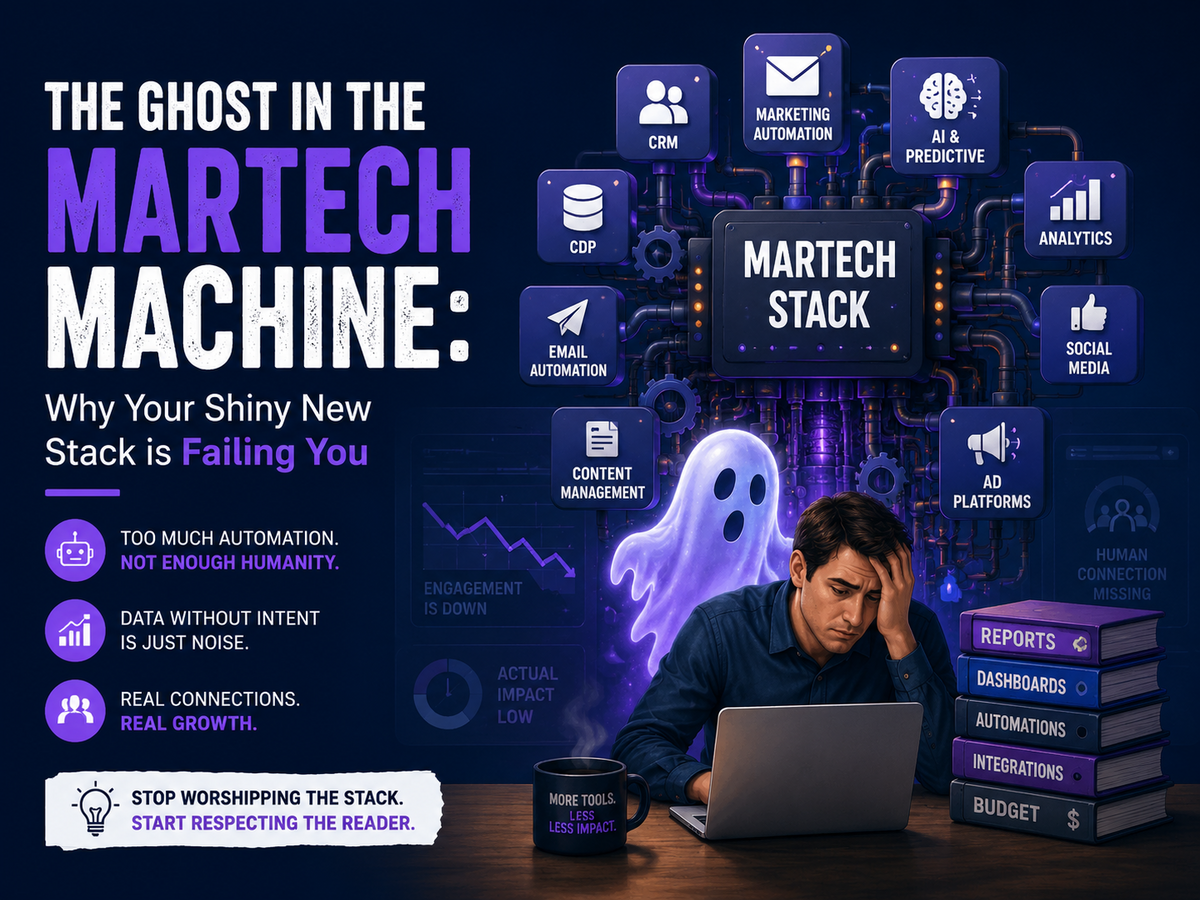
Enterprise marketing has never had more technology at its disposal. Artificial intelligence writes emails, customer data platforms promise a unified customer view, automation tools trigger campaigns in milliseconds, and predictive analytics claim to forecast buyer behavior before a prospect even reaches out. On paper, it feels like marketers have finally achieved the dream of frictionless growth.
Yet, a different story is unfolding behind executive dashboards.
Despite record investments in marketing technology, many organizations are struggling to improve customer engagement, shorten sales cycles, or demonstrate meaningful return on investment. According to recent industry research, companies continue to expand their MarTech budgets while simultaneously reporting lower platform utilization and increasing complexity. The result is a growing realization that simply adding more software doesn't automatically create better marketing.
The MarTech Stack Keeps Growing—So Does the Complexity
Over the past decade, the average enterprise marketing stack has evolved from a handful of specialized tools into an ecosystem containing dozens of platforms. Customer relationship management systems, marketing automation, analytics platforms, customer data platforms, AI assistants, social media management software, personalization engines, and content management systems now operate simultaneously.
While each platform solves a specific challenge, together they often create another one.
Marketing teams spend significant time managing integrations, cleaning customer data, synchronizing workflows, and troubleshooting disconnected systems. Instead of simplifying operations, technology frequently becomes another operational burden.
The promise of seamless automation is often replaced by fragmented customer experiences.
Automation Without Strategy Creates Empty Engagement
One of the biggest misconceptions surrounding modern MarTech is that automation can replace thoughtful marketing.
Automation excels at executing repetitive tasks. It can schedule campaigns, personalize subject lines, trigger follow-up emails, and score leads based on predefined rules. What it cannot do is understand context, emotion, or business intent.
When organizations automate every customer interaction without considering relevance, communications begin to feel mechanical. Buyers receive perfectly timed emails that fail to address their actual challenges. Personalized messages reference company names while ignoring genuine business needs.
Technology becomes efficient at sending messages—but ineffective at creating conversations.
The Hidden Cost of Too Many Tools
Every new platform promises better visibility, deeper analytics, or improved customer insights. However, every additional tool also introduces new data silos, integration requirements, training needs, licensing costs, and governance challenges.
Many organizations discover that their teams only utilize a fraction of their platform capabilities. Sophisticated features remain untouched while employees continue relying on spreadsheets and manual processes.
This phenomenon creates what many industry analysts describe as "technology debt"—where maintaining the stack consumes more resources than the value it delivers.
Instead of enabling innovation, the stack begins demanding constant maintenance.
AI Is Powerful—but It Isn't a Marketing Strategy
Artificial intelligence has become the newest layer in nearly every MarTech platform. AI can summarize customer interactions, generate campaign copy, recommend audience segments, and analyze enormous datasets within seconds.
These capabilities are transformative when guided by experienced marketers.
However, AI cannot replace strategic thinking.
It cannot independently define positioning, understand evolving market dynamics, build long-term customer trust, or recognize subtle shifts in buyer psychology. Organizations expecting AI to solve foundational marketing problems often discover that the technology simply amplifies existing weaknesses.
Poor strategy executed faster is still poor strategy.
Buyers Are Becoming More Difficult to Impress
Modern B2B buyers conduct extensive independent research before speaking with vendors. They compare solutions, consume analyst reports, attend webinars, read customer reviews, and seek trusted educational resources.
They expect every interaction to provide value.
Generic nurture sequences, repetitive sales emails, and automated LinkedIn outreach are becoming increasingly easy to ignore. Decision-makers quickly recognize templated communication regardless of how sophisticated the automation platform may be.
Trust is no longer built through volume.
It is built through relevance, expertise, and consistency.
Content Is Becoming the Most Valuable Layer of the Stack
As technology becomes increasingly commoditized, content quality is emerging as the true competitive advantage.
Organizations investing in original research, technical whitepapers, industry reports, customer success stories, and educational resources are creating experiences that software alone cannot replicate.
High-value content provides context that analytics cannot measure directly. It demonstrates expertise, addresses complex business problems, and builds credibility long before a sales conversation begins.
Technology should amplify exceptional content—not compensate for its absence.
The Future of MarTech Is Integration, Not Accumulation
Industry leaders are beginning to rethink their technology strategies. Rather than continuously adding new platforms, many enterprises are focusing on simplifying their ecosystems.
The emphasis is shifting toward:
- Consolidating overlapping tools
- Improving first-party data quality
- Building stronger platform integrations
- Prioritizing customer experience over automation volume
- Measuring meaningful engagement instead of vanity metrics
This evolution represents a broader shift from technology-first marketing to customer-first marketing.
Looking Beyond the Software
The most successful marketing organizations aren't necessarily the ones with the largest technology budgets. They're the ones that understand technology is only an enabler.
Software can automate workflows.
AI can accelerate execution.
Analytics can reveal patterns.
But none of these capabilities replace human understanding.
The "ghost" inside today's MarTech machine isn't another AI model or automation engine—it's the missing human perspective. Organizations that combine intelligent technology with authentic customer insight will continue to outperform those chasing every new platform that enters the market.
As the MarTech landscape continues to evolve, the question is no longer "Which new tool should we buy?" The more important question has become "Does our technology actually help us understand and serve our customers better?"
The answer to that question will define the next generation of marketing success.