

The traditional white paper has a familiar formula: identify a business problem, assemble research, add expert commentary, design a polished PDF, and place it behind a form.
For years, that model worked.
But B2B buyers are changing faster than the format.
Today’s decision-makers are surrounded by dashboards, interactive reports, AI-generated summaries, short-form insights, podcasts, webinars, and increasingly sophisticated research tools. They do not necessarily want another 30-page document asking them to download, read, and decide.
They want information they can explore.
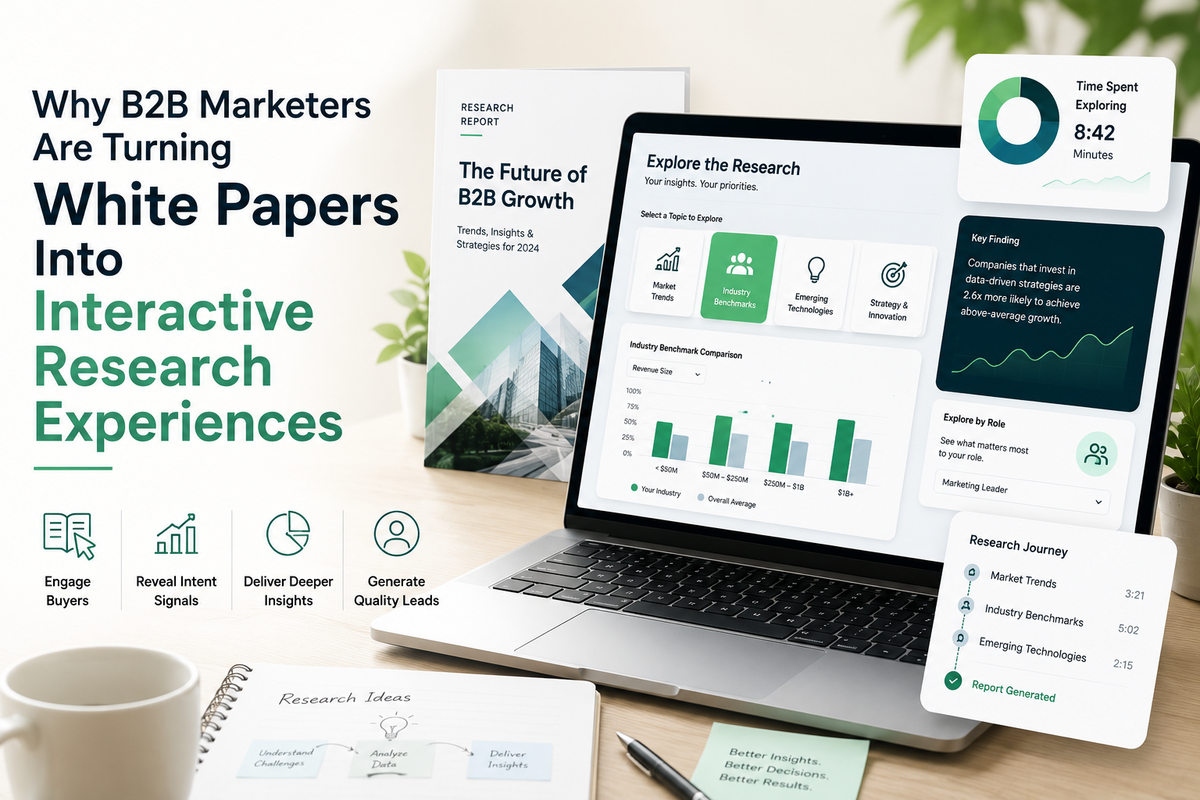
That shift is transforming whitepaper lead generation. Instead of treating a white paper as a static asset designed primarily to capture an email address, forward-thinking B2B marketers are turning research into interactive experiences that allow prospects to investigate the data, explore scenarios, compare findings, and discover insights relevant to their own businesses.
The result is more than a content upgrade. It represents a fundamental change in how B2B research can create engagement, demonstrate expertise, and reveal buyer intent.
The Whitepaper Is Evolving From Document to Digital Experience
The rise of generative AI has made basic information easier to obtain than ever. A buyer can ask an AI assistant to summarize an industry trend, explain a technology, compare approaches, or provide an overview of a business challenge within seconds.
That creates a difficult question for traditional white papers: why download something simply to obtain information that AI can summarize instantly?
The answer increasingly lies in what AI cannot easily replicate: proprietary research, original datasets, expert interpretation, interactive exploration, and context.
This is where interactive white papers are gaining relevance.
Instead of presenting research as a linear sequence of pages, organizations can allow readers to interact with the findings. A technology executive could filter research by company size. A financial leader could explore industry-specific benchmarks. A marketing executive could compare adoption rates across regions or business segments.
The content becomes responsive to the reader.
This is particularly relevant as B2B buyers increasingly conduct research independently before engaging with sales teams. Gartner has continued to highlight the importance of low-friction, self-service buying experiences, while the growing influence of AI search is further reducing the number of traditional touchpoints between initial research and vendor conversations.
For whitepaper lead generation, this changes the value proposition. The objective is no longer simply getting someone to complete a form. It is creating an experience compelling enough that the buyer willingly spends time exploring the research.
That time becomes a signal in itself.
Interactive Research Creates Richer Intent Signals
A conventional whitepaper download tells marketers relatively little.
Someone submitted a form. They received the asset. Perhaps they opened it. Perhaps they never did.
An interactive research experience can tell a much richer story.
A visitor who repeatedly explores data about enterprise AI adoption, compares their industry against benchmarks, and spends several minutes examining a specific section is revealing substantially more about their interests than someone who simply downloads a PDF or engages with a link building campaign.
This is where whitepaper lead generation begins to overlap with behavioral intelligence.
Modern B2B marketers are increasingly looking beyond demographic information such as job title, company size, or industry. Behavioral signals can provide stronger context around what a prospective buyer actually cares about.
Interactive research can capture these signals through content engagement rather than intrusive questioning. The experience itself becomes a form of intent discovery.
This also aligns with the broader shift toward first-party data. As privacy expectations increase and marketers become less dependent on third-party identifiers, owned digital experiences are becoming increasingly important sources of customer intelligence.
The most valuable data may not be the information a buyer types into a form. It may be what they choose to explore once they arrive.
That distinction is important.
The future of whitepaper lead generation is therefore less about collecting more leads and more about understanding the quality and context of the engagement behind those leads.
The Best Whitepapers May Become Living Research Platforms
The biggest opportunity may be moving beyond the idea of an interactive PDF altogether.
Imagine a research report that updates as new industry data becomes available. Instead of downloading a static document published six months ago, buyers interact with a continuously evolving research environment containing benchmarks, expert commentary, charts, regional comparisons, and emerging trends.
That model turns a white paper into something closer to a research platform.
AI can make these experiences even more dynamic. Natural-language interfaces can allow visitors to ask questions about the underlying research, while recommendation systems can surface relevant findings based on what they explore. Organizations can combine proprietary research with interactive visualizations and expert interpretation to create experiences that feel substantially more valuable than conventional gated content.
This does not mean the PDF disappears.
There will always be situations where executives want a downloadable report they can share internally or reference during meetings. But the PDF can become one component of a much broader content ecosystem rather than the entire experience.
For B2B decision-makers, this evolution also creates a strategic advantage. A well-designed research experience can establish authority before a sales conversation ever begins. It demonstrates that the organization understands the market, has invested in original research, and can translate complex information into useful business intelligence.
That is a very different role from simply producing another gated asset.
Ultimately, the evolution of whitepaper lead generation reflects a larger transformation in B2B marketing. Buyers do not necessarily need more information. They need better ways to understand information.
Interactive research meets that need by turning passive consumption into active discovery. It gives prospects greater control over the questions they investigate while giving marketers a deeper understanding of what matters to those prospects.
As AI makes generic content increasingly abundant, original research and meaningful experiences will become more valuable, not less. The competitive advantage will belong to organizations that can transform their proprietary knowledge into something buyers can explore, question, and apply.
The next generation of white papers may therefore look less like documents and more like digital research environments.
And when that happens, the most important metric may no longer be how many people downloaded the white paper.
It may be how deeply they explored what it revealed.